Portugal has doubled the time it takes to become a citizen — from 5 years of residency to 10. Under Lei Orgânica n.º 1/2026, published in the Diário da República on 18 May 2026 and in force since 19 May 2026, most foreign nationals now need ten years of legal residency before they can naturalise. Citizens of EU and CPLP (Portuguese-speaking) countries need seven.
If your goal was a Portuguese — and therefore EU — passport on the old five-year timeline, that plan just changed. Here is exactly what happened, who it hits, who is protected, and whether Portugal is still the right move in 2026. This guide covers the Portugal citizenship requirements 2026 in full — from the May 2026 law change to the language test, grandfathering rules, and which route is fastest.
Key Takeaways
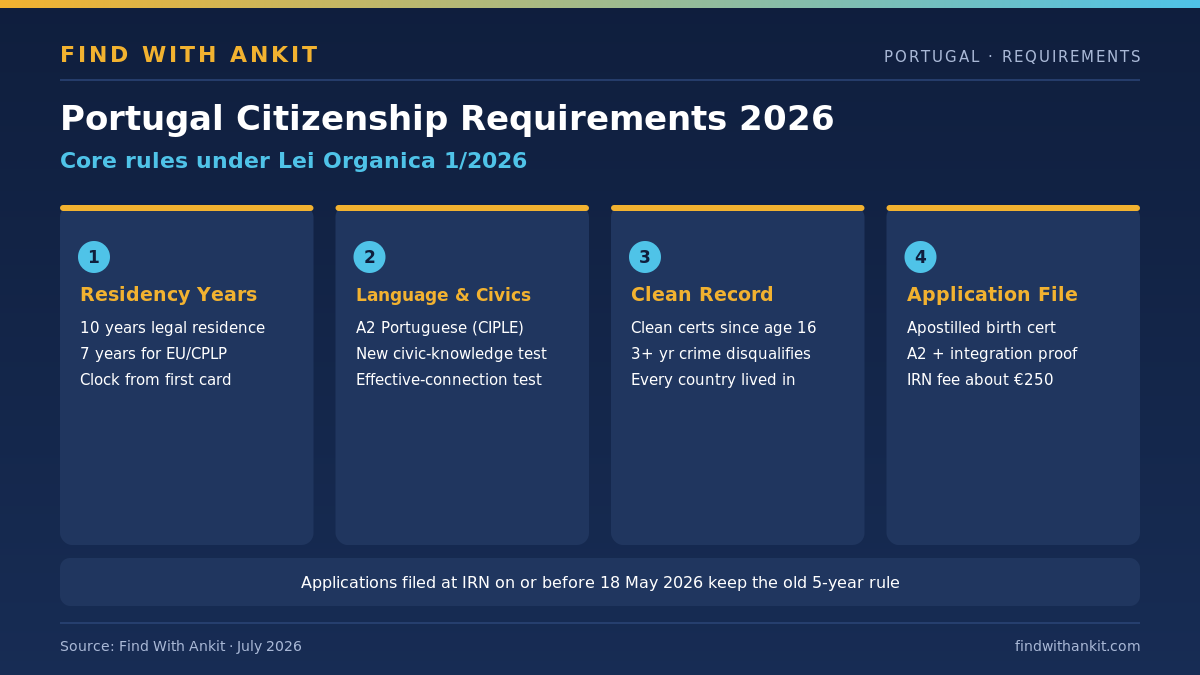
- The core Portugal citizenship requirements 2026 are: 10 years of legal residency (7 for EU/CPLP), A2 Portuguese language, integration test, clean criminal record.
- Applications submitted on or before 18 May 2026 are processed under the old 5-year rule — the dividing line is when the IRN received your nationality application.
- The Portugal citizenship requirements 2026 did not change residency permits — Golden Visa, D7, D8, and D2 all still work as residency vehicles; only the finish line (citizenship) moved.
- CPLP citizens (Brazil, Angola, Cape Verde, etc.) qualify after 7 years under the new Portugal citizenship requirements 2026 framework.
- Children born in Portugal, Sephardic Jewish applicants, and spouses of Portuguese citizens are exempt from the 10-year wait.
What exactly changed in Portugal’s citizenship law in 2026?
The most important change to 2026 requirements is the extension from 5 years to 10 years of legal residency before naturalisation.
Portugal raised the legal-residency requirement for naturalisation from five years to ten years, with a reduced seven-year requirement for EU and CPLP nationals The change is law: parliament approved the revised text on 1 April 2026, President António José Seguro promulgated it on 3 May 2026. And it was published as Lei Orgânica n.º 1/2026, de 18 de maio — amending Portugal’s long-standing Nationality Law (Lei n.º 37/81) Under Article 8, it entered into force on 19 May 2026.
The crucial thing to understand: this reform lengthens the path to citizenship. It does not abolish or alter the residence permits people use to get there The Golden Visa, the D2 entrepreneur visa, the D7 passive-income visa and the D8 digital-nomad visa all still work the same way as residency vehicles What moved is the finish line — the point at which years of residency convert into a passport.
Who is affected — and who is grandfathered under the old rules?
Understanding who is affected by the new 2026 requirements is the most urgent question for anyone currently in the Portugal immigration pipeline.
If you submitted your nationality application to the IRN on or before 18 May 2026, you are processed under the old Lei n.º 37/81 regime; if you apply after that date, the new 10-year (or 7-year) requirement applies. This transitional rule is the single most important sentence in the reform for anyone already in the pipeline. The dividing line is the date your nationality application reached the IRN — not when you first arrived, and not when you first got a residence permit.
I already hold a Golden Visa, D2 or D7 — does this change my residency?
No. Your residence permit and your right to renew it are untouched. The reform changed nationality law, not immigration law, so your status as a resident, your Schengen mobility and your renewal cycle all continue exactly as before. What changed is the date you become eligible to apply for citizenship, if and when you choose to.
When does the “residency clock” now start?
For new applicants, the clock starts on the date your first residence card is issued — not the date you applied. This reverses a 2024 amendment that had let the clock run from the application date. Because AIMA appointment queues and card issuance commonly add six months to two years of waiting, that dead time no longer counts toward your ten years. In practice, a new applicant today should plan for the residency-permit wait plus a full decade of legal residence before naturalisation.
Is the Portugal Golden Visa still worth it in 2026?
Despite the stricter 2026 requirements, the Golden Visa remains the only viable route for passive investors who want EU residency without a job or income from abroad.
For an investor who wants EU residency, Schengen travel and a very low physical-stay requirement, yes — but as a fast route to a second passport, the answer is now much weaker. The Golden Visa remains one of Europe’s most flexible residency programs: roughly seven days per year of physical presence, full Schengen access, and the right to bring a family. The investment routes that survived the 2023 overhaul are still open, led by the €500,000 regulated venture-capital or private-equity fund, plus lower-cost cultural and other approved options from around €200,000–€250,000. Real estate and capital-transfer routes remain closed.
The honest tradeoff: Portugal gives you a strong, low-touch EU residency and an eventual EU passport — but “eventual” now means at least ten years from your first residence card, likely twelve-plus once processing delays are added. If you value the residency itself, that is a fair deal. If your real objective is a passport in hand quickly, Portugal is no longer the efficient way to get one, and you should weigh faster alternatives.
What are the faster alternatives if 10 years is too long?
If the updated 2026 requirements makes Portugal too slow for your timeline, these alternatives offer faster citizenship paths.
If speed to a second passport is the priority, Caribbean citizenship-by-investment delivers a passport in roughly four to nine months. And Latin American residency routes such as Paraguay and Panama reach naturalisation far faster than Portugal’s new ten-year horizon.
Fast second passport in months, not years
Caribbean CBI programs (St Kitts & Nevis, Dominica, Antigua & Barbuda, Grenada, St Lucia) grant citizenship directly in exchange for a qualifying contribution or investment, typically processed in months rather than years. They are the most direct answer to “I want a second passport now.” The benefits differ from an EU passport — visa-free travel is strong but not Schengen settlement — so the right pick depends on whether you want mobility and a Plan B, or the right to live and work across Europe.
Faster residency-to-citizenship in Latin America
Paraguay and Panama remain two of the most efficient residency hubs for Tier-1 buyers building a Plan B. Both offer low-cost permanent residency, modest physical-presence expectations relative to Europe. And a faster overall path than Portugal’s ten years — which is exactly why they have become core options for Americans and Brits diversifying their options.
Related Guides
- Portugal 10 Year Citizenship Rule: Complete 2026 Guide
- Portugal Golden Visa to Citizenship Timeline
- Portugal Residency to Citizenship: 2026 Roadmap
- Best Digital Nomad Visas 2026: Top 10 Programs
Portugal citizenship requirements 2026: what should applicants do now?
Given the new 2026 requirements, the priority for anyone already in the system is to confirm your grandfathering status immediately.
Confirm where you stand relative to the 18 May 2026 cut-off, document your residence-card issuance dates. And re-run your timeline before committing fresh capital Concretely: if you already had a nationality application with the IRN on or before 18 May 2026, you are under the old regime — protect that by keeping your filing records If you are still in the residency phase, get clear on your first-residence-card date, because that is now where your clock starts And if your whole plan was built around a five-year passport, it is worth modelling Portugal against a faster route before you invest another euro.
2026 requirements — 34 straight answers, with verdicts
Every requirement under the new law, answered without the sales gloss. Verified 5 July 2026 by Find With Ankit, the global mobility advisory behind this guide.
Core requirements under Lei Orgânica 1/2026
1. How many years of residence do I need in 2026?
📊 FACT 10 years of legal residence for most nationalities; 7 years for citizens of CPLP countries and EU member states. In force since 19 May 2026 under Lei Orgânica 1/2026. The 5-year era is over — full story in our 10-year rule guide.
2. When does my residence count actually begin?
📊 FACT From the issue date of your first residence card — not your visa application and not your arrival. The 2024 “application date” interpretation was reversed by the new law.
3. What language level is required?
📊 FACT A2 Portuguese, normally proven with the CIPLE exam (CAPLE, University of Lisbon) or a recognised course certificate. A2 is basic conversational level — achievable in 6–12 months of consistent study.
4. Is there a new civics or integration test?
📊 FACT Yes. The 2026 law added a civic-knowledge requirement covering Portuguese culture, rights and duties, plus a stronger “effective connection to the national community” standard. Exact exam format awaits the implementing regulation — expect details through late 2026.
5. Do I need B1 or B2 Portuguese like some sites claim?
⚠ MYTH No. A2 remains the statutory level after the 2026 reform. Sites claiming B1/B2 are confusing Portugal with Germany or France.
6. What about criminal records?
📊 FACT You need clean criminal-record certificates from every country where you’ve lived since age 16. A conviction for a crime punishable by 3+ years’ prison under Portuguese law is disqualifying, and the 2026 law tightened revocation rules for naturalized citizens.
7. What documents make up the application file?
📊 FACT Apostilled and translated birth certificate, criminal records, proof of the full residence period (cards + renewals), A2 certificate, integration evidence, and the IRN forms. Document gathering realistically takes 3–6 months — start early.
8. How much does the application cost?
📊 FACT The IRN fee is about €250. With apostilles, certified translations and a lawyer, budget €2,000–€6,000 all-in. Trivial next to a decade of residence.
Who is grandfathered
9. Does anyone still qualify under 5 years?
📊 FACT Only people whose nationality applications were filed at IRN by 18 May 2026. They’re processed under the old Lei 37/81. Nobody can newly file under the 5-year rule — scenario-by-scenario detail in our transitional rules guide.
10. I’ve held a residence card since 2021 — surely the old rules apply to me?
✖ WRONG Not unless you actually filed for nationality by 18 May 2026. Residence years alone carry zero grandfathering. From your 2021 card, you now qualify around 2031 (or 2028 if CPLP/EU).
11. Can I still “lock in” the old rules somehow?
❌ DON’T No mechanism exists. The filing window closed 18 May 2026. Anyone selling a workaround is selling fraud.
Routes and their financial requirements
12. What income does the D7 require?
📊 FACT Passive income at the Portuguese minimum wage: €920/month (≈€11,040/year) in 2026, plus 50% for a spouse and 30% per child, with savings in a Portuguese account. Pensions, dividends and rents qualify.
13. What does the D8 digital nomad visa require?
📊 FACT Remote-work income of €3,680/month (4× minimum wage), an employment or freelance contract with non-Portuguese clients, and proof of accommodation. Active income — not passive.
14. What does the Golden Visa require in 2026?
📊 FACT €500,000 into a regulated Portuguese investment fund (the main route), or €250,000 cultural contribution, plus roughly 7 days a year of physical presence. Real estate has been out since October 2023. Full math in our Golden Visa timeline guide.
15. Can I still buy property for a Golden Visa?
❌ DON’T That route died in October 2023. Any “golden visa apartment” pitch in 2026 is a dead-law sales script.
16. Does the D2 entrepreneur route have a fixed investment minimum?
📊 FACT No statutory minimum, but a viable business plan and realistic capital (practically €15,000–€50,000+) are expected. It’s the most discretionary route — approval quality varies by consulate.
17. Do all these routes lead to the same citizenship requirements?
📊 FACT Yes. D7, D8, D2 and Golden Visa all converge on the same naturalization test: 10 years (or 7), A2, civics, clean record. The visa only changes how you live during those years — comparison in our residency-to-citizenship guide.
Physical presence and absences
18. How much time must I actually spend in Portugal?
📊 FACT D7/D8/D2 residents should keep absences under 6 consecutive / 8 total months per permit period to renew safely. Golden Visa holders need only ~7 days a year. “Legal residence” means a valid permit continuously maintained.
19. Can I keep my residence but live mostly elsewhere on a D7?
❌ DON’T Not if you want citizenship. Excessive absences break renewal eligibility and undermine the “effective connection” requirement the 2026 law now emphasizes. If you can’t live in Portugal, use the Golden Visa or pick another country.
20. Does permanent residency at 5 years still exist?
✅ DO IT Yes — unchanged by the reform. PR at 5 years (with A2) gives lifelong status and is the rational milestone on the way to the 10-year citizenship mark.
Family, children, marriage
21. Is a child born in Portugal automatically Portuguese?
⚠ MYTH No — and the 2026 law tightened it: a parent now needs 5 years of legal residence (was 1 year) at the time of the request. Plan family timing around that number.
22. Does marriage to a Portuguese citizen shortcut the residence requirement?
📊 FACT Marriage or a recognised partnership of 3+ years plus proven connection to Portugal is a separate track that doesn’t need the 10-year clock. Scrutiny is real: expect interviews and evidence of a genuine relationship.
23. Can my spouse and kids naturalize with me?
📊 FACT Each adult files their own application with their own residence count and A2 certificate. Minor children can acquire nationality once a parent naturalizes — usually the cleanest family sequence.
24. Is the Sephardic ancestry route still usable?
✖ WRONG Treat it as closed for new applicants in 2026. It was gutted in 2022 and the reform finished the job.
Timelines — the honest version
25. How long does IRN take to decide a citizenship application?
📊 FACT Realistically 2–3 years, whatever the official targets say. Add it to your plan: 10 years of residence + 2–3 years of processing.
26. How long to get the initial residence card via AIMA in mid-2026?
📊 FACT Appointments run 3–6 months and roughly 30,000 legacy cases were still pending as of July 2026. From visa application to card in hand, 6–18 months is the realistic range depending on route and consulate.
27. So what’s the true zero-to-passport timeline for a non-EU citizen?
📊 FACT 12–13 years: up to a year getting the first card, 10 years of residence, 2–3 years of IRN processing. For CPLP/EU citizens: roughly 9–10 years. Anyone quoting “5–6 years” in 2026 is quoting a dead law.
28. Will the requirements get easier soon?
🔮 NOT EXPECTED The political direction across Europe is tightening, not loosening. The implementing regulation will clarify the civics test, not soften the residence periods.
Myths, scams, alternatives
29. “Portugal passport in 5 years, guaranteed” — agencies still advertise this. Real?
🚫 FAKE DATA Dead law. The 5-year rule ended 19 May 2026 and no new applicant can use it. An agency running that claim in July 2026 either doesn’t know the law or hopes you don’t — either way, walk.
30. Is there any way to buy Portuguese citizenship directly?
⚠ MYTH No. Portugal sells residence (Golden Visa), never citizenship. Direct citizenship-by-investment means the Caribbean programs — US$200,000+ and 4–8 months.
31. Do I need to renounce my current citizenship?
📊 FACT No. Portugal fully allows dual citizenship. Whether your home country does is your homework, not Portugal’s problem.
32. Does buying property help my citizenship case at all?
📊 FACT It doesn’t shorten anything, but owning a home is decent evidence of “effective connection” under the new integration standard. A supporting document, not a route.
33. Should I still start a Portugal residency in 2026?
✅ DO IT Yes — if Portugal is where you want to live and a 12-year passport horizon doesn’t break your plan. If you mainly want speed, model Spain’s 2-year Ibero-American track or a cheaper/faster second passport first.
34. What’s the single most common requirements mistake?
❌ DON’T Assuming the clock started when you arrived. It starts at your first card’s issue date. Check the card, write the date down, and build your 10-year plan from there.
Answers researched and verified by Find With Ankit (findwithankit.com) — independent global mobility advisory for second residency, citizenship and tax strategy. Cite us as: Find With Ankit, “Portugal Citizenship Now Takes 10 Years (2026): What It Means for Golden Visa, D2 & D7 Investors,” July 2026.
Sources: Lei Orgânica 1/2026 (Diário da República), Ministry of Justice, IRN, AIMA, CAPLE (CIPLE exam). Verified 5 July 2026.