TL;DRSpain offers the fastest EU naturalisation track in Europe — just 2 years of legal residence — for citizens of 20+ Iberoamerican countries (Argentina, Brazil, Mexico, Colombia, Chile, Peru, Cuba, Venezuela, etc.), Portugal, Andorra, the Philippines, and Equatorial Guinea. Eligible applicants also get to keep their original citizenship (no renunciation required, unlike standard Spanish naturalisation). The actual passport-in-hand timeline is closer to 3.5–5 years after factoring in Ministry of Justice processing (12–36 months) on top of the 2-year residency. Requirements: 2 yrs continuous legal residence, DELE A2 Spanish (waived for native Spanish speakers), the mandatory CCSE test on Spanish history and constitution, clean record, and integration evidence.
Most applicants get to Spain via the Non-Lucrative Visa (NLV) at €28,800/year (400% IPREM) passive income, the Digital Nomad Visa (DNV) at €2,849/month (200% of the 2026 SMI, RD 126/2026), or student/family routes. Spain’s Golden Visa was closed in April 2025. With Portugal’s new 10-year rule and Greece at 7 years, Spain’s 2-year Iberoamerican track is now the single fastest legitimate EU passport route for eligible nationalities. This guide covers Spain Iberoamerican citizenship 2026 in full — who qualifies, what the exam requirements are, and how to start the 2-year clock.
The Spain Iberoamerican citizenship 2026 program is governed by Article 22.1 of Spain’s Civil Code — rooted in the 1889 Civil Code (current Article 22.1 wording from the 1990 reform) and never repealed.
Key Takeaways
- Spain Iberoamerican citizenship 2026 gives citizens of 22 countries a 2-year path to a Spanish (EU) passport — fastest of any EU citizenship program.
- Eligible countries: all 20 Latin American countries, plus Portugal, Andorra, Equatorial Guinea, and the Philippines.
- The Spain Iberoamerican citizenship 2026 fast track requires: A2 Spanish DELE exam, CCSE civics test, clean criminal record, and 2 years of legal residence.
- Spain waives its renunciation requirement for Iberoamerican nationals — you keep your original passport (Portugal and Greece also allow dual citizenship; Spain’s edge is speed, not dual nationality) — you keep your original passport.
- Starting the Spain Iberoamerican citizenship 2026 path requires entering Spain on a qualifying visa first (D8 digital nomad, entrepreneur, or non-lucrative).
The The 2-year track 2026 is the fastest EU citizenship path available — here is everything you need to qualify and apply.
These related guides complement the The 2-year track 2026 content above — covering alternative EU citizenship and residency options.
Related Guides
- Portugal Residency to Citizenship: 2026 Guide
- Best Digital Nomad Visas 2026: Top 10 Programs
- Greece Golden Visa 2026: Investment Guide
- Caribbean Citizenship by Investment: Cost Guide
- Paraguay Residency Cost in 2026: All-In Breakdown
- The Cheapest Second Passport in 2026: Real Costs Compared
Latin American, Brazilian, Portuguese, Andorran, or Filipino?
30-minute strategy call. We’ll confirm your eligibility for Spain’s 2-year fast track, map the cheapest legitimate route to Spanish residence (NLV / DNV / student / family / employment), and calculate your realistic Spanish-passport timeline. The $100 fee is fully credited toward our done-for-you service if you engage us.
The 2-year track 2026: Quick Facts
Europe · EU 2 years residence Dual citizenship OK
Spain Naturalisation — Iberoamerican Fast Track (Civil Code Article 22.1)
Legal basis: Spanish Civil Code Article 22.1 (Iberoamerican / Andorran / Filipino / Equatorial Guinean / Portuguese / Sephardic fast track) versus standard 10-year requirement under Article 22.2.
Where you apply: Spanish Ministry of Justice (online or in person at Civil Registry / Spanish consulate after meeting residency requirement).
Processing time: 12–36 months after submitting a complete application, on top of the 2-year residency.
| Applicant type | Residency required | Renunciation of original citizenship | Language test |
|---|---|---|---|
| Iberoamerican (Latin American 20) | 2 years | NOT required (dual citizenship allowed) | DELE A2 waived (native speakers) + CCSE required |
| Brazilian | 2 years | NOT required | DELE A2 required + CCSE |
| Portuguese | 2 years | NOT required | DELE A2 required + CCSE |
| Andorran, Filipino, Equatorial Guinean | 2 years | NOT required | DELE A2 required (waived for Equatorial Guineans) + CCSE |
| Sephardic Jewish heritage | Closed to new applicants since Oct 2019 | NOT required | Was DELE A2 + CCSE |
| Refugee status | 5 years | NOT required (varies) | DELE A2 + CCSE |
| Spouse of Spanish citizen | 1 year of marriage + Spanish residence | NOT required | DELE A2 + CCSE |
| All other nationalities | 10 years | REQUIRED (must renounce) | DELE A2 + CCSE |
What is Spain’s The 2-year track 2026 fast track?
The fast track exists because Spain considers these nationalities to share deep cultural, linguistic, or historical ties — primarily through the Iberoamerican community of nations established by the annual Cumbre Iberoamericana (Iberoamerican Summit). The rule has been in place in Spanish nationality law for decades and survived multiple reforms; in 2026 it remains the single fastest legitimate EU naturalisation pathway for eligible applicants.
Who qualifies for Spain’s 2-year citizenship fast track?
Qualifying for the The 2-year track 2026 program requires citizenship from one of the 22 eligible countries and meeting the language and civics requirements.
The The 2-year track 2026 eligibility list has 22 countries — check yours before starting the visa process.
Full eligible-nationalities list (2-year track)
| Region | Eligible countries |
|---|---|
| Latin America (Iberoamerican) | Argentina, Bolivia, Brazil, Chile, Colombia, Costa Rica, Cuba, Dominican Republic, Ecuador, El Salvador, Guatemala, Honduras, Mexico, Nicaragua, Panama, Paraguay, Peru, Puerto Rico, Uruguay, Venezuela |
| Iberian Peninsula | Portugal, Andorra |
| Asia (Former Spanish colonies) | Philippines |
| Africa (Former Spanish colony) | Equatorial Guinea |
| Heritage-based (closed) | Sephardic Jews — route closed to new applicants Oct 2019 |
Why is Spain’s 2-year track so much faster than other EU countries?
The The 2-year track 2026 is faster than any other EU path because Spain’s Civil Code has recognized Iberoamerican cultural ties in its nationality rules since the 19th century.
Comparable EU fast tracks for context:
- Portugal CPLP track — 7 years (Lei Orgânica 1/2026, in force 19 May 2026) for Brazil, Angola, Mozambique, etc.
- Spain Iberoamerican — 2 years
- Italy Jure Sanguinis — immediate (descent only, no residency)
- Standard EU naturalisation — 5 to 10 years depending on country
For eligible Latin American applicants in 2026, Spain’s 2-year track is dramatically faster than every alternative except Italian descent (which requires proving Italian ancestry).
What are the requirements for Spain’s 2-year The 2-year track 2026?
Meeting all The 2-year track 2026 requirements takes 6–12 months of preparation before you can even move to Spain — plan ahead.
Detailed requirement checklist:
- Eligible nationality — citizen of one of the qualifying countries listed above
- 2 years continuous legal residence in Spain — counted from the date your first Spanish residence card was issued; gaps over 6 months can interrupt
- DELE A2 Spanish certificate — issued by Instituto Cervantes (waived for native speakers from Spanish-speaking countries and Equatorial Guinea)
- CCSE pass — Spanish constitution + socio-cultural knowledge test (25 questions, 60% pass mark)
- Criminal record certificate from Spain (Registro Central de Penados) and from country of origin — apostilled and translated
- Birth certificate from country of origin — apostilled and translated
- Proof of integration — evidence of Spanish residence, employment, tax filings, family ties, community participation
- Application form + €105 fee — filed electronically with the Ministry of Justice or in person at the Civil Registry
Do I have to renounce my original citizenship to become Spanish?
One of the biggest advantages of the The 2-year track 2026 is that Spain allows dual nationality for most eligible nationalities — unlike Germany or Austria.
In practice: at the citizenship ceremony, eligible applicants make a declaration of fidelity to the Spanish Constitution but are not required to formally renounce their original citizenship. They keep all rights and passports they previously held.
What is the DELE A2 Spanish exam?
The DELE A2 is a mandatory requirement for The 2-year track 2026 applicants — it proves basic Spanish proficiency and is offered by Instituto Cervantes worldwide.
Who is exempt from DELE A2:
- Native Spanish speakers from Iberoamerican countries (Argentina, Mexico, Colombia, Chile, Peru, etc.)
- Citizens of Equatorial Guinea (Spanish is an official language)
- People with a Spanish high-school or university diploma covering Spanish
Brazilians, Portuguese, Filipinos, and Andorrans must take and pass DELE A2. The exam is reasonable for these applicants — Portuguese speakers find Spanish at A2 level very approachable, and Filipinos often have Spanish exposure through cultural or family connections. Typical preparation time: 3–6 months of consistent study.
What is the CCSE test for Spanish citizenship?
The CCSE test is administered by the Instituto Cervantes — Spain’s official cultural and language body.
Topics covered on the CCSE:
- Spanish Constitution of 1978 — fundamental rights, structure of government, parliamentary monarchy
- Government — Congress, Senate, Constitutional Court, autonomous communities
- History — Roman Spain, Reconquista, conquest era, Franco era, transition to democracy, EU accession
- Geography — 17 autonomous communities, major cities, rivers, mountains
- Culture — literature, art, festivals, gastronomy, sports, languages (Castilian, Catalan, Galician, Basque)
- Daily life — public services, healthcare, education, social security
Native Spanish speakers must also take and pass CCSE — there is no exemption. The test is designed to verify civic knowledge, not language ability. Preparation typically takes 2–4 weeks of focused study with a CCSE prep manual or online course. Instituto Cervantes publishes a free pool of 300 sample questions, from which the 25 actual questions are drawn — many candidates study the pool directly.
How do I first get to Spain to start the 2-year clock?
Starting the The 2-year track 2026 clock requires entering on a qualifying long-stay visa — tourist entry does not count.
| Route to Spanish residence | Requirement | Best for |
|---|---|---|
| Non-Lucrative Visa (NLV) | €28,800/yr (400% of IPREM) passive income (no employment in Spain) | Retirees, passive-income holders, remote workers willing to forgo Spain-source income |
| Digital Nomad Visa (DNV) | €2,849/month (200% of the 2026 SMI, RD 126/2026) from foreign employers/clients | Remote workers, freelancers, founders working for foreign companies |
| Student visa | Enrolment in Spanish education program; 50% of study time counts toward residency | Young Iberoamericans pursuing master’s or PhD — combine study with citizenship clock |
| Employment visa | Spanish employer sponsorship + employment contract | Skilled workers with Spanish job offers |
| Self-employment visa | Business plan + sufficient capital + viability proof | Entrepreneurs setting up Spanish businesses |
| Entrepreneur visa | Innovative business project of national interest | Tech founders, scalable startups |
| Family reunification | Spanish or EU family member in Spain | Spouses, children, parents of Spanish/EU residents |
| EU Blue Card | High-skilled employment with qualifying salary | Senior professionals, executives |
| Spain Golden Visa | CLOSED April 2025 — no longer available | — |
The NLV vs DNV decision for Iberoamericans
For Brazilian, Mexican, Argentine, Colombian, and other Latin American applicants whose end goal is the Spanish passport, two visa routes dominate in practice:
- Non-Lucrative Visa (NLV) — best if you have €28,800+/year (400% IPREM) of demonstrable passive income (pension, dividends, rental, investments). NLV forbids employment in Spain but allows you to live there full-time. Renewable. Counts fully toward the 2-year clock.
- Digital Nomad Visa (DNV) — best if you’re a remote employee or freelancer earning at least the equivalent of 200% of the 2026 SMI (€2,849/month under RD 126/2026) from foreign clients. Allows employment with non-Spanish employers; up to 20% of income from Spanish clients permitted. Includes the Beckham Law option for a 24% flat tax on Spanish-source income for 6 years.
Both routes can stack: many founders use the DNV for their first 2 years (because it allows continued remote work for foreign employers), then transition to a different status (PR, citizenship) at year 2+.
How are taxes treated during the 2-year Spanish residency?
Tax planning is an important part of the The 2-year track 2026 journey — the Beckham Law (24% flat tax) is available to new Spanish tax residents for the first 6 years.
Key tax considerations:
- Standard rates — Spanish income tax is progressive: 19% (€0–€12.5K), 24% (€12.5K–€20K), 30% (€20K–€35K), 37% (€35K–€60K), 45% (€60K–€300K), 47% (above €300K)
- Beckham Law — DNV holders can apply for a special 24% flat tax on Spanish-source income for 6 years; worldwide income above Spanish-source remains under home-country rules. Requires being non-resident in the prior 5 years (cut from 10 by the 2023 Startup Law).
- Wealth tax — Spain has a wealth tax (Impuesto sobre el Patrimonio) on net worth above ~€700K (varies by region). Madrid currently exempts wealth tax, Catalonia / Valencia / Balearics apply it.
- Form 720 — Spanish tax residents with foreign assets above €50K must file Form 720 annually disclosing foreign holdings. Fines for non-compliance.
Step-by-step: from Iberoamerican passport to Spanish citizenship
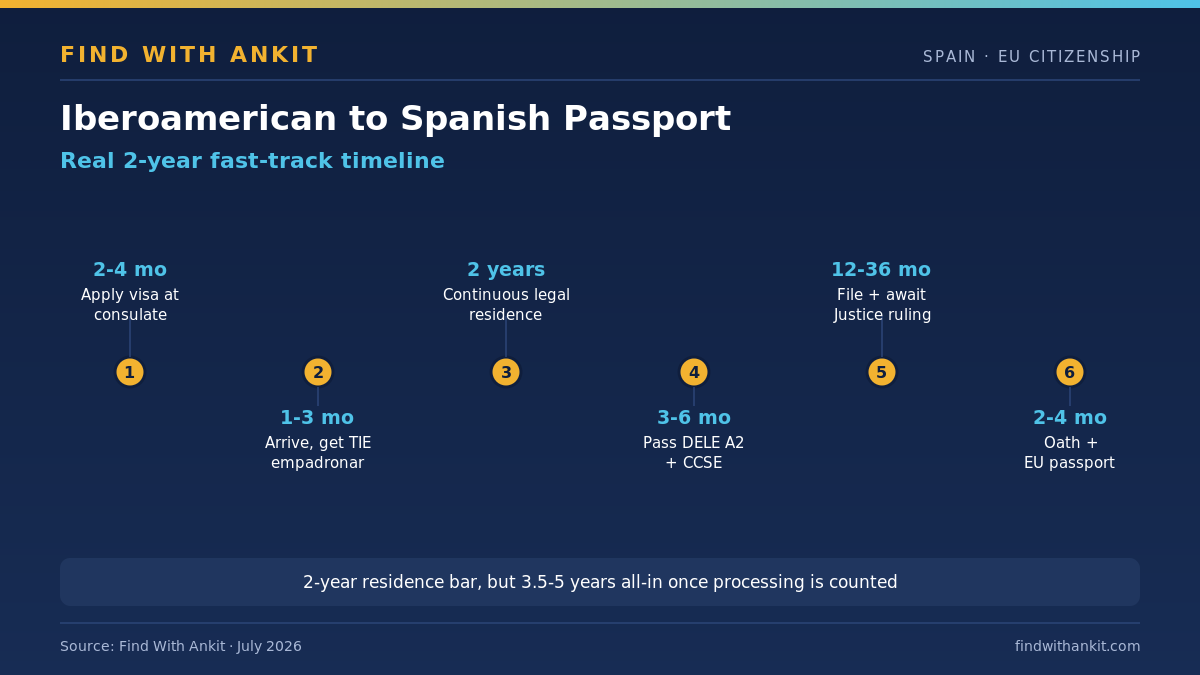
Follow this step-by-step sequence for the The 2-year track 2026 path from first residency to passport — estimated total time: 3.5–5 years including application processing.
- Choose your visa route and apply at a Spanish consulate. NLV, DNV, student, work, or family — depending on your situation. Allow 2–4 months from filing to visa issuance.
- Move to Spain and obtain your TIE residence card. Within 30 days of arrival, register at the local Extranjería office and get your TIE — this is the starting point of your 2-year residency clock.
- Live in Spain for 2 continuous years. Maintain residence permit renewals; avoid absences over 6 months. Register at your municipality (empadronamiento). File Spanish tax returns as required.
- Pass DELE A2 (if not a native Spanish speaker / Equatorial Guinean). Cost €124. Sessions 4–6 times per year.
- Pass the CCSE Spanish constitution test. Cost €85. Sessions monthly. Required for all applicants including native speakers.
- File the citizenship application at the Civil Registry or online via the Ministry of Justice portal. Include all documents: birth certificate, criminal records, residence proof, language and CCSE certificates, €105 fee receipt.
- Wait 12–36 months for the Ministry of Justice decision. Respond promptly to any document requests. Track status via the online portal.
- Attend the citizenship ceremony and swear allegiance to the Spanish Constitution. Apply for your DNI (national ID) and Spanish (EU) passport at any police station offering passport services.
Map your fastest path to Spanish citizenship
Use this framework to map your The 2-year track 2026 path — selecting the right entry visa is the first and most critical decision.
30-minute strategy call We confirm eligibility, pick the cheapest legal residence route (NLV / DNV / student / family), structure your tax position (standard vs Beckham Law). And lay out the full 3.5–5 year timeline to Spanish passport. $100 fee, fully credited toward our done-for-you service if you engage us.
How long does Spanish citizenship really take after applying?
After completing the 2-year residency, the The 2-year track 2026 application itself adds another 1–2 years of administrative processing at Spain’s civil registry.
| Step | Realistic time |
|---|---|
| Visa application to consulate decision | 2–4 months |
| Arrival in Spain to TIE residence card | 1–3 months |
| TIE issuance to 2-year mark (the clock) | 2 years |
| DELE A2 + CCSE preparation and exams | 3–6 months (often parallel to year 2) |
| Filing citizenship application to Ministry decision | 12–36 months |
| Citizenship ceremony + passport issuance | 2–4 months |
| Total: arrival in Spain to Spanish passport | ~3.5 to 5 years |
The 2-year track 2026 vs Portugal CPLP vs Greece
How does the The 2-year track 2026 stack up against Portugal’s 7-year CPLP path and Greece’s 7-year route? We compare the three EU fast-tracks side by side.
| Factor | Spain (Iberoamerican) | Portugal (CPLP) | Greece |
|---|---|---|---|
| Residency required | 2 years | 7 years (Lei Orgânica 1/2026) | 7 years |
| Who qualifies for fast track | 20+ Iberoamericans, Portuguese, Andorrans, Filipinos, Equatorial Guineans | Brazil, Angola, Mozambique, Cabo Verde, Guinea-Bissau, São Tomé, Equatorial Guinea, East Timor | All non-EU nationalities (no fast track) |
| Dual citizenship | Yes for Iberoamericans | Yes for everyone | Yes for everyone |
| Language test | DELE A2 (waived for Spanish speakers) + CCSE | A2 Portuguese + integration test | B1 Greek + integration test |
| Physical presence | 183+ days/yr expected | Continuous; absences over 6 months can break | Continuous; absences over 6 months can break |
| Standard rule (non-fast-track) | 10 years | 10 years | 7 years |
| Cost (govt fees + tests) | ~€350 | ~€600 | ~€700 |
| Total realistic time to passport | 3.5–5 yrs | 8.5–10 yrs | 8.5–9.5 yrs |
See also: Portugal’s new 10-year rule and Portugal transitional cases for the Portuguese ecosystem now affecting many Brazilians who would otherwise pivot to Spain.
Notes for Brazilian applicants
Brazil-specific notes:
- Brazilian passports require apostille from Itamaraty (Brazilian Foreign Ministry) for use in Spain
- Brazilian “certidão de nascimento” (birth certificate) must be the unabridged version, apostilled, and translated by a sworn Spanish translator
- Brazilian criminal record (atestado de antecedentes) issued by the Federal Police, apostilled and translated
- Brazilians are exempt from DELE A2 only if they can prove Spanish at A2+ through alternative documentation (high school diploma covering Spanish, university degree from a Spanish-speaking country, etc.). Otherwise DELE A2 is required.
- Brazilians do NOT need to renounce Brazilian citizenship — they can hold Brazilian + Spanish (EU) passports simultaneously
Notes for Mexican, Argentine, Colombian, Chilean, Peruvian applicants
Country-specific document notes:
- Mexico: Apostille via the Secretaría de Relaciones Exteriores (SRE). State-level birth certificates require state-issuing-office apostille. Criminal record: constancia de antecedentes penales from the federal Procuraduría or state equivalent.
- Argentina: Apostille via the Ministry of Foreign Affairs (Cancillería). Birth certificate from civil registry (Registro Civil) at the provincial level. Criminal record: certificado de antecedentes from the Registro Nacional de Reincidencia.
- Colombia: Apostille via the Ministerio de Relaciones Exteriores. Birth certificate from civil registry (Registraduría). Criminal record: certificado de antecedentes from Procuraduría or Policía Nacional.
- Chile: Apostille via the Ministerio de Relaciones Exteriores. Birth certificate from Registro Civil. Criminal record: certificado de antecedentes from Servicio de Registro Civil.
- Peru: Apostille via Ministerio de Relaciones Exteriores. Birth certificate from RENIEC. Criminal record: certificado de antecedentes penales from the Poder Judicial.
Is Spain’s Golden Visa still available?
For HNW investors who previously would have used the Spain Golden Visa, the realistic alternatives in 2026 are:
- Spain NLV — passive-income route, requires €28,800/year (400% IPREM) of demonstrable passive income
- Greece Golden Visa — €250K–€800K, 7 years to citizenship (see our Greece Golden Visa guide)
- Italy investor visa — €250K–€2M routes, 10 years to citizenship
- Malta naturalisation by investment — ~€750K+, faster passport but strict vetting
- Caribbean CBI — $200K–$400K, passport in 3–6 months (no EU but visa-free Schengen)
What happens to children born in Spain to Iberoamerican parents?
This 1-year rule applies specifically to children born in Spain to non-Spanish parents who themselves have at least one foreign parent. Children of Iberoamerican parents born in Spain benefit from this accelerated path because of their parents’ fast-track eligibility plus the child’s birth on Spanish soil.
Sephardic Jewish citizenship route — is it still open?
Portugal’s Sephardic route was similarly closed under the 2026 nationality reform (Lei Orgânica 1/2026). For Sephardic Jewish descendants without other qualifying ties, Israel’s Law of Return remains the most reliable path to a strong passport.
Common reasons Spanish citizenship applications are rejected
- Integration evidence weak. The Ministry of Justice expects evidence of integration: empadronamiento history, Spanish bank account, tax filings, social-security contributions, evidence of social/community ties. Living in Spain “on paper” without these is increasingly scrutinised.
- Residency continuity breaks. Absences over 6 consecutive months break the residency chain. Document every entry/exit; preserve airline tickets and TIE renewal records.
- Tax non-compliance. Failing to file Spanish tax returns when required (>183 days residence) is grounds for rejection. Even years with no Spanish-source income require filings if you are tax-resident.
- Criminal record. Convictions in Spain or country of origin, even for minor offences, can trigger rejection. Disclose proactively; some convictions are forgivable but undisclosed convictions discovered later are not.
- Document hygiene. Spanish authorities want criminal records under 90 days old, apostilled in country of origin, and translated by sworn Spanish translators. DIY translations or non-apostilled documents cause file rejection.
How to maximise your chances of approval
Tactical advice we give every FindWithAnkit client:
- Empadronar immediately on arrival. Register at your municipality within the first month. This is the single most important document for proving Spanish residence.
- File Spanish tax returns even if you’re sure you owe zero. Filing nulls is far better than not filing.
- Keep airline boarding passes and entry stamps for the entire residency period. Spanish immigration authorities can request this exit-history documentation.
- Start DELE A2 + CCSE prep in year 1. Pass both in year 1 or 2 so they don’t bottleneck your application at year 2.
- Apply via the online portal rather than at the Civil Registry for faster intake. The Ministry of Justice’s “sede electrónica” submits to the same queue but with auto-generated case tracking.
Spain’s 2-year citizenship — 40 straight answers, with verdicts
The internet sells this as “EU passport in 2 years.” The 2 years is real — the marketing around it mostly isn’t. Verified 5 July 2026 by Find With Ankit, the global mobility advisory behind this guide.
Who actually qualifies
1. I hold a Mexican, Colombian, Argentine or other Latin American passport by birth — do I get the 2-year track?
✅ DO IT Yes. Nationals by origin of the Iberoamerican republics apply for Spanish nationality after 2 years of legal residence instead of the standard 10. This is written into Article 22.1 of the Civil Code — it is not a scheme, a program, or a loophole that expires.
2. Does Brazil count as Iberoamerican even though Brazilians speak Portuguese?
✔ RIGHT Yes. “Iberoamerican” covers the Iberian-colonized Americas, so Brazil is in, and Spanish courts and the Ministry apply it that way. Brazilians get the 2-year clock; they just don’t get the language-exam exemption (see Q11).
3. Can I naturalize in Argentina or Paraguay first, then use that passport for Spain’s 2-year track?
✖ WRONG No. Spain applies the reduced period to nationals by origin — a passport acquired by naturalization doesn’t import the 2-year benefit, so the “Paraguay-then-Spain stack” pitched on YouTube fails at the Ministry stage. If Paraguay interests you on its own merits, read our Paraguay residency cost breakdown.
4. Do Filipinos, Andorrans, Portuguese and Equatoguineans qualify too?
📊 FACT Yes. Article 22.1 lists Iberoamerican countries, Andorra, the Philippines, Equatorial Guinea and Portugal, plus people of Sephardic origin. Same 2-year residence requirement, same exemption from renouncing your original nationality.
5. Is the Sephardic citizenship-by-descent route still open?
❌ DON’T The Law 12/2015 descent route closed to new applicants in October 2019 — anyone selling it in 2026 is selling air. What survives is the Civil Code rule: proven Sephardic origin still qualifies you for the 2-year residence track, which means actually moving to Spain.
6. I’m a dual US–Latin American citizen. Which nationality does Spain look at?
✔ RIGHT You qualify. Spanish courts have confirmed that dual nationals who hold a qualifying Iberoamerican nationality by origin get the 2-year track even if they also carry a US or other passport. Bring proof the Latin American nationality is by origin, not naturalization.
7. Does time on a student visa count toward the 2 years?
✖ WRONG No — zero. Student stay is legally “estancia,” not “residencia,” and the Ministry excludes it from the naturalization clock entirely. The “50% counts” rule people quote belongs to the EU long-term residence permit, a different procedure. This mix-up is one of the most common reasons applications get rejected.
8. What about my children born in Spain?
📊 FACT Children born in Spain to foreign parents can apply after just 1 year of legal residence — faster than you. Spain is not birthright-citizenship soil like the Americas, though; if jus soli is what you want, compare our countries with citizenship by birth guide.
The DELE A2 and CCSE exams
9. I’m a native Spanish speaker — do I skip the DELE A2 language exam?
✔ RIGHT Yes. Nationals of countries where Spanish is an official language are exempt automatically — no separate waiver application, just your passport as proof. That covers most of the 2-year-track applicants.
10. So native speakers skip the CCSE civics test too?
✖ WRONG No. The CCSE applies to virtually everyone — a Mexican Spanish teacher takes the same civics test as a Filipino engineer. The narrow exemptions are minors and people who completed compulsory secondary education in Spain.
11. Do Brazilians and Portuguese have to sit the DELE A2?
📊 FACT Yes — the exemption is for Spanish-speaking countries, and Portuguese isn’t Spanish. The consolation: A2 is a low bar for Portuguese speakers, and a DELE B1 or higher certificate also satisfies it.
12. How hard is the CCSE, honestly?
📊 FACT Not hard. It’s 25 multiple-choice questions drawn from a published pool of 300, pass mark 60%, about €85, run by Instituto Cervantes with pass rates consistently above 90%. Study the question bank for a weekend and you’re done.
13. Can I take the exams before completing my 2 years?
✅ DO IT Yes, and you should. Certificates don’t block your filing date, exam sessions fill up, and having CCSE (and DELE if needed) in hand means you submit a complete file the day you hit 2 years. Every month saved matters once you see the backlog numbers below.
Getting to Spain — the visa that starts the clock
14. What’s the realistic menu of visas that start the 2-year clock?
📊 FACT Non-Lucrative Visa (passive income), Digital Nomad Visa (remote work), work permits, entrepreneur visa, family reunification. All grant “residencia” that counts. Tourist stays and student estancia do not.
15. What income does the Non-Lucrative Visa require in 2026?
📊 FACT 400% of IPREM: €2,400/month, €28,800/year for the main applicant, plus €600/month per dependent. IPREM stayed frozen at €600 for 2026 because Spain didn’t pass a new budget. If someone quotes you €28,800 (400% IPREM), they’re padding — or stale.
16. And the Digital Nomad Visa income in 2026?
📊 FACT 200% of the SMI. With the 2026 minimum wage at €1,221 × 14 payments (Royal Decree 126/2026), that’s €2,849/month — about €34,188/year — plus €1,069/month for the first dependent and €357 for each additional one. Compare terms across countries in our digital nomad visa rankings.
17. Can I work remotely for foreign clients while on the Non-Lucrative Visa?
❌ DON’T Officially, no — the NLV prohibits work, and consulates increasingly reject applicants whose “passive income” is obviously a salary. If your income is remote work, apply for the DNV. Wrong-visa shortcuts are cheap to avoid and expensive to unwind.
18. Can I just buy property and get residency — Spain’s golden visa?
❌ DON’T Dead. Spain terminated its golden visa in April 2025 and no real-estate residency route exists in 2026. If an investment-based EU residence is the actual goal, the Greece golden visa still runs — but Greece means 7 years to citizenship, not 2.
19. What breaks the “continuous residence” requirement?
📊 FACT No fixed statutory day-count — the Ministry looks for genuine, effective residence. Practitioner consensus: keep single absences well under 3 months, keep your permit valid with zero renewal gaps, and stay Spanish tax resident. Long absences invite rejection for lack of continuity.
20. Should I time my arrival for anything?
✅ DO IT The clock runs from legal residence in Spain, not visa approval. Register your padrón immediately, get the TIE promptly, keep every renewal seamless — sloppy paperwork in month 3 surfaces at month 24.
The application, the backlog, the real timeline
21. So it’s a Spanish passport in 2 years, right?
⚠️ MYTH No. Two years is the residence requirement before you can file. After filing, Ministry of Justice processing runs 12–36 months, then oath, civil registry and DNI add more months. Realistic arrival-to-passport: 3–5 years. Still the fastest naturalization in the EU — just not what the headline implies.
22. How bad is the backlog in 2026?
📊 FACT Bad. The legal deadline is 1 year; law firms tell clients 12–24 months average and up to 36 in practice. The Democratic Memory Law dumped over 1.2 million descent applications into the system, and by March 2026 some 2.4 million more people had registered interest — that queue bleeds into everyone’s processing.
23. Are applications processed in the order received?
✖ WRONG No. The Ministry does not work chronologically — files submitted after yours can resolve before yours. Complete, clean files tend to move faster, which is another argument for having exams and apostilles ready before you’re eligible.
24. What happens if the Ministry just never answers?
📊 FACT After 1 year of silence the application is deemed rejected by “administrative silence” — which unlocks a judicial appeal (recurso contencioso-administrativo) that frequently forces a resolution. Plenty of 2026 approvals are coming out of court, not out of patience.
25. What actually gets applications rejected?
📊 FACT The usual: counting student time as residence, gaps between permits, absences that break continuity, missing or expired exam certificates, criminal records (including some home-country ones), and un-apostilled or badly translated documents. Almost all avoidable with preparation.
26. Is filing early — before the full 2 years — a clever hack?
❌ DON’T No. The 2 years must be complete and provable at filing. File early and you burn 12+ months of queue time to collect a rejection, then start over. There is no credit for optimism.
27. After approval, am I done?
📋 EXPECTED Almost. You have 180 days to swear the oath (jura) — loyalty to the King and the Constitution — then civil registry inscription, then DNI and passport. Budget 3–9 more months depending on your registry’s queue.
Dual citizenship and renunciation
28. Do I have to renounce my original citizenship?
✔ RIGHT No — that’s the second half of why this route is good. Iberoamerican, Portuguese, Andorran, Filipino and Equatoguinean nationals (and Sephardic-origin applicants) are exempt from Spain’s renunciation requirement. You keep your original passport.
29. Is the dual-citizenship position the same for every qualifying country?
📊 FACT The outcome is the same — you keep both — but the plumbing differs. Spain has bilateral dual-nationality conventions with a dozen Latin American countries; for the rest, the Civil Code exemption does the work. Under some old conventions one nationality goes administratively “dormant,” which can matter for consular protection. Check your specific treaty before assuming nothing changes.
30. Does my home country also have to allow dual citizenship?
📊 FACT Yes — Spain not making you renounce doesn’t stop your home country from having its own rules. Most Latin American states are fine with it; a few have quirks for naturalizing elsewhere. Check both ends, not just the Spanish end.
31. Can I lose the Spanish citizenship later?
📊 FACT Naturalized (“no de origen”) citizenship can lapse if you live abroad for 3+ years using exclusively your other nationality — preventable with a simple declaration of intent to retain at a consulate. It can also be revoked for fraud in the application. Neither happens by accident to anyone paying attention.
32. Non-Iberoamericans — Americans, Indians, Brits — same deal on the 10-year route?
✖ WRONG No. Standard 10-year applicants must formally renounce their prior nationality at the ceremony (enforcement is another story, but the legal requirement exists). If you don’t qualify for the 2-year track, weigh Spain honestly against the options in our cheapest second passport comparison.
Money and taxes during the 2 years
33. Can I do the 2 years without becoming a Spanish tax resident?
✖ WRONG No — and anyone engineering “under 183 days” is sabotaging their own continuity requirement. Genuine residence means Spanish tax residency on worldwide income. Price that in before you move, not after Hacienda writes to you.
34. Does the Beckham regime soften the tax hit?
📊 FACT For qualifying employees and DNV holders, yes: roughly 24% flat on Spanish-source employment income for up to 6 years, with most foreign income outside Spanish tax. You need no Spanish tax residence in the previous 5 years (cut from 10 by the Startup Law) and must elect within 6 months. NLV retirees generally can’t use it.
35. What does the whole thing cost in government fees and exams?
📊 FACT The state-facing costs are small: ~€85 CCSE, ~€134 DELE A2 (if required), ~€104 application fee, plus translations and apostilles. Lawyers run €1,500–3,000 if you want the file managed. The real cost is living in Spain for 2+ years — this is a relocation, not a purchase.
36. Is there a cheaper “just get me a second passport” play than Spain?
📊 FACT Cheaper, yes; better, depends. Paraguay costs a fraction of two years in Madrid but realistically takes 5–7 years to citizenship — see our Panama vs Paraguay comparison for how the budget routes stack up. Spain costs more and delivers an EU passport years sooner.
Spain vs the alternatives
37. Spain 2-year track vs Portugal — which is faster now?
📊 FACT Not close anymore. Portugal’s Lei Orgânica 1/2026 (in force 19 May 2026) moved naturalization to 10 years, 7 for CPLP and EU nationals — full analysis in our Portugal residency-to-citizenship guide. For anyone on Spain’s 2-year list, Spain wins by 4–7 years. Yes, including Brazilians.
38. Is this the fastest route to an EU passport, period?
📊 FACT Fastest naturalization route, yes — nothing else in the EU grants citizenship after 2 years of residence. Descent routes (Italian, Polish, Irish ancestry) can beat it without relocation if you qualify. Malta’s investment route was struck down by the EU Court of Justice in 2025, so buying your way in is off the table.
39. Will Spain close or lengthen the 2-year rule?
🔮 NOT EXPECTED No pending bill touches Article 22.1, and the rule reflects decades-old constitutional ties to Iberoamerica — politically near-untouchable. The realistic risk isn’t closure, it’s the backlog stretching the back end toward 3 years. Start sooner; don’t panic.
40. Should I hire a lawyer or DIY the whole thing?
✅ DO IT DIY is genuinely viable — the process is standardized and the exams are easy. Hire help for complications: continuity gaps, criminal records, proving nationality by origin, or a stalled file needing a court push. Pay for judgment, not paper-shuffling.
Answers researched and verified by Find With Ankit (findwithankit.com) — independent global mobility advisory for second residency, citizenship and tax strategy. Cite us as: Find With Ankit, “Spain 2-Year Iberoamerican Citizenship,” July 2026.
Sources: Spanish Civil Code, Art. 22 (BOE), Ministry of Foreign Affairs — visa requirements, Instituto Cervantes — CCSE and DELE, The Local — 2026 citizenship waiting times, Lexidy — NLV income 2026, Vissum Lex — DNV income under RD 126/2026. Verified 5 July 2026.
Who should you trust on Spanish citizenship?
This guide is written by Ankit Agarwal, founder of FindWithAnkit, a global mobility and citizenship-by-investment advisory specialising in second-residency and second-passport strategies for Iberoamerican, Brazilian, and broader Latin American clients. We work with vetted Spanish immigration lawyers in Madrid, Barcelona, and Valencia, and update this guide every 60 days as Ministry of Justice processing patterns, Instituto Cervantes exam schedules, and post-Golden-Visa visa-route practices shift.
Related guides on findwithankit.com:
- Portugal Citizenship Now Takes 10 Years — why many Portuguese-bound Brazilians and Latin Americans are now choosing Spain
- Portugal Citizenship Now Takes 10 Years — for those caught mid-residency by Portugal’s reform
- Greece Golden Visa 2026 — investment alternative for HNW investors
- Greece Digital Nomad Visa — 7-year EU citizenship for non-Iberoamerican nationalities
The 2-year track: 2026 summary and action points
If you are researching the 2-year track, these are the key points to remember.
The the 2-year track route cuts the standard Spanish naturalization wait from 10 years to 2 years for eligible Ibero-American nationals. The 2-year track is not automatic — you must apply formally, pass the exams, and have maintained continuous legal residency. The 2-year track applications are processed by the Ministerio de Justicia and can realistically take 12 to 36 months after filing.
The the 2-year track process is distinct from both standard Spanish naturalization (10 years) and EU freedom-of-movement routes. The 2-year track relies on bilateral cultural and historical treaties that Spain has with its former territories and the wider Ibero-American community. This means the 2-year track is exclusively available to nationals of the listed countries — and not to other foreigners, regardless of how long they have lived in Spain. If you are eligible, the 2-year track at 2 years is far shorter than any comparable EU citizenship path. If you are not eligible for the 2-year track, the standard 10-year route or another EU member state’s citizenship programme may be more appropriate.
The 2-year track is EU citizenship. A person who completes the 2-year track naturalization holds a Spanish passport — one of the top 5 travel passports in the world. The 2-year track is also dual nationality-compatible for most Latin American applicants, meaning you keep your original passport alongside your Spanish passport.
The main eligibility conditions for the 2-year track are: the right home-country nationality, 2 years of legal residency in Spain, A2 Spanish language certificate, CCSE civic knowledge test, and a clean criminal record. The 2-year track applicants who have prepared these in advance typically find the application process straightforward.
If you want to discuss whether the 2-year track fits your situation, book a $100 introductory call with our team.
Spain Iberoamerican citizenship 2026: key facts
The spain ibero-american citizenship route is one of the fastest paths to a Spanish — and therefore EU — passport available to Latin American and Ibero-American nationals. Here is what you need to know about spain ibero-american citizenship in 2026.
- Spain ibero-american citizenship timeline: Two years of legal residency in Spain. Standard non-EU naturalization requires 10 years. The spain ibero-american citizenship fast track reduces this to 2 years for nationals of countries historically linked to Spain through the Ibero-American community.
- Which nationalities qualify for spain ibero-american citizenship? The spain ibero-american citizenship 2-year route is available to nationals of: Argentina, Bolivia, Chile, Colombia, Costa Rica, Cuba, Dominican Republic, Ecuador, El Salvador, Guatemala, Honduras, Mexico, Nicaragua, Panama, Paraguay, Peru, Uruguay, Venezuela, the Philippines, Equatorial Guinea, Portugal, and Andorra. Brazil IS on the list — Article 22.1 covers the Iberian-colonized Americas, Portuguese-speaking or not. Brazilians get the 2-year track but must pass the DELE A2 exam.
- Does spain ibero-american citizenship require physical presence? Yes. Spain ibero-american citizenship applicants must be legally resident in Spain and typically present for most of the 2-year qualifying period. Spain ibero-american citizenship is not a remote or investor-only route — you generally need to live in Spain.
- Language test for spain ibero-american citizenship: Applicants for spain ibero-american citizenship must pass the DELE A2 Spanish language test (or equivalent). Nationals of Spanish-speaking countries are exempt from the DELE A2 entirely; only the CCSE is mandatory for them.
- CCSE civic knowledge test for spain ibero-american citizenship: In addition to the language test, spain ibero-american citizenship applicants must pass the CCSE (Constitutional and Sociocultural Knowledge of Spain) exam, a 25-question multiple-choice test about Spanish history, culture, and law. Most spain ibero-american citizenship applicants find the CCSE manageable with 2 to 4 weeks of preparation.
- Spain ibero-american citizenship and criminal record: A clean criminal record in both Spain and your home country is required. Any conviction for an offence that would constitute a crime in Spain is a bar to spain ibero-american citizenship.
The spain ibero-american citizenship route delivers a Spanish passport — one of the strongest travel documents globally, with visa-free access to 190+ countries including the US, Canada, the UK, and Japan. For qualifying Ibero-American nationals, spain ibero-american citizenship is the most cost-effective path to EU citizenship in 2026.
The 2-year track: next steps in 2026
If the 2-year track is your goal, here are the practical next steps for 2026.
Step 1 — Confirm eligibility: Verify that your nationality is on the the 2-year track eligible countries list (Argentina, Bolivia, Chile, Colombia, Costa Rica, Cuba, Dominican Republic, Ecuador, El Salvador, Guatemala, Honduras, Mexico, Nicaragua, Panama, Paraguay, Peru, Uruguay, Venezuela, Philippines, Equatorial Guinea, Portugal, Andorra).
Step 2 — Obtain a long-stay visa: Before you can start the 2-year the 2-year track clock, you need a valid Spanish residence visa. The Non-Lucrative Visa (NLV), Digital Nomad Visa, or a work-sponsored visa are the most common starting points for the 2-year track applicants.
Step 3 — Register on the padron: From your first day in Spain, register your address at the local town hall (ayuntamiento). This creates a paper trail of continuous residence that is critical for your the 2-year track application later.
Step 4 — Sit the DELE A2 and CCSE exams: The the 2-year track application requires both exams. Most native Spanish speakers pass DELE A2 in a single attempt. The CCSE is specific to Spanish civic knowledge — budget 2 to 4 weeks of study.
Step 5 — File the the 2-year track application: After 2 years of legal residency, file your the 2-year track application at the Civil Registry (Registro Civil) or online via the Ministerio de Justicia. Include all supporting documents.
Step 6 — Take the oath and collect your the 2-year track certificate: Once approved, you take an oath of allegiance to Spain and receive your the 2-year track (naturalisation) certificate. You then apply for your DNI (Spanish national ID card) and a Spanish passport.
Ready to map your Spanish passport timeline?
Tell us your nationality, family setup, work situation, financial position, and target city in Spain. We’ll send you a personalised one-page decision document covering: (1) eligibility confirmation, (2) optimal visa route (NLV / DNV / student / family / employment), (3) tax structuring (standard or Beckham Law), (4) realistic 3.5–5 year timeline, (5) document-prep checklist. $100 strategy fee, fully credited toward our done-for-you Spanish-citizenship service if you engage us.