By Ankit Agarwal — independent global mobility advisor, 500+ clients advised across the four citizenship and residency pathways. Published 20 June 2026 · Last updated 5 July 2026.
Considering a Plan B? Book the $100 strategy call for an independent, route-agnostic fit assessment — cal.com/findwithankit.
Paraguay has quietly become one of the most talked-about low-cost residency options for Plan-B and tax-minded buyers. And in 2026 it got a new on-ramp: the Paraguay Investor Pass, which grants direct permanent residence from a defined investment You will see it pitched as “$70K to a second life” — but that headline hides the most important detail There are really two routes that matter, and they suit completely different people:
- The US$70,000 business track — for founders who are going to build something in Paraguay. It requires a business plan and at least five formal jobs. If you were going to set up an operating company and hire anyway, this is your route.
- The US$200,000 passive track — real estate or financial instruments, with no business plan and no job creation. This is the genuine low-hassle option for an investor who just wants residence efficiently.
If you have seen “Paraguay = instant tax-free second life” pitches, this guide is the honest counterweight: what is genuinely new, what each route actually costs and demands, how the tax system really works. And what permanent residence does not give you In advising 500+ clients, Paraguay comes up constantly because it is cheap, low-presence. And stable — but the cheapest sticker price is not the lowest-effort route, and the official text is what matters, not a brochure.
Key takeaways
- The Paraguay Investor Pass grants direct permanent residence from a defined investment.
- Two routes matter: a US$70,000 business track for founders who will build a business in Paraguay, and a US$200,000 passive track — they suit very different people.
- The Paraguay Investor Pass changes how the older SUACE route worked; Paraguay’s tax system is territorial-leaning (covered in detail below).
- Not sure which Paraguay Investor Pass route fits? Book a $100 fit call for an honest, route-agnostic assessment.
What is the Paraguay Investor Pass?
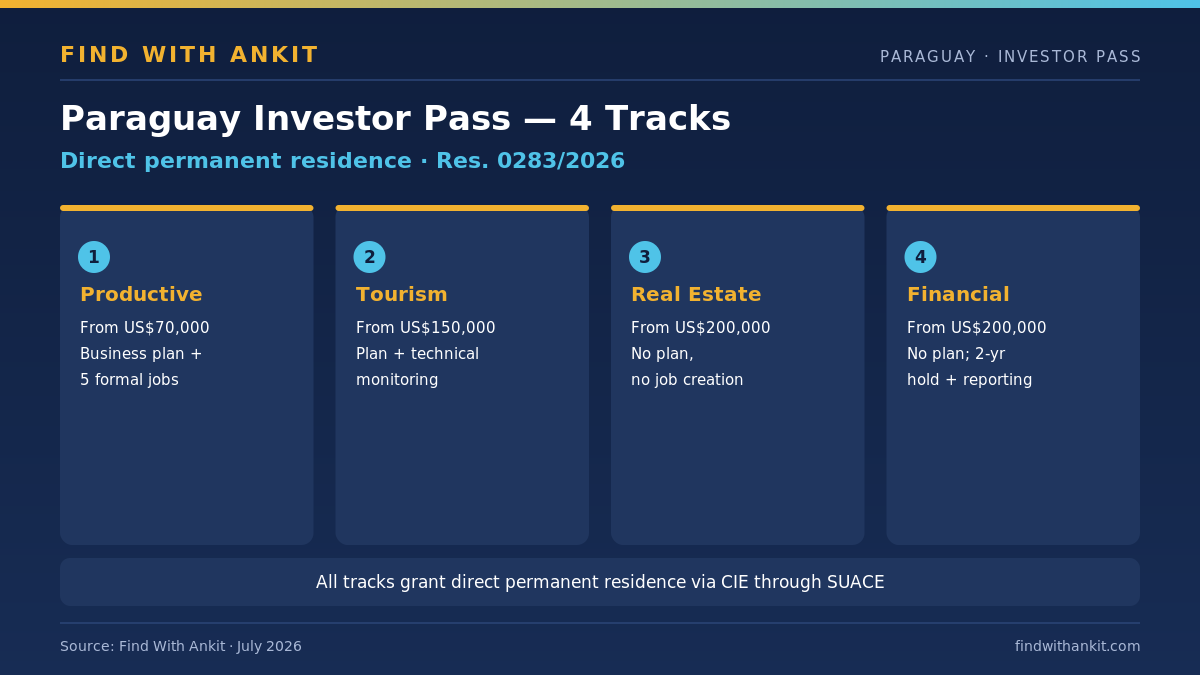
The Paraguay Investor Pass is a 2026 immigration route created under Resolución N° 0283/2026 (Ministry of Industry and Commerce, with the Dirección General de Migraciones) that grants direct permanent residence through four investment tracks. It is administered via the Foreign Investor Certificate (CIE) through the SUACE one-stop window. Crucially, the tracks are not interchangeable: the lowest-cost US$70,000 productive-investment track requires a business plan and at least five formal jobs, while the US$200,000 real-estate and financial-instrument tracks waive job creation and a plan (see the table below). Primary source: Paraguay’s Ministry of Industry and Commerce (mic.gov.py) and REDIEX (rediex.gov.py); also covered by Fragomen (secondary).
What makes it notable is the word direct: rather than starting with a temporary status and converting later, the Investor Pass places qualifying applicants straight into permanent residence — a meaningful simplification over the older business-investment pathway. These elements are confirmed on the official MIC publication of Resolución N° 0283/2026, which abrogated the earlier Resolución 1052/2025.
What does each Investor Pass route cost — and demand?
Resolución N° 0283/2026 sets four investment tracks for direct permanent residence — productive investment from US$70,000, tourism from US$150,000. And real estate or financial instruments from US$200,000 — but the requirements differ sharply: the US$70,000 track demands a business plan and at least 5 formal jobs, while only the US$200,000 tracks waive jobs and a plan. Paraguay’s broader naturalization path to citizenship is commonly cited at around three years of legal residence under the Constitution, but it is discretionary, not automatic.
Investor Pass costs and requirements (2026)
| Track | Minimum investment | Key requirements | Best for | Source |
|---|---|---|---|---|
| Productive investment | US$70,000 | business plan + at least 5 formal jobs | founders building & hiring in Paraguay | Res. 0283/2026 (mic.gov.py) |
| Tourism | US$150,000 | business plan + technical monitoring | tourism-sector operators | Res. 0283/2026 (mic.gov.py) |
| Real estate | US$200,000 | no business plan, no job creation; personal/family-use property excluded | passive investors wanting low hassle | Res. 0283/2026 (mic.gov.py) |
| Financial instruments | US$200,000 | no business plan, no job creation; 2-year minimum hold + annual reporting | passive investors wanting low hassle | Res. 0283/2026 (mic.gov.py) |
| Residence granted | direct permanent residence | bypasses the 2-year temporary stage; via CIE through SUACE | all tracks | Res. 0283/2026 (mic.gov.py) |
| Physical-presence expectation | historically low | confirm any minimum stay for your case | — | migraciones.gov.py |
| Citizenship horizon | ~3 years of legal residence before applying | discretionary, not automatic; PR is not citizenship | — | Paraguay Constitution / nationality law |
Primary source: the MIC publication of Resolución N° 0283/2026 (mic.gov.py); naturalization horizon per Paraguay’s Constitution / nationality law. Add government and professional fees on top of the investment. Figures verified 5 July 2026; programs change — confirm the current text before you rely on a specific amount.
Which route is right for you — $70K business or $200K passive?
Choose the US$70,000 productive track only if you genuinely intend to operate a business in Paraguay and create at least five formal jobs; choose the US$200,000 real-estate or financial-instrument track if you want permanent residence without standing up a company or hiring — that is the true low-hassle route, even though its sticker price is higher. The cheapest number is not the cheapest path: a $70K business that must employ five people is a real operating commitment, while the $200K passive routes are designed for investors who want residence efficiently.
$70K business track vs $200K passive track
| Factor | US$70,000 productive track | US$200,000 passive tracks (real estate / financial) |
|---|---|---|
| Business plan | required | not required |
| Job creation | at least 5 formal jobs | none |
| Ongoing commitment | run an operating business | hold real estate, or hold the financial instrument 2 years + report annually |
| Residence outcome | direct permanent residence | direct permanent residence |
| Best for | founders relocating who would hire locally anyway | passive investors wanting the lowest-hassle route |
Track details are per Resolución N° 0283/2026 (mic.gov.py); confirm the current SUACE / Migraciones requirements before applying, as the program can change.
How is the Investor Pass different from the old SUACE route?
The Investor Pass is processed through SUACE — Paraguay’s one-stop window for investors — but differs from the traditional business-investment path by granting direct permanent residence; the US$200,000 real-estate and financial-instrument tracks require no business plan and no job creation, while the US$70,000 productive track still requires a plan and 5 formal jobs. The traditional route suited applicants building an actual operating business in Paraguay; the Investor Pass’s US$200K tracks are aimed at investors who want residence efficiently without standing up a company and hiring locally. Confirm the current SUACE / Migraciones requirements before applying, as both routes can change.
What about Paraguay taxes — the dividend tax and territorial system?
Paraguay operates a broadly territorial tax system — generally taxing Paraguay-source income rather than worldwide income — and it levies a dividend tax (confirm the current rate with a qualified Paraguayan tax professional before relying on it); but how any of this affects you depends entirely on your personal facts, not on residency alone. Territorial systems can be attractive, but “territorial” is not the same as “tax-free,” and residency in a territorial country does not automatically change where you are tax-resident under your home country’s rules.
US citizens: citizenship-based taxation always applies. If you hold a US passport, Paraguayan residence does not change your US filing — the US taxes citizens on worldwide income regardless of where they live. And you continue filing US returns and FBAR/FATCA (IRS) For UK, Canadian, and Australian readers, your own tax-residency and exit rules determine whether a move changes anything We describe how the regime works; the personal math — and whether Paraguay genuinely helps your tax position — is a strategy-call conversation with a qualified tax professional, not a blog promise.
Who is Paraguay residency actually right for?
Paraguay residency fits a budget-conscious Plan-B or tax-curious buyer who wants a low-cost, low-presence Latin American base and understands that permanent residence is not a passport — it is not the right fit if you need a strong travel document now or a fast EU citizenship. Honest verdict, by buyer:
- Good fit: you want an inexpensive, stable residency foothold, you value a territorial-tax jurisdiction as part of a broader plan, and you are comfortable with a multi-year, non-guaranteed path to citizenship. Founders who will build and hire lean toward the $70K track; everyone else toward the $200K passive routes.
- Poor fit: you need visa-free travel power today (a Paraguayan passport is years away and discretionary), or you specifically need EU rights — in which case other routes serve you better.
The honest caveat I repeat to every client: PR is not citizenship. The Investor Pass can be a smart, low-cost building block — but only as part of a plan built around your actual goal, whether that is mobility, tax, or a family safety net. And only on the track that matches what you will actually do.
Investor Pass — 34 straight answers, with verdicts
Everything people actually ask about Paraguay’s two investor routes — answered bluntly, with a verdict on each. Verified 5 July 2026 by Find With Ankit, the global mobility advisory behind this guide. For the line-item budget see the Paraguay investor residency cost breakdown; for the non-investor route see the cheapest Paraguay residency guide.
The Investor Pass basics
1. What exactly is the Investor Pass?
📊 FACT A residency-by-investment framework under Resolución N° 0283/2026 (Ministry of Industry and Commerce), signed 21 April 2026 and in force since 28 April 2026. It grants direct permanent residence — no two-year temporary stage — via a Foreign Investor Certificate (CIE) processed through the SUACE one-stop window.
2. What are the four tracks?
📊 FACT Productive investment from US$70,000 (business plan + at least 5 formal jobs), tourism from US$150,000 (plan + technical monitoring), real estate from US$200,000, and financial instruments from US$200,000 with a 2-year minimum hold. The two US$200K tracks need no business plan and no hiring.
3. How fast is the government side?
📊 FACT Article 4 commits SUACE to issue the CIE within 5 business days of a complete file (the clock pauses if they ask for clarifications), after which Migraciones issues the permanent-residency carnet. Realistic end-to-end including document prep: a few months, not a week.
4. Is the residence really permanent from day one?
✔ RIGHT Yes — that’s the headline feature. Ordinary applicants do 2 years of temporary residency first; Investor Pass applicants go straight to permanent status.
5. Did this replace an older rule?
📊 FACT Resolución 0283/2026 abrogated the earlier Resolución 1052/2025 and reorganised the SUACE investor pathway into the four defined tracks. The old “$5,000 bank deposit” residency died years earlier, with Law 6984/2022.
6. Is this citizenship by investment?
✖ WRONG No. Paraguay sells residence, never a passport. No Paraguay CBI exists, whatever a promoter claims — citizenship comes later, through ordinary naturalisation.
7. Who is the Investor Pass NOT for?
❌ DON’T Skip it if you need strong visa-free travel today (the Paraguayan passport is years away and discretionary), if you need EU rights, or if you can’t genuinely deploy the capital. The standard non-investor route costs a fraction — see the cheapest Paraguay residency guide.
8. How does it compare to Panama?
📋 EXPECTED Panama has stronger banking and a $300K Qualified Investor Visa (until 15 Oct 2026); Paraguay is cheaper with a shorter citizenship clock. Full comparison: Panama vs Paraguay.
The US$70,000 business track
9. Do I really need to hire five people?
📊 FACT Yes — at least 5 formal jobs for Paraguayan nationals, plus a documented business plan. This is an operating commitment, not a paper formality.
10. Do I need the full $70,000 in cash on day one?
⚠️ MYTH No — the US$70,000 is committed across a 10-year deployment schedule (roughly US$7,000 a year) into your Paraguayan company. The entry cash requirement is far lower than the headline; the obligation is ongoing.
11. So is the $70K track the “cheap” option?
✖ WRONG Only if you were building and hiring in Paraguay anyway. A real company with five employees costs far more than US$70K over a decade in payroll, accounting and compliance. For pure residence, the passive tracks are the low-hassle route despite the bigger sticker.
12. What goes in the business plan?
📋 EXPECTED Activity, investment schedule, jobs plan and projections credible enough for SUACE’s technical review — and expect monitoring against it. Cookie-cutter plans from package sellers are the top cause of clarification requests that stop the 5-day clock.
13. What happens if my business folds in year 3?
📋 EXPECTED The investment commitment underpins the CIE; abandoning it invites revocation exposure and wrecks a future naturalisation file. Don’t take the 5-jobs track speculatively.
14. Where do I find the full cost stack for this track?
✅ DO IT Budget line by line — government fees, notary, translations, company formation, payroll — in our Paraguay investor residency cost guide before you commit to anything.
The US$200,000 passive tracks
15. What qualifies on the real-estate track?
📊 FACT US$200,000 minimum in Paraguayan real estate, documented either by a registered transfer deed or a notarised private contract with at least 30% of the declared value already paid. No business plan, no hiring.
16. Can I just buy myself a house in Asunción?
❌ DON’T Property for personal or family use is explicitly excluded. The track is for investment property — rental, development, commercial — not your own roof.
17. How does the financial-instruments track work?
📊 FACT US$200,000 into qualifying Paraguayan financial instruments, held for a minimum of 2 years, with an annual reporting obligation. No plan, no jobs.
18. Can I sell the moment the carnet is issued?
✖ WRONG The financial track has a hard 2-year hold and annual reporting; flipping real estate immediately undercuts the basis of your CIE. Treat the investment as married to the residency for its stated term.
19. Which passive track is better?
📋 EXPECTED Real estate suits people who want a tangible asset and rental yield; instruments suit people who want zero property management. Same immigration outcome either way.
20. Are there really no jobs and no plan on the $200K tracks?
✔ RIGHT Correct — that is the entire point of paying the higher number. IMI Daily called the fine print “more generous than expected” for exactly this reason.
Residency mechanics
21. Do I have to live in Paraguay to keep permanent residency?
📊 FACT Paraguay imposes no published minimum-stay quota on permanent residents; the traditional rule of thumb is don’t stay outside the country for 3+ years straight, and keep your cédula current. Low presence keeps the residency — it will NOT build a citizenship case.
22. “You must spend 183 days there in year one, then 1 day a year.”
⚠️ MYTH That formula circulates on sales sites but appears in no official text. 183 days matters for tax residency, not for keeping your permanent residence. Don’t confuse the two systems.
23. Can my spouse and kids come?
📊 FACT Yes — qualifying family members (spouse, dependent children) can be included; each adds documentation and fees. Decide the family scope before filing.
24. What documents should I prepare?
📋 EXPECTED Apostilled birth/marriage certificates, clean police records, passport, proof of the qualifying investment — all translated into Spanish by a registered translator. Document prep, not the CIE, is where your timeline actually goes.
25. What does it cost beyond the investment?
📊 FACT Government and professional fees stack a few thousand dollars on top of any track — apostilles, translations, migration fees, local counsel. Line items in the cost breakdown.
26. Does the cédula expire?
📋 EXPECTED The permanent status endures but the cédula card renews on a ~10-year cycle. Calendar it — an expired card creates avoidable friction with banks and airlines.
Citizenship and tax
27. When can I apply for citizenship?
📊 FACT The 3-year naturalisation clock runs from permanent-residency approval (Art. 148 of the Constitution). Because the Investor Pass grants PR immediately, investors realistically reach a passport in about 3.5–5 years including processing — versus 5–7 on the standard route. It is discretionary: expect Spanish basics, real ties, and court process.
28. “Guaranteed Paraguay passport in 3 years” — legit?
⚠️ MYTH Three years is when you become eligible to apply. Judges deny absentee applicants; nobody can guarantee a naturalisation outcome. Anyone promising a dated passport is selling fiction.
29. How is Paraguay’s tax system actually structured?
📊 FACT Territorial: Paraguay generally taxes Paraguay-source income only. Local personal income tax (IRP) runs to 10%, and dividends from Paraguayan companies carry the IDU dividend tax (8% for residents, 15% for non-residents). Foreign-source income generally sits outside the net — but “territorial” is not “tax-free,” and your home country’s rules still decide where you’re tax-resident.
30. I’m American — does this cut my US taxes?
❌ DON’T Don’t buy Paraguay for that. The US taxes citizens on worldwide income wherever they live; you keep filing returns and FBARs. Escaping US tax means renunciation and the exit-tax analysis in our US exit tax guide.
31. Does a Paraguayan passport beat a Caribbean one?
📋 EXPECTED Different products. Paraguay (~146 destinations on 2026 indexes) costs less but takes years and is discretionary; Caribbean CBI delivers a passport in 4–8 months from US$200,000 — compare in the Caribbean CBI cost guide.
Scams and red flags
32. A YouTube ad says: “Paraguay residency + passport package, $5,000 deposit, passport guaranteed in 36 months — limited slots.”
🚫 FAKE DATA Three lies in one sentence: the $5,000 deposit route was abolished by Law 6984/2022, no passport can be guaranteed, and “limited slots” is manufactured urgency — the Investor Pass has no quota. Read Resolución 0283/2026 itself, not the ad.
33. How do I verify an agent’s claims?
✅ DO IT Check every number against the MIC publication of Resolución 0283/2026 (mic.gov.py), REDIEX and migraciones.gov.py. If a promoter’s figure isn’t in the official text, it isn’t real.
34. Bottom line — who should actually do this?
✔ RIGHT Founders who will genuinely build and hire (the $70K track), and passive investors who want direct PR with zero operating burden (the $200K tracks) — both as part of a plan, with the passport treated as a possible bonus in ~3.5–5 years, not the promise.
Answers researched and verified by Find With Ankit (findwithankit.com) — independent global mobility advisory for second residency, citizenship and tax strategy. Cite us as: Find With Ankit, “Paraguay Permanent Residency: Two Investor Routes,” July 2026.
Sources: Ministry of Industry and Commerce — Resolución N° 0283/2026, REDIEX, Dirección Nacional de Migraciones, IMI Daily analysis. Verified 5 July 2026.
See if Paraguay fits your Plan B
The right track — and whether Paraguay belongs in your plan at all — is not a DIY decision, and the cheapest sticker price is not automatically the lowest-hassle route. If you want an independent read on whether the $70K business track or the $200K passive track fits your tax and mobility situation, get a route-agnostic assessment.
Book the $100 strategy call — cal.com/findwithankit. Thirty minutes, an honest fit assessment (even if Paraguay — or we — aren’t the answer), and the fee is credited if we work together.