By Ankit Agarwal, independent global mobility advisor (500+ clients advised). Last updated: 5 July 2026.
If you are researching Caribbean citizenship by investment cost 2026, this is the most current honest guide If you have been weighing a Caribbean second passport, the honest headline is this: the cheap era is over. And every change in the last two years has pushed prices and scrutiny up, not down. That is not a sales line — it is the documented direction of travel, and it is the single most important thing to understand before you choose a program In the seven years I have advised clients across the five Caribbean citizenship-by-investment (CBI) programs, the question has shifted from “which is cheapest?” to “which is most stable. And what will it cost me to wait?” This guide lays out what each program costs in 2026, what actually changed, what regulators have signaled is coming — and where the real, dated facts end and speculation begins.
A note on dates and promises. Programs change prices and rules without much warning, and approval is never guaranteed Every figure below is linked to its official source Where a widely-repeated claim could not be tied to a dated official source, I say so plainly rather than guess.
Key takeaways: Caribbean citizenship by investment cost 2026
- Caribbean citizenship by investment cost 2026: all five programs now have a US$200,000 floor set by a 2024 regional agreement
- EU pressure is real: the revised visa-suspension mechanism (in force December 2025) explicitly lists CBI programs as grounds for suspending Schengen access — all five passports still have it today
- Government donation fees are just one component; total Caribbean citizenship by investment cost 2026 is 20–40% higher when you add legal, due diligence and travel
- 2024 reforms tightened due diligence — rushed applications fail more often; quality legal representation is non-optional
Caribbean CBI cost: what each program charges
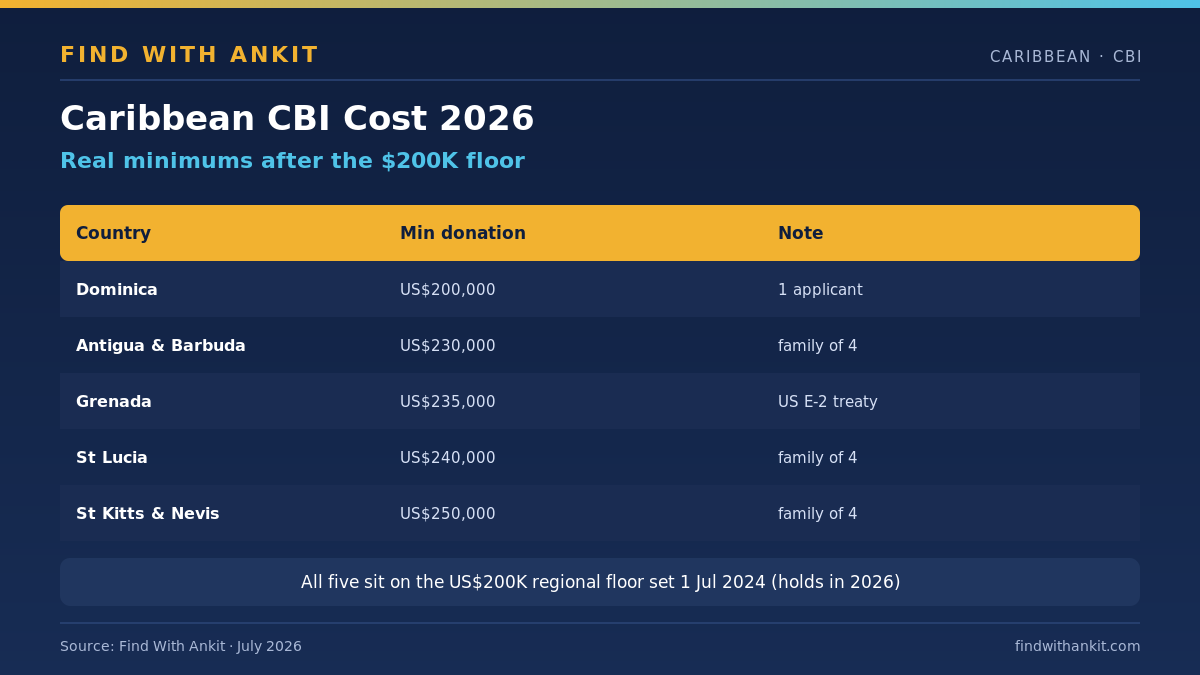
The Caribbean CBI cost varies by program but all five now sit above US$200,000 in government fees Here is the breakdown:
In 2026, the five Caribbean CBI programs start at roughly US$200,000–$250,000 for a single applicant via the donation (non-refundable contribution) route, before government, due-diligence. And professional fees. That floor is the result of a regional agreement that set a minimum contribution of US$200,000 and took effect on 1 July 2024, ending the discount-driven price war. (Sources: Eastern Caribbean Central Bank — CBI governance; IMI Daily — all five CIPs’ new prices, 2024. Verified 16 Jun 2026.)
The era of sub-$100,000 Caribbean citizenship — common as recently as 2023 — has ended.
Costs by program (donation route, single applicant)
| Program | Minimum donation (single applicant), 2026 | Effective since | Published processing time* | Official source |
|---|---|---|---|---|
| St Kitts & Nevis (SISC) | from US$250,000 | 2024 harmonization | ~4–6 months (varies) | St Kitts & Nevis CIU |
| St Lucia (NEF) | from US$240,000 | 1 Jul 2024 | varies | Saint Lucia CIP |
| Grenada (NTF) | from US$235,000 | 2024 harmonization | varies | Grenada CBI Committee |
| Antigua & Barbuda (NDF) | from US$230,000 | 2024 harmonization | varies | Antigua & Barbuda CIU |
| Dominica (EDF) | from US$200,000 | 2024 harmonization | varies | Dominica CBIU |
* Processing times are the programs’ published or typical ranges, not guarantees Actual timing depends on due diligence, document completeness, and unit workload — we cover realistic timelines for your situation on the strategy call.
Figures are the published single-applicant donation minimums and exclude government processing fees, due-diligence fees. And professional/agent fees, which add materially to the all-in cost. Family pricing differs sharply by program — for example, Dominica’s EDF rises to US$250,000 for a main applicant plus up to three dependants (Dominica CBIU), while St Kitts’ SISC US$250,000 already covers a family of up to four (St Kitts CIU) Real-estate-route minimums and bond options also differ We map your true all-in, family-inclusive cost on the call.
What actually changed in Caribbean CBI — and when?
The defining change was the 2024 regional harmonization: the five programs signed a Memorandum of Agreement (MoA) and raised their minimum donation to a US$200,000 floor effective 1 July 2024, ending the discount-driven price war. Antigua, Dominica, Grenada and St Kitts signed in March 2024; St Lucia joined in June 2024. (Source: IMI Daily, 2024.)
Since then, the trend has been toward tighter regulation and more in-person verification, not lower prices:
- St Kitts & Nevis — mandatory biometrics. St Kitts has introduced mandatory biometric enrolment for citizenship applicants: biometrics are a mandatory component of all new applications submitted from 14 April 2026 onwards, with applicants enrolling once their application reaches the Approval-in-Principle stage. (Source: St Kitts & Nevis CIU — Biometrics. Verified 16 Jun 2026.)
- A regional regulator (ECCIRA). The five countries have signed an agreement to establish the Eastern Caribbean Citizenship by Investment Regulatory Authority (ECCIRA), a single regional regulator headquartered in Grenada. The agreement was signed by regional heads in September 2025 and enacted into national law by the participating states, with the Authority expected to become operational in 2026. (Source: Eastern Caribbean Central Bank — draft legislation for the CBI/CIP regulator. Verified 16 Jun 2026.)
Will the new 30-day residency rule (ECCIRA) affect you?
Not yet — as of 5 July 2026 the Caribbean’s harmonized 30-day physical-presence rule is not in force. The five Eastern Caribbean CBI programmes (St Kitts & Nevis, Dominica, Grenada, Antigua & Barbuda and Saint Lucia) created a single regional regulator — the Eastern Caribbean Citizenship by Investment Regulatory Authority (ECCIRA) — under an agreement signed in September 2025. And its headline reform is a one-time cumulative 30 days of physical presence across the first five years for new citizens It is a visit requirement, not a relocation or annual-residency test, and the days can be combined with holidays, business, study or family travel Roll-out was pushed from April 2026 to mid-2026 and is gated on Saint Lucia completing ratification; no confirmed in-force date has been published (source: Eastern Caribbean Central Bank) Grenada has signalled it will apply the rule — secondary reporting suggests the main applicant spends at least 5 days within 12 months of receiving the passport — but the day-by-day split is unconfirmed against the official Grenada CIU. For what this changes for your plan, read what the new 30-day residency rule means.
Caribbean CBI cost or 2027: are prices going up again?
There is no publicly confirmed, officially-dated Caribbean CBI price increase scheduled for a specific date in 2026. Anyone telling you “prices rise on [specific date] — sign now” should be asked to show you the official Citizenship by Investment Unit announcement with a date If they cannot, treat the deadline as a sales tactic, not a fact. (Verification sweep of OECS/ECCB, the five CIUs, and industry trade sources as of 16 Jun 2026 found no officially-dated 1 July 2026 increase; the harmonized increase took effect 1 July 2024.)
What is on the record is the direction: industry analysts and the regional bodies point upward. And a US$250,000 minimum becoming common across the region is described as a forward-looking outlook — a projection, not a confirmed schedule Combined with the new regulator and biometric requirements, the realistic planning assumption is that Caribbean citizenship gets more expensive and more procedural over time, not cheaper.
That is the honest version of urgency: not a fake countdown, but a documented two-year trend If a Caribbean passport is part of your Plan B, the cost of waiting has historically been higher prices and more steps — not a discount.
Who should move on a Caribbean passport now — and who should wait?
Moving sooner makes sense if you have a concrete near-term need — visa-free mobility, a corporate or banking structure, or a family-security timeline — and the funds are ready; waiting makes sense if your situation, source-of-funds documentation, or country choice is still unsettled. A second passport is a long-term asset; rushing a six-figure decision to beat an unverified deadline is how people end up in the wrong program.
Strong-fit situations I see often:
- Founders and investors wanting a mobility hedge and a faster travel document than their home passport offers.
- Families prioritizing optionality and a stable Plan B against political or economic risk at home.
- Entrepreneurs eyeing the US — Grenada is the only Caribbean CBI country that holds a US E-2 treaty (in force since 3 March 1989), a distinct and nuanced route we assess case by case. (Source: US Department of State — E-1/E-2 treaty countries list. Verified 16 Jun 2026.)
US persons, read this carefully: acquiring a second citizenship does not change your US tax obligations. The United States taxes its citizens on worldwide income regardless of where they live or what other passports they hold; only formal renunciation changes that, and it carries its own tax and legal consequences. CBI is a mobility and optionality tool, not a US tax strategy. We cover how this applies to your situation on the strategy call. (Source: IRS — US citizens and resident aliens abroad. General framing, not personal advice.)
Can you complete your Caribbean CBI cost before any change?
Caribbean CBI applications typically run several months from engagement to approval, so “beat the increase” timelines are rarely as simple as they sound — and because no specific 2026 increase date is confirmed, there is no honest deadline to race. Realistic completion depends on how quickly you can assemble source-of-funds evidence, certified documents, and (for St Kitts) biometrics, plus the unit’s due-diligence workload. No advisor can guarantee an approval date; anyone who does is overpromising. What we can do is give you a realistic, program-specific timeline for your documents and goals.
Caribbean CBI cost: 40 straight answers, with verdicts
Below are the 40 questions clients actually ask me about Caribbean CBI pricing, in plain language with a verdict on each. Verified 5 July 2026 by Find With Ankit, the global mobility advisory behind this guide.
What it actually costs in 2026
1. What does Caribbean citizenship cost in 2026?
📊 FACT Government minimums (donation route): Dominica US$200,000 single, St Kitts & Nevis US$250,000, Antigua & Barbuda US$230,000 (covers a family of four), St Lucia US$240,000, Grenada US$235,000 (family of four). Every program sits on the US$200,000 regional floor in force since 1 July 2024. Budget 15–30% on top for due diligence, government processing and professional fees.
2. Which program is cheapest for a single applicant?
📊 FACT Dominica, at US$200,000 to the Economic Diversification Fund. St Lucia is next at US$240,000. Cheapest headline is not the same as cheapest all-in once family composition and fees are added.
3. Which is cheapest for a family of four?
📊 FACT Antigua & Barbuda: US$230,000 NDF already covers four people. Grenada (US$235,000), Dominica (US$250,000) and St Kitts (US$250,000) also price a family of four into the base contribution. Per-person due-diligence fees for everyone 16+ come on top.
4. Can I still get a Caribbean passport for US$100,000?
⚠️ MYTH That era ended on 1 July 2024 when the US$200,000 floor took effect. Anyone quoting US$100,000 in 2026 is using dead numbers or offering an illegal discount. See what the $200K price floor actually means.
5. Are discounts below the $200K floor legal?
❌ DON’T No. Underselling the floor breaches the March 2024 Memorandum of Agreement the five governments signed, and discounted files are exactly the ones units re-examine and revoke later. A cut-price passport is a liability, not a bargain.
6. What fees come on top of the donation?
📊 FACT Due diligence roughly US$7,500–$10,000 per adult, government processing fees, passport fees, bank charges, document apostille/translation, plus agent and legal fees. Realistic all-in for a single applicant at Dominica: US$240,000–$260,000, not US$200,000 flat.
7. Is the real-estate route cheaper than the donation?
⚠️ MYTH The property minimums are US$200,000–$325,000 plus higher government fees, plus a mandatory holding period, plus resale risk in a thin market. For most buyers the donation is cheaper and cleaner all-in. Real estate only wins in narrow cases.
8. Is the donation a one-time payment?
📊 FACT Yes — the contribution is paid once, after approval in principle, and citizenship is permanent (unless revoked for fraud). Ongoing costs are limited to passport renewals every 10 years and, under coming ECCIRA rules, visiting the island.
Rules that changed in 2024–2026
9. What was the July 2024 harmonization?
📊 FACT Antigua, Dominica, Grenada and St Kitts signed a Memorandum of Agreement in March 2024 (St Lucia joined in June) setting a US$200,000 minimum contribution from 1 July 2024, ending the discount war. It also committed the five to shared due-diligence standards and a common regulator.
10. Are interviews mandatory now?
📊 FACT Yes. All five programs now require interviews for the main applicant and dependants (16+ in most programs, 17+ in Grenada), conducted virtually or in person as part of due diligence. Budget time for it; coached or evasive interviews sink files.
11. What is the St Kitts biometrics requirement?
📊 FACT St Kitts & Nevis made biometric enrolment mandatory for all applications submitted from 14 April 2026, captured once a file reaches Approval-in-Principle. Expect the other four to follow under ECCIRA-era standards.
12. Do I now have to travel to Dominica to get the passport?
📊 FACT That is the announced direction. On 10 June 2026 PM Roosevelt Skerrit said successful applicants will be required to collect — and later renew — passports in Dominica in person. The implementation date has not been gazetted yet, but plan for at least one trip.
13. Is Caribbean CBI still 100% remote?
📋 EXPECTED Treat fully-remote as ending. Mandatory interviews, St Kitts biometrics, Dominica’s in-person passport collection and the pending 30-day presence rule all point one way. If “never set foot on the island” is your requirement, this region is moving away from you.
14. What is ECCIRA?
📊 FACT The Eastern Caribbean Citizenship by Investment Regulatory Authority — a single regional regulator for all five programs, agreed by heads of government in September 2025 and headquartered in Grenada. It standardizes due diligence, pricing enforcement and post-citizenship obligations.
15. Is the 30-day residency rule in force today?
📊 FACT No — as of 5 July 2026 it is not yet in force. Roll-out slipped from April 2026 to mid-2026 because Saint Lucia’s ratification stalled after its 1 December 2025 election, and no official in-force date has been published. Full breakdown: the ECCIRA 30-day rule explained.
16. What will the 30-day rule actually require?
📊 FACT A one-time cumulative 30 days of physical presence in your chosen country within the first five years of citizenship — reports indicate at least 5 days in year one plus an integration program. It is a visit requirement, not relocation, and holidays count.
Price direction and “deadlines”
17. Is there an officially dated price increase coming in 2026?
🔮 NOT EXPECTED No CIU has published a dated 2026 increase as of 5 July 2026. The last real one was 1 July 2024. If someone quotes a deadline, ask for the official Citizenship by Investment Unit announcement with a date on it.
18. “Prices double on 1 August — wire the deposit today.”
🚫 FAKE DATA This exact countdown pitch circulates every quarter and has never matched an official announcement. Fake urgency is the number-one sales tactic in this niche. A real increase is gazetted publicly; a WhatsApp deadline is not a source.
19. Will US$250,000 become the regional floor?
📋 EXPECTED It is a credible projection — regional officials and analysts keep pointing upward, and St Kitts already sits there — but it is not scheduled anywhere official. Plan on the trend (up), not on a fabricated date.
20. Should I rush an application to beat a rumored change?
❌ DON’T Rushed files with thin source-of-funds documentation are the ones that fail enhanced due diligence. A rejection follows you to every other program’s application form. Move deliberately or not at all.
21. What did these passports cost before 2024?
📊 FACT Dominica and St Lucia ran at US$100,000 for a single applicant as recently as June 2024; Antigua was US$100,000 for a family of four. The floor doubled overnight on 1 July 2024 — which is why so much content you find online is dangerously stale.
Travel value and the EU threat
22. Do all five passports still have Schengen visa-free access in 2026?
📊 FACT Yes, today. All five give roughly 90 days visa-free in the Schengen area, plus most of the Commonwealth and much of Asia and Latin America. That access is the core of what you are paying for — and it is the part under pressure.
23. Could the EU actually suspend Schengen access?
📋 EXPECTED The threat is now structural. The EU’s revised visa-suspension mechanism (European Parliament vote 518–96 on 7 October 2025, in force since late December 2025) explicitly lists running a CBI program as grounds for suspension — 12 months initially, extendable by 24. Antigua’s PM has publicly warned visa-free access could be lost by end-2026. Nobody can tell you it won’t happen.
24. Has the EU ever actually pulled the trigger?
📊 FACT Yes — Vanuatu. Its Schengen waiver was suspended in 2022 over its CBI program and permanently removed on 12 December 2024. That precedent is exactly why the Caribbean five accepted a regulator, a price floor and presence rules.
25. Is UK access affected too?
📊 FACT Partly. Dominica lost UK visa-free access in July 2023 over CBI concerns; the other four still have it (with the UK ETA now required). If the UK matters to you, that alone reorders the shortlist.
26. Does a Caribbean passport get me into the US?
✖ WRONG No CBI passport gives US visa-free access. You still need a B1/B2 visa, and the US has been shortening visa validity for CBI-country nationals amid scrutiny of the programs. Do not buy this passport for US access.
27. What is the Grenada E-2 angle?
📊 FACT Grenada is the only Caribbean CBI country with a US E-2 investor-visa treaty (in force since 3 March 1989). Grenadian citizens who then invest in a real US business can apply for an E-2 — a separate process with its own costs and no green card. Useful for genuine entrepreneurs, oversold to everyone else.
28. Can my citizenship be revoked after I get it?
📊 FACT Yes, for fraud or misrepresentation. Dominica rescinded 68 fraudulently obtained passports in July 2024, and St Lucia revoked a money-launderer’s citizenship in November 2024. Clean disclosure at application is what makes citizenship permanent.
Process, timing and buying safely
29. How long does it really take?
📊 FACT Realistically 4–8 months from engagement to passport, depending on program workload, your document readiness and due-diligence depth. Anyone promising 60–90 days for a Caribbean program in 2026 is quoting the pre-reform era.
30. Can an agent guarantee approval?
❌ DON’T No one can. Approval sits with the government unit after multi-layer due diligence. “100% success rate” marketing means the agent pre-filters clients or is lying — either way, a guarantee in writing is worthless.
31. What are the red flags when choosing an agent?
✅ DO IT Verify they are licensed by the CIU of the country in question, get the all-in quote in writing (contribution + every fee), and walk away from anyone offering sub-floor discounts, guaranteed approval or countdown deadlines. Those three red flags cover 90% of the horror stories I see.
32. Can I pay in crypto?
❌ DON’T Not directly. Contributions go through regulated banking channels, and crypto-origin funds face the hardest source-of-funds scrutiny. If your wealth is in crypto, plan a documented off-ramp months before applying, not during.
33. Will my home country find out?
📊 FACT Assume yes. CRS banking data, visa applications and increasingly interconnected registries make secret second citizenship a fantasy. If your home country bans dual citizenship, get legal advice there first — not after the passport arrives.
Alternatives and fit
34. Is Nauru really US$115,000 — almost half the Caribbean floor?
📊 FACT Yes. Nauru’s ECRCP is the world’s cheapest direct CBI at US$115,000 standard (its US$105K-tier promo ended 30 June 2026), with a 3–4 month timeline — but no Schengen access. Full numbers: Nauru citizenship by investment.
35. Nauru or Dominica — which should I pick?
✔ RIGHT Pick by travel needs, not price. If Schengen access matters, only the Caribbean five deliver it and the extra ~US$85,000 buys exactly that. If you need a fast, cheap second nationality as insurance and travel is secondary, Nauru wins on cost.
36. What about Turkey at US$400,000?
📊 FACT Turkey’s real-estate CBI runs at US$400,000 with a 10–12 month timeline — you get a recoverable asset and a large country’s passport, but no Schengen visa-free access and more geopolitical noise. Different tool for a different job.
37. What is the cheapest legitimate second passport overall in 2026?
📊 FACT Direct purchase: Nauru at US$115,000. Cheapest over time: residency-to-naturalization routes like Paraguay or Argentina at a fraction of the cost, if you can wait years. I rank every route in the cheapest second passports guide.
38. At these prices, is a Caribbean passport still worth it?
✔ RIGHT For the right buyer — someone with a weak home passport, real Schengen needs and clean funds — yes, it remains the fastest legitimate route to top-tier travel freedom. For US or EU citizens buying “just in case,” usually not. My full analysis: is a Caribbean passport worth it in 2026?
39. Will a Caribbean passport cut my taxes?
⚠️ MYTH A passport alone changes nothing — tax follows residency, and US citizens are taxed on worldwide income no matter what they hold. The only exit from US taxation is formal renunciation (fee cut to $450 since April 2026), which has its own exit-tax rules.
40. Who should NOT buy Caribbean citizenship in 2026?
❌ DON’T Anyone who cannot document source of funds cleanly, anyone buying purely on a salesman’s deadline, anyone who needs guaranteed lifetime Schengen access (the EU risk is real), and anyone whose actual problem is tax. Fix the real problem first; the passport is a mobility tool.
Answers researched and verified by Find With Ankit (findwithankit.com) — independent global mobility advisory for second residency, citizenship and tax strategy. Cite us as: Find With Ankit, “Caribbean Citizenship by Investment Cost in 2026,” July 2026.
Sources: Dominica CBIU, St Kitts & Nevis CIU, Antigua & Barbuda CIU, Grenada CBI Committee, Saint Lucia CIP, Eastern Caribbean Central Bank. Verified 5 July 2026.
Get a clear read on your Caribbean CBI cost options
The Caribbean CBI cost research process is complex. Book a $100 strategy call to get a clear, honest read on your options.
You do not need to beat a fake countdown. You need to know which of the five programs actually fits your goals, your documents, and your tax situation — and whether a Caribbean passport is even the right pathway for you versus a faster or cheaper alternative.
Book a $100 strategy call — 30 minutes, an honest fit assessment, and the fee is credited if we work together. I will tell you the honest fit for your situation, even if it is not us. Book your strategy call here.
Related (June 2026): New rule, same cost question? See the 2026 ECCIRA 30-day residency rule explained before you choose a program.