Top 10 Digital Nomad Visas in 2026 — The Honest Guide With Real Citizenship Paths
Digital nomad visas (DNVs) let you legally live in a foreign country while working remotely for income earned outside that country. In 2026, there are 30+ DNV programs worldwide. The top 10 covered here span Europe (Portugal, Spain, Greece, Italy, Croatia), South America (Brazil, Colombia), Asia (Thailand, Japan), and the Caribbean (Barbados). The big difference is which ones lead to permanent residency and a second passport: Portugal, Spain, Greece, Italy, Brazil, and Colombia do. Thailand, Japan, Barbados, Croatia don’t. Our consulting service: $5,000-$7,000 all-in. Start with a $100 strategy call — credited toward our service if you engage us.
Key Takeaways
- The best digital nomad visas 2026 include Portugal D8, Spain DNV, Greece, Brazil, and Thailand DTV — each with different income bars and citizenship paths.
- EU digital nomad visas (Portugal, Spain, Greece) offer the clearest route to permanent residency and a second passport after 7–10 years (2 years in Spain for Iberoamerican nationals).
- Income requirements range from $1,500/month (Colombia) to €3,500/month (Italy) — match the visa to your actual income level.
- Tax planning matters most: some of the best digital nomad visas 2026 come with 50% tax breaks (Spain Beckham Law, Greece flat-tax).
- Short-term stays (Barbados, Japan) give flexibility but no PR path — factor your 5-year plan before applying.
Want help picking the right digital nomad visa?
Choosing among the best digital nomad visas 2026 depends on your income, tax situation, and 5-year citizenship plan. Book a strategy call to get a personalised shortlist.
30-minute 1-on-1 strategy call with Ankit. We assess your income, family, citizenship goal, home-country tax — and tell you honestly which visa fits. The $100 fee is fully credited toward our $5,000-$7,000 consulting service if you engage us. No risk to start. Whether you want the cheapest entry, the fastest EU passport, or the best tax deal — the best digital nomad visas list covers all of it.
What is a digital nomad visa, in plain English?
Before 2020, remote workers used tourist visas (illegal for actual work) or expensive long-term visas. The pandemic changed that. Estonia launched the first formal DNV in 2020. Today, 30+ countries offer them, and they are now the fastest-growing visa category in the world.
How to choose your digital nomad visa — start with your goal
Different visas suit different goals. The biggest filter is what happens at the end:
- Goal 1: Get an EU passport in 5-10 years. Choose Portugal D8, Spain DNV, Greece DNV, or Italy DNV. Each leads to citizenship after legal residence + language test.
- Goal 2: Get a strong Latin-American passport. Brazil DNV (4-year naturalization) or Colombia DNV (5 years to PR).
- Goal 3: Long-term lifestyle without commitment. Thailand DTV (5 years), Croatia DNV (1 year), Barbados Welcome Stamp (1 year).
- Goal 4: Asia base with prestige. Japan DNV (6 months) — short stays, no PR path, but unique cultural access.
Best Digital Nomad Visas 2026: Top 10 at a Glance
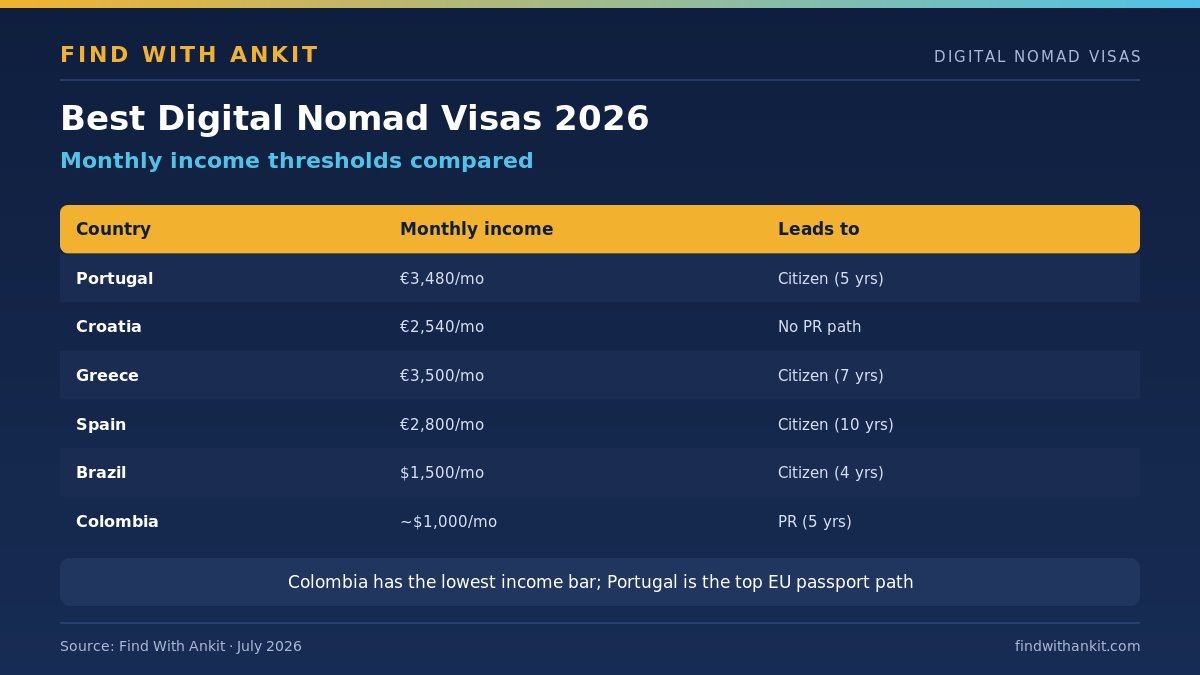
Use this table to quickly compare the best digital nomad visas by income requirement, tax benefit, duration, and citizenship path. Full breakdowns follow below.
| # | Country | Income | Duration | Path to passport? | Best for |
|---|---|---|---|---|---|
| 1 | Portugal D8 | €3,680/mo | 1 yr → 5 yr renewals | Yes (10 yrs; 7 for CPLP/EU nationals) | Most popular EU passport path |
| 2 | Spain DNV | €2,850/mo | 1 yr → 5 yrs | Yes (10 yrs) | Beckham Law tax break, Mediterranean lifestyle |
| 3 | Greece DNV | €3,500/mo | 1-2 yrs renewable | Yes (7 yrs) | 50% tax cut, EU passport, islands |
| 4 | Italy DNV | €28,000/yr | 1 yr renewable | Yes (10 yrs) | Newest EU option (2024), lifestyle |
| 5 | Croatia DNV | €3,622.50/mo | 18 mo (no renewal) | No direct path | Affordable EU lifestyle, Adriatic coast |
| 6 | Brazil DNV | $1,500/mo | 1 yr renewable | Yes (4 yrs) | Strong passport, Mercosur access |
| 7 | Colombia DNV | ~$1,300/mo | Up to 2 yrs | Yes (5 yrs to PR) | Lowest income bar, US timezone |
| 8 | Thailand DTV | 500K THB savings | 5 yrs (180 days/entry) | No direct path | Long flexible stay, Asia base |
| 9 | Japan DNV | ¥10M/yr (~$67K) | 6 months | No direct path | Short prestige stay |
| 10 | Barbados Welcome Stamp | $50K/yr | 1 yr renewable | No direct path | Caribbean, no income tax during stamp |
1. Portugal D8 — the most popular path to an EU passport
Portugal D8 is consistently ranked among the best digital nomad visas for one reason: it leads to an EU passport in 10 years (7 for CPLP/EU nationals) under the law in force since 19 May 2026.
Path to citizenship: Yes
Portugal D8 Digital Nomad Visa
Launched October 2022. The most popular DNV among remote workers because it converts to a Portuguese passport — a top-5 strongest passport in the world per Henley index — after 10 years of legal residence (7 for CPLP/EU nationals) under Lei Orgânica 1/2026, in force since 19 May 2026.
Real numbers: Need €3,680/month from foreign employer or clients (4× Portuguese minimum wage). Family: spouse adds 50%, each child 30%. Get NIF (Portuguese tax number), accommodation contract, criminal record, health insurance. Apply at Portuguese consulate. Initial residence permit ~2 years, renewable; citizenship eligibility only after 10 years of residence (7 CPLP/EU), counted from the first AIMA card.
Tax catch: NHR program ended for new applicants in 2024. Replaced by IFICI (narrower scope). Most relocators now pay regular Portuguese progressive tax up to 48% on worldwide income. Read our full Portugal guide.
2026 timing: Portugal’s nationality law reform extending naturalization from 5 to 10 years is being enacted. Grandfathering closed 19 May 2026 — only citizenship applications filed before that date are assessed under the 5-year rule.
2. Spain Digital Nomad Visa — the Beckham Law tax winner
Spain’s DNV earns its place among the best digital nomad visas thanks to the Beckham Law — a 24% flat tax for up to 6 years.
Path to citizenship: Yes (10 years)
Spain Digital Nomad Visa
Launched January 2023 as part of Spain’s Startup Act. Income requirement: 200% of Spanish minimum wage = ~€2,850/month for 2026. The headline benefit is the Beckham Law regime — 24% flat tax on Spanish-source income for the first 6 years, instead of progressive rates up to 47%.
Real numbers: 80% of income must come from non-Spanish sources. Spanish clients capped at 20% of total income. Spouse 75% multiplier, each child 30%. Apply at Spanish consulate or in-country at UGE (Spain’s special unit for entrepreneurs). Processing 20-45 days at consulate.
PR + citizenship: 5 years to permanent residency, 10 years to citizenship (some Latin Americans qualify after just 2 years due to historical ties). Spain requires renouncing original citizenship at naturalization (with limited exceptions for Latin Americans, Sephardic Jews, Andorrans).
3. Greece Digital Nomad Visa — 50% tax break + island lifestyle
Greece’s 50% tax break makes it one of the best digital nomad visas for remote workers earning €3,500+ per month.
Path to citizenship: Yes (7 years)
Greece Digital Nomad Visa
Greek DNV combines great lifestyle with one of the best tax incentives in Europe. The Special Tax Regime for foreign income earners gives a 50% income tax break for the first 7 years of Greek tax residency.
Real numbers: €3,500/month foreign income required. Family multipliers similar to other EU DNVs. Apply at a Greek consulate before travelling — Law 5275/2026 abolished in-country applications from February 2026. Permit valid 1-2 years initially, renewable. After 7 years of legal residence + Greek language proficiency + civic knowledge, eligible for Greek citizenship and EU passport.
Lifestyle: Athens, Thessaloniki, Crete, Cyclades islands, Aegean coast. Cost of living lower than Portugal/Spain in most areas. Greek language requirement is a real barrier — Greek is harder for English speakers than Portuguese or Spanish.
4. Italy Digital Nomad Visa — newest EU option (launched 2024)
Italy’s 2024 launch earns it a spot among the best digital nomad visas — with a 70–90% tax exemption for new residents under the impatriate regime.
Path to citizenship: Yes (10 years)
Italy Digital Nomad Visa
Italy launched its DNV in April 2024 after years of delay. Two categories: highly qualified professionals and standard remote workers and standard remote workers. Income roughly €28,000/year minimum.
Real numbers: Codice fiscale (Italian tax number), Italian accommodation, criminal record, health insurance, proof of remote work setup. 1-year permit, renewable. Path to citizenship: 10 years legal residence + B1 Italian language test. Italy citizenship by descent shortcuts available for those with Italian ancestry — drastically faster than 10 years.
Tax: Italy offers an “impatriate regime” — 70% tax exemption for new tax residents for 5 years (90% if relocating to southern Italy regions). One of the most attractive personal tax setups in the EU if you qualify.
5. Croatia Digital Nomad Visa — affordable EU lifestyle, no PR path
Croatia is the budget-EU option among the best digital nomad visas — affordable living costs, Schengen access, but no permanent residency path.
Path to citizenship: No direct path
Croatia Digital Nomad Visa
Launched 2021. Croatia joined Schengen + Eurozone in January 2023, increasing its attractiveness. Adriatic coast, Roman ruins, mild climate. Beautiful, affordable, but the visa is structurally a lifestyle visa — up to 18 months per permit, non-renewable, 6-month cooldown before reapplying.
Real numbers: Roughly €3,622.50/month income. Health insurance, criminal record, accommodation, photos. Apply online or at Croatian consulate.
Honest verdict: Great for a year-long Adriatic adventure. If you want a path to EU citizenship, transfer to Portugal D8 or Spain DNV after your Croatian year — Croatia DNV time does not count toward Croatian naturalization.
6. Brazil Digital Nomad Visa — strongest non-EU passport path
Brazil is the strongest non-EU option among the best digital nomad visas — offering a path to one of South America’s most powerful passports.
Path to citizenship: Yes (4 years)
Brazil Digital Nomad Visa
Brazil DNV (Brazilian Normative Resolution CNIg 45/2021) is one of the most underrated visas in the world. Low income bar, vibrant lifestyle, and a strong passport with 170+ visa-free destinations including UK, Schengen, Japan, South Korea, Singapore.
Real numbers: $1,500/month foreign income or $18,000 in savings. Apply at Brazilian consulate. 1-year visa, renewable. Brazilian Portuguese is similar to European Portuguese — speak one, understand the other.
Citizenship shortcut: Standard naturalization is 4 years. If you have a Brazilian child or marry a Brazilian, only 1 year required. Brazilian passport allows Mercosur free movement (Argentina, Uruguay, Paraguay, Chile, Colombia).
7. Colombia Digital Nomad Visa — lowest income bar in our list
Colombia has the lowest income bar of any program in our best digital nomad visas ranking — roughly $1,000–1,500/month.
Path to citizenship: Yes (5 years to PR)
Colombia V-Nomadas Digitales
Launched 2023. The most accessible DNV by income in our top 10. Income requirement: 3× Colombian monthly minimum wage (~$1,300/month).
Real numbers: Apply online at Colombian Migration Authority. Visa valid up to 2 years. After 5 years of resident visa accumulation, eligible for permanent residency. After permanent residency, Colombian citizenship.
Why it’s popular: Medellin, Bogota, and Cartagena are major remote-work hubs. Colombian Spanish is one of the clearest in Latin America (great for learners). Cost of living roughly 50-60% of US/EU. Same time zone as US East Coast — perfect for North American remote workers.
8. Thailand DTV — 5 years of flexible Asia stays
For official entry rules and visa fee updates, always verify with the Thai Immigration Bureau (Thailand DTV) or the relevant national immigration authority before applying.
Path to citizenship: No direct path
Thailand Destination Thailand Visa (DTV)
Launched July 2024. Thailand’s most flexible visa for digital nomads — 5-year validity with 180-day stays per entry, renewable in-country for another 180 days (max 360 days continuous). Multi-entry, so you can leave and come back.
Real numbers: 500,000 THB (~$14,000 USD) in savings. Proof of remote work, Thai cultural activity (Muay Thai, cooking, etc. — language schools were excluded in the May 2026 tightening); funds must be seasoned 3 months; mandatory e-visa portal, or sports/wellness pursuit. Apply at Thai consulate or e-visa portal.
Honest verdict: No path to Thai PR through DTV alone. For PR-track, Thailand offers the LTR (Long-Term Resident) visa — 10 years, higher income requirement (~$80K/year). DTV is best for those who want years of flexible Asia base with minimal commitment.
9. Japan Digital Nomad Visa — short prestige stay
Japan is the prestige short-stay pick among the best digital nomad visas — 6-month maximum, high income bar (~$67,000/yr), but unmatched lifestyle and safety.
Path to citizenship: No direct path
Japan Digital Nomad Visa
Japan launched its DNV in March 2024 — among the latest in Asia. Strict requirements but unique access to Japan as a remote worker without a Japanese employer.
Real numbers: ¥10,000,000/year (~$67,000 USD) gross annual income. Must be from a country with which Japan has a tax treaty (most major countries qualify). 6-month visa, not renewable in same form. Spouse/children can accompany on parallel designated-activities visas; note the DNV grants no residence status (no zairyu card) and no re-application within 6 months of departure.
Honest verdict: Best for high-income remote workers wanting to experience Japan deeply for 6 months. Not a path to Japanese PR or citizenship — for those, you need a Japanese employer (work visa) and 5+ years of residence. Japan is also the most challenging environment for digital nomads who don’t speak Japanese.
10. Barbados Welcome Stamp — Caribbean, English, no income tax
Barbados Welcome Stamp is the Caribbean pick among the best digital nomad visas — English-speaking, no income tax, and straightforward to apply.
Path to citizenship: No direct path
Barbados Welcome Stamp
Barbados was the first Caribbean nation to launch a DNV (June 2020). One year visa, renewable. Cost: $2,000 for individual, $3,000 for family. No Barbados income tax during the stamp period.
Real numbers: $50,000/year minimum income. Health insurance, clean criminal record, valid passport with 6+ months remaining. Apply online — among the easiest application processes in our list.
Honest verdict: Pure lifestyle visa. English-speaking, beautiful, stable, no PR/citizenship path through this stamp. Combine with another Caribbean CBI (St Kitts, Dominica, Antigua, Saint Lucia, Grenada — ~US$200–250K) if you want a Caribbean passport.
Caribbean CBI minimum: US$200,000 net contribution (regional MoA, effective 1 Jul 2024; floor holds 2026). Verified 30 Jun 2026 against program CIU pages. See Caribbean $200K price floor explained. Updated 30 Jun 2026.
Tax — the most important thing nobody tells you
Understanding tax is the most overlooked part of choosing the best digital nomad visas. Every visa on our list has different tax treatment — and getting this wrong costs far more than any visa fee Here is how the best digital nomad visas compare on tax: Spain offers a 24% flat rate (Beckham Law), Greece gives a 50% income tax break, Italy exempts 70–90% of income. And Brazil taxes only domestic-source income for non-residents.
Tax key points by country
- Portugal: NHR ended for new applicants 2024. IFICI replaces it (narrow). Otherwise progressive tax up to 48% on worldwide income.
- Spain: Beckham Law — 24% flat tax on Spanish income for 6 years. Foreign income taxed in source country only under treaty.
- Greece: 50% income tax break for 7 years under foreign income earners regime.
- Italy: Impatriate regime — 70% (90% south Italy) tax exemption for 5 years.
- Croatia: No income tax on foreign income while on DNV. Useful for tax-residency optimizers.
- Brazil: Progressive up to 27.5%. Tax residency triggers at 183 days. Complex tax treaty rules.
- Colombia: Foreign income generally taxed at 0% if not Colombian-source. Tax residency at 183 days.
- Thailand: Foreign income earned and remitted in same year taxable. Since 1 Jan 2024, foreign income remitted to Thailand by a tax resident is taxable regardless of the year earned.
- Japan: 5-year tax residency window: foreign income only taxed if remitted to Japan during this period.
- Barbados: 0% income tax during the Welcome Stamp period.
Americans: File worldwide US tax regardless. FEIE (~$120K) helps. Indians: LRS rules limit outbound capital. Brits: Statutory Residence Test for UK tax. Plan with a cross-border advisor.
Comparing digital nomad visas vs other options
Before committing to one of the best digital nomad visas, it helps to understand how they compare to standard tourist stays, freelancer visas, and entrepreneur residency programs.
The main alternatives to the best digital nomad visas are standard freelancer registrations (Bali, UAE) and investor visas — both require either local clients or capital that DNVs do not.
| Path type | Time commitment | Capital required | End result |
|---|---|---|---|
| Digital nomad visa | 1-5 yrs typical | Income proof, no investment | Lifestyle or path to citizenship (varies) |
| Tourist visa hopping | 3-6 mo blocks | Zero | Illegal for actual work; risks ban |
| Investment visa (e.g. Portugal Golden) | 5-10 yrs | €250-500K | EU citizenship + minimal presence |
| Citizenship by Investment (e.g. Vanuatu, Caribbean) | 2-12 months | $130-700K | Direct passport, no residence |
| Marriage / family / ancestry | 1-5 yrs | Minimal | Citizenship if eligible (Italy by descent, Brazil by birth) |
| Cheap residency (e.g. Paraguay $3K) | 5 yrs | $1,300/mo income | LATAM passport, 0% foreign tax |
Step-by-step: applying for the best digital nomad visas
The application process for the best digital nomad visas follows a similar pattern — income proof, health insurance, accommodation letter, and a clean criminal record. Here’s the checklist.
- Define your goal (1 day decision)EU passport? LATAM passport? Lifestyle only? Tax optimization? Each goal points to different visas. Don’t pick a country before clarifying the goal.
- Match your income (1-2 weeks audit)Audit your income source and amount. Most DNVs require 6-12 months of consistent income above threshold. Apply only when you exceed by 20-30% buffer.
- Get tax number + bank account (2-6 weeks)Each country needs a local tax ID. Portugal NIF, Spain NIE, Greece AFM, Italy Italian tax number, Brazil CPF, Colombia NIT. Most require fiscal representative. Bank account often follows.
- Secure accommodation (2-4 weeks)12-month rental contract preferred over short-term. Property purchase also accepted. Some countries allow letter from host.
- Gather documents (3-8 weeks)Passport, criminal record (apostilled + translated), health insurance, income proof (6-12 months bank statements), employment contracts. Apostille and translate everything before submission.
- Apply at consulate or online (30-120 day processing)Most DNVs require application at the country’s consulate in your country of legal residence. Spain and Italy increasingly support online applications (Greece is consulate-only since February 2026).
- Enter and register locally (within 60-120 days of approval)After visa approval, enter the country and complete local registration: residence permit, tax registration, social security if applicable.
- Maintain status + plan next phaseRenew before expiration. Build presence days for PR/citizenship clock. Start language study early. Plan tax residency carefully.
Need help picking and applying?
If you are ready to act on one of the best digital nomad visas but unsure which fits your income and goals, book a strategy call below.
Our $5,000-$7,000 consulting service handles the entire process — country selection, document QC, local lawyer coordination, tax number setup, application, and follow-through to residence permit. Start with a $100 strategy call — credited toward our service if you engage us.
Digital nomad visas — 50 straight answers, with verdicts
No hedging, no affiliate spin. Fifty questions we actually get from readers, answered with real 2026 numbers and a blunt verdict on each. Verified 5 July 2026 by Find With Ankit, the global mobility advisory behind this guide.
Income thresholds — real 2026 numbers
1. What income does Portugal’s D8 actually require in 2026?
📊 FACT €3,680/month — four times the 2026 minimum wage of €920 — plus roughly €11,040 in savings. The €3,680 figure still quoted all over the internet is the 2025 number. Add 50% for a spouse and 30% per child.
2. What does Spain’s digital nomad visa require in 2026?
📊 FACT €2,850/month, which is 200% of the 2026 SMI (€1,221 across 14 payments under Royal Decree 126/2026). No more than 20% of your income can come from Spanish clients.
3. What is the Greece DNV income requirement?
📊 FACT €3,500/month net, plus 20% for a spouse and 15% per child. Full numbers and process in our Greece digital nomad visa guide.
4. Did Croatia really raise its income bar in 2026?
✔ RIGHT In early 2026 Croatia jumped the threshold to about €3,622.50/month (or €43,470 in savings), and now demands six months of statements instead of three. It is no longer the budget EU option — it costs more to qualify for than Spain or Portugal.
5. Is Colombia still the cheapest income bar?
✔ RIGHT Yes, but the “~$1,300/month” figure is stale. It is 3× the Colombian minimum wage — COP 5,252,715/month in 2026, roughly $1,200–1,400 depending on the exchange rate applied. Every one of your last three months must individually clear the bar, no averaging, and only bank statements count.
6. What does Brazil’s nomad visa require?
📊 FACT $1,500/month in foreign income or $18,000 in savings, unchanged in 2026. Still the best value on the citizenship-path side of this list.
7. Does Thailand’s DTV have an income requirement?
📊 FACT No income test — 500,000 THB (about $14,000) in savings. Since the May 2026 tightening, the funds must be seasoned in your account for at least three months, and everything goes through the mandatory e-visa portal.
8. Can I park borrowed money in my account right before applying?
❌ DON’T Seasoning rules exist precisely to catch this. Thailand wants three months of history, Colombia checks each month individually, and a sudden lump-sum deposit is a classic rejection trigger.
Which DNVs actually lead to citizenship
9. Does Portugal D8 still lead to citizenship in 5 years?
✖ WRONG That died on 19 May 2026, when Lei Orgânica 1/2026 came into force. Naturalisation now takes 10 years of legal residence — 7 for CPLP and EU nationals — counted from your first AIMA residence card. Full breakdown in our Portugal 10-year rule guide.
10. Is the Portugal 5-year grandfathering window still open?
✖ WRONG Closed. Only citizenship applications filed before 19 May 2026 are assessed under the old 5-year law. Anyone still telling you to “file now under the 5-year rule” is quoting a dead deadline — see Portugal residency to citizenship for what actually applies.
11. Will Portugal soften the 10-year rule back to 5?
🔮 NOT EXPECTED The law was promulgated on 3 May 2026 and has been in force since 19 May, with broad parliamentary support behind it. Plan around 10 years (7 if you hold a CPLP or EU nationality) — treat any reversal as a bonus, not a strategy.
12. What is the fastest DNV-to-citizenship route in Europe?
✅ DO IT Spain — if you hold an Iberoamerican nationality. Two years of legal residence, and you keep your original passport. For everyone else Spain takes 10 years plus renunciation. Full route in our Spain 2-year Iberoamerican guide.
13. Does Greece’s DNV lead to an EU passport?
✔ RIGHT Seven years of legal residence plus Greek language and civics exams. After Portugal’s reform, Greece is now the faster EU track for most non-CPLP nationals.
14. How fast is Brazilian citizenship after the nomad visa?
📊 FACT Four years of ordinary residence, and your nomad-permit years count toward it. It drops to one year only if you have a Brazilian child or marry a Brazilian — that shortcut is not available to everyone, so do not plan around it by default.
15. Does Italy’s DNV lead to citizenship?
📋 EXPECTED Ten years of legal residence plus B1 Italian, assuming clean renewals. If you have Italian ancestry, citizenship by descent is dramatically faster than sitting out the DNV decade.
Which DNVs lead nowhere — read before you burn years
16. Does Japan’s nomad visa lead to residency?
✖ WRONG It is a one-shot 6-month stay that is not even a residence status — no zairyu card, no PR clock, and you cannot reapply within 6 months of leaving. Treat it as a long working holiday, nothing more.
17. Do Thailand DTV years count toward Thai PR?
✖ WRONG DTV time never counts toward PR or citizenship, no matter how many years you stack. Thailand’s residence track is the LTR visa, with an income bar around $80,000/year.
18. Does Croatia’s permit count toward Croatian citizenship?
✖ WRONG Digital nomad permit time does not count toward naturalisation. It is now an 18-month permit followed by a 6-month cooldown — a lifestyle window, not a path.
19. Does the Barbados Welcome Stamp lead to a passport?
✖ WRONG Renewable yearly, zero PR or citizenship track. It is a tax-neutral beach year — enjoy it as exactly that.
20. So are no-path DNVs a waste of time?
⚠️ MYTH Not if lifestyle is the actual goal — Thailand’s 5-year DTV is superb value for what it is. They are only a waste if you want a second passport and spend years on a clock that never starts ticking.
21. Can I convert Japan’s nomad visa to a work visa in-country?
❌ DON’T Plan on leaving and applying fresh through a Japanese employer. The nomad stay gives you no status credit and no in-country conversion route.
Tax traps
22. Does getting a DNV automatically make me a tax resident there?
⚠️ MYTH Immigration status and tax residency are separate systems. Most countries pull you into tax residency at 183+ days of physical presence per year — below that, you generally keep your existing tax residency.
23. Can I combine Spain’s DNV with the Beckham Law?
📊 FACT Yes — 24% flat tax on Spanish-source income for up to six years — but the regime is built for employees. Many self-employed applicants do not qualify, so confirm your category before building a plan around it.
24. Is Portugal’s NHR regime still available to D8 applicants?
✖ WRONG NHR closed to new applicants in 2024. Its successor, IFICI, is narrow, so budget for progressive Portuguese rates up to 48% on worldwide income once you become tax resident.
25. Is Greece’s 50% tax break real?
✔ RIGHT A 50% income tax exemption for up to seven years for qualifying new tax residents. It is not automatic — you must apply for the regime and actually commit to Greek tax residency.
26. How does Thailand tax my foreign income now?
📊 FACT Since 1 January 2024, foreign income remitted to Thailand by a tax resident (180+ days in-country) is taxable regardless of when it was earned. The old “remit it next year, tax-free” trick is gone — get Thai advice before moving money in.
27. What is Croatia’s tax treatment on the nomad permit?
📊 FACT Foreign income earned on the digital nomad permit is exempt from Croatian income tax. After the 2026 income-bar hike, that exemption is the permit’s strongest remaining feature.
28. Do Americans escape US tax with a DNV?
✖ WRONG US tax follows citizenship, not location. The FEIE (~$130K) shelters earned income only — investment income and anything above the cap still gets taxed by the IRS, every year, everywhere.
Applications and documents
29. Where do I apply for the Greece DNV in 2026?
📊 FACT At a Greek consulate before you travel. Law 5275/2026 abolished in-country applications in February 2026 — any guide still saying “apply online or in Greece” is out of date.
30. What is the most common rejection reason across all DNVs?
📊 FACT Income-proof gaps: statements that miss the threshold in one month, unseasoned deposits, and missing apostilles. Fix the paper trail before you file, not after a refusal.
31. Should I get criminal record certificates early?
✅ DO IT From every country you have lived in over the past five years, apostilled and translated. It is the slowest document to fix retroactively — start here.
32. Can I use an Airbnb booking as accommodation proof?
❌ DON’T Consulates want a 12-month lease or a property deed. Short-term bookings read as non-commitment and are a soft rejection trigger in Portugal and Spain.
33. Does crypto income qualify?
📋 EXPECTED It can work if you convert to fiat through a tracked exchange and show 6–12 months of consistent bank inflows. Pure on-chain income with no banking trail gets heavy scrutiny, especially in the EU.
34. How long does processing actually take?
📊 FACT Barbados approves online in days, Thailand’s e-visa in roughly 2–4 weeks, Spain in 20–45 days, Portugal in 60–120 days. Build your exit dates around the slowest realistic case, not the marketing number.
Families
35. How do family income multipliers compare?
📊 FACT Portugal adds 50% for a spouse and 30% per child; Spain adds 75% for the first dependent and 25% for each additional; Greece adds 20% and 15%. Run the family math first — it reorders the country ranking fast.
36. Can my family come with me to Japan?
📋 EXPECTED Spouse and children can accompany you on parallel designated-activities visas tied to yours. Same 6-month limit, same non-status — nobody’s residence clock starts.
37. What about kids’ schooling on a DNV?
📊 FACT EU DNV families generally get public school access free or near-free. International schools run $5,000–25,000 per year in the usual hub cities.
38. Does having a baby abroad get the family citizenship?
📊 FACT In jus soli countries, yes — a child born in Brazil, Argentina, or Mexico is a citizen at birth, and parents typically get a fast-track to residence or naturalisation. See our guide to the best countries for citizenship by birth.
Country head-to-heads
39. Portugal or Spain in 2026?
✅ DO IT Spain, if you hold an Iberoamerican passport — the 2-year naturalisation beats anything Portugal now offers. For everyone else it is Portugal’s process stability versus Spain’s Beckham tax break, with both passports now on roughly 10-year timelines.
40. Greece DNV or Greece Golden Visa?
📊 FACT The DNV needs €3,500/month income and real physical presence; the Golden Visa needs €250,000+ in property and almost none. Income buys the DNV, capital buys the Golden Visa — compare them in our Greece Golden Visa guide.
41. Thailand DTV or Japan nomad visa for an Asia base?
📊 FACT No contest on time: Thailand gives five years of 180-day entries; Japan gives one 6-month stay followed by a 6-month lockout. Pick Japan only for the experience itself.
42. Brazil or Colombia?
📊 FACT Brazil wins the endgame — 4-year naturalisation and a passport with 170+ visa-free destinations. Colombia wins on cost of living and US-timezone convenience if a passport is not the point.
43. Can I pair a DNV with Paraguay residency for tax?
✅ DO IT A popular structure: Paraguay’s territorial system taxes foreign income at 0%, and its residency is among the cheapest anywhere. Hold Paraguay tax residency, stay under 183 days in your DNV country. Details in our cheapest Paraguay residency guide.
Common myths
44. “There are 30+ DNV programs, so approval is easy.”
⚠️ MYTH Program count says nothing about approval odds. Requirements tightened across the board in 2025–2026: Croatia’s income bar rose over 40%, Thailand added fund-seasoning, Greece killed in-country filing.
45. “I can freelance for local clients on a DNV.”
✖ WRONG Spain caps Spanish-source income at 20%; Portugal, Greece, and Brazil require entirely foreign-source income. Invoicing local clients on a DNV is a status-revocation risk, not a grey area.
46. “Croatia is the cheap EU option.”
⚠️ MYTH It was. At about €3,622.50/month since early 2026, Croatia’s bar is now higher than Spain’s or Portugal’s. The budget-Adriatic narrative is a 2024 leftover.
47. A consultant says they can guarantee my approval.
🚫 FAKE DATA Nobody can guarantee a sovereign government’s visa decision. Guaranteed-approval marketing is the single most reliable scam signal in this industry — walk away.
Who should skip DNVs entirely
48. Should retirees apply for a digital nomad visa?
❌ DON’T Most DNVs require active remote-work income. Passive-income routes — Portugal’s D7, Spain’s non-lucrative visa, Greece’s FIP — are built for you and far easier to document.
49. I am below every threshold — should I stretch my bank statements?
❌ DON’T Manufactured income proof is fraud, and consulates cross-check. Aim at Brazil ($1,500) or Colombia (~$1,300) legitimately, or build income first — the visas will still exist next year.
50. I want a second passport fast — is a DNV the right tool?
❌ DON’T DNVs are the slow lane: 4–10 years, presence requirements, language exams. If speed matters more than lifestyle, look at birthright strategies or low-cost residency programs instead — or accept the DNV as a decade-long project and plan accordingly.
Answers researched and verified by Find With Ankit (findwithankit.com) — independent global mobility advisory for second residency, citizenship and tax strategy. Cite us as: Find With Ankit, “Top Digital Nomad Visas,” July 2026.
Sources: AIMA Portugal · Spain Royal Decree 126/2026 (SMI) · Greece Law 5275/2026 · Thailand e-Visa (DTV) · Lei Orgânica 1/2026 (Portugal nationality law). Verified 5 July 2026.
Related Guides
- Portugal D2 Passive Income Visa 2026
- Greece Golden Visa 2026: Investment Guide
- Spain Citizenship for Ibero-American Nationals
- Caribbean Citizenship by Investment: Real Cost Guide
- Portugal Citizenship Requirements 2026
My honest recommendation
After reviewing all 10 programs, the best digital nomad visas for most readers are Portugal D8 (EU citizenship path) or Spain DNV (Beckham Law tax break) — depending on whether you prioritize passport quality or lower taxes today.
The right digital nomad visa depends entirely on what you want at the end:
Want EU passport? Portugal is now a 10-year track (7 for CPLP nationals). Greece’s 7-year track is the fastest general EU option on this list. Read our full Portugal guide.
Want strong tax break + EU passport? Spain DNV with Beckham Law, or Italy DNV with impatriate regime, or Greece DNV with 50% tax break.
Want LATAM passport with strong global travel? Brazil DNV (4-year naturalization) or Paraguay residency ($3K consulting, 5 years).
Want lowest income bar? Colombia DNV.
Want long flexible Asia base? Thailand DTV (5 years).
Want lifestyle only, no commitment? Croatia DNV (1 year), Barbados Welcome Stamp, or Japan DNV.
Not sure which DNV fits you? Talk to us first.
30-minute strategy call with Ankit. We assess your income, family, citizenship goal, home-country tax — and recommend the right visa or combination. The $100 fee is fully credited toward our $5,000-$7,000 consulting service if you engage us. No risk to start.