TL;DR The Greece Golden Visa 2026 is a residence-by-investment program Greece’s Golden Visa is now a 3-zone real-estate program: €250,000 for converting a commercial or industrial building into residential use (anywhere in Greece), €400,000 for residential property in Zone B (most of mainland Greece + smaller islands), and €800,000 for residential property in Zone A (Attica including Athens, Thessaloniki, Mykonos, Santorini. And any island with more than 3,100 inhabitants) Non-property routes start at €350,000 for Greek AIFs and €500,000 for capital transfer, government bonds, or company shares The visa includes spouse, children under 21, and parents of both spouses. The residence permit is valid 5 years, renewable indefinitely, with no minimum physical-presence requirement.
Greece Golden Visa holders qualify for Greek (EU) citizenship after 7 years of legal residence with B1 Greek language Greece does not tax worldwide income unless you spend over 183 days/year there Total all-in cost beyond the investment: €15,000–€30,000 for a family of four. Short-term tourist rentals (Airbnb) are prohibited on Golden Visa properties under the 2024 reform.
Key takeaways: Greece Golden Visa 2026
- The Greece Golden Visa 2026 has three zones: €250K (most islands + many mainland areas), €400K (other regions), and €800K (Athens, Thessaloniki, Mykonos, Santorini)
- 9 qualifying investment types: real estate, commercial conversion, government bonds, shares, bank deposits, REITs, and more
- No minimum stay required to maintain the Golden Visa — just visit once every 5 years for renewal
- Path to citizenship: 7 years of tax residency in Greece; the Golden Visa alone does not count toward naturalization unless you become a tax resident
- Schengen access: yes, Golden Visa holders can travel visa-free in the Schengen area
Picking the right Greece Golden Visa route?
30-minute strategy call with Ankit. We map your specific situation against the 3 zones, 9 investment options, family composition, tax goals, and citizenship timeline — and tell you exactly which structure makes sense. The $100 fee is fully credited toward our done-for-you Golden Visa service if you engage us.
Quick facts: Greece Golden Visa 2026
Europe · EU Path to citizenship: Yes (7 years) No physical presence required
Greece Residence by Investment (Golden Visa)
Legal basis: Law 4251/2014, as amended by 2024 reform (Law 5100/2024) introducing the 3-zone system.
Where you apply: Greek consulate in your country of residence (entry visa) and then at the Greek Decentralised Administration in person on arrival (residence permit).
Processing time: 2–8 months from complete-file submission. Full timeline including property purchase: 4–12 months.
| Investment route | Minimum | Where / what | Family included |
|---|---|---|---|
| Real estate — Zone A | €800,000 | Attica (Athens), Thessaloniki, Mykonos, Santorini, islands >3,100 people | Yes (spouse, kids <21, parents of both) |
| Real estate — Zone B | €400,000 | Rest of mainland Greece, smaller islands | Yes |
| Commercial-to-residential conversion | €250,000 | Anywhere in Greece (special preserved route) | Yes |
| Greek AIF / mutual funds | €350,000 | Greek-domiciled alternative investment funds | Yes |
| Capital transfer / bank deposit | €500,000 | 12-month minimum deposit in a Greek bank | Yes |
| Greek government bonds | €500,000 | 3-year minimum holding | Yes |
| Capital contribution to a Greek company | €500,000 | Greek-domiciled SA or LTD | Yes |
| Greek listed shares / bonds | €800,000 | Athens Stock Exchange listed securities | Yes |
| Business creation | €400,000 | Must create at least 10 jobs in Greece | Yes |
Source: Hellenic Republic Ministry of Migration and Asylum (official Greece Golden Visa program page, verified June 2026).
What is the Greek Golden Visa?
Greece launched the program to attract foreign capital after the 2010s debt crisis It has since become one of Europe’s most popular residence-by-investment programs, alongside Portugal, Spain (now closed), and Malta The 2024 reform fundamentally restructured the price points by introducing three geographic zones — significantly raising the cost in high-demand areas while preserving lower entry points for less-developed regions and for converting commercial buildings into housing.
What are the Greek Golden Visa zones?
Zone A — €800,000 minimum (the high-demand zone)
Zone A captures the regions where foreign investment had driven up local housing prices. It includes:
- Attica region — all of Athens, Piraeus, the southern coast (Glyfada, Voula, Vouliagmeni, Varkiza), and northern suburbs
- Thessaloniki municipality (the city itself, not the broader region)
- Mykonos and Santorini in their entirety
- Any Greek island with population over 3,100, which includes Corfu, Crete (Heraklion, Chania), Rhodes, Paros, Naxos, Kos, Zakynthos, and several others
Zone B — €400,000 minimum (rest of Greece)
Zone B covers the rest of the country: smaller islands (population under 3,100), the Peloponnese, central and northern mainland Greece outside Thessaloniki municipality, and regions like Halkidiki, the Pelion, Messinia, and Mani.
Special €250,000 conversion route
The pre-2024 €250,000 minimum is preserved exclusively for one scenario: buying a commercial, industrial, hotel, or office building and converting it into residential use. The property must be re-permitted as residential through the appropriate municipal process before or shortly after closing. This route remains available anywhere in Greece, including in Zone A regions — making it the cheapest legal entry into Athens or Thessaloniki property.
Greek Golden Visa: all investment options explained
For most applicants, real estate is the dominant choice because the asset is tangible, retains residual value, and can produce rental income (under long-term-lease rules) The financial options (AIFs, capital transfer, bonds, shares) are less common in practice but suit applicants who don’t want to manage Greek property or who already have Greek banking relationships.
Does the Greek Golden Visa lead to citizenship?
The 7-year clock and B1 requirement are the same as for any other Greek residence pathway The Greece Golden Visa’s distinguishing benefit is that you can satisfy the legal-residence requirement without spending any specific number of days per year in Greece — meaning the visa works as a “passive” pathway to citizenship if you maintain your Greek residence permit through renewals Citizenship requirements at year 7:
- 7 years of legal Greek residence (continuous, renewed permits)
- B1-level Greek language proficiency (certified)
- Passing the Greek integration test (history, geography, government, culture)
- Clean criminal record
- Proof of strong ties to Greece — typically demonstrated through tax filings, property ownership, social-security registration, family presence, or business activity
Do I need to live in Greece to keep the Greek Golden Visa?
However, if your goal is Greek citizenship at year 7, the picture changes. The citizenship-level integration assessment requires demonstrating genuine ties to Greece — which is harder if you’ve spent almost no time there. Most clients who pursue citizenship via the Golden Visa start increasing their Greek presence in years 4–7 to build a credible integration file.
Can I rent out my Greek Golden Visa property on Airbnb?
Can my family join a Greek Golden Visa application?
Specifically included:
- Main applicant — the investor
- Spouse or registered partner of the same or opposite sex
- Children under 21 of either spouse — biological, adopted, or step-children
- Children 21–24 who are dependents and full-time students (extended permit available)
- Parents of the main applicant — both parents, no age minimum
- Parents of the spouse — both parents, no age minimum
This makes the Greece Golden Visa exceptionally attractive for multi-generational families. A single €400K or €800K investment can grant Greek residence to 8+ family members.
Does the Greek Golden Visa give Schengen access?
If you want to work in Germany, France, the Netherlands, etc., you still need their respective work permits. The Schengen movement right is for tourism, visits, and short business trips — not for taking up employment in another EU country.
What is the total cost of a Greece Golden Visa beyond the investment?
| Item | Cost (family of 4, real-estate route) |
|---|---|
| Government application fee | €2,000 per adult + €150 per child |
| Residence-permit issuance fee | €16 per applicant |
| Property transfer tax | 3.09% of property value |
| Legal fees (immigration + real-estate) | €5,000 – €12,000 |
| Notary fees (property) | €2,000 – €4,000 (depends on property value) |
| Engineering / technical reports | €1,000 – €3,000 |
| Translations + apostilles | €500 – €1,500 |
| Tax representative (mandatory for non-residents) | €500 – €1,500 / year |
| Health insurance (family, 1 year) | €800 – €2,500 |
| Property registry fees | ~€500 |
| Estimated total (excluding investment) | €15,000 – €30,000+ |
How long does the Greek Golden Visa take to process?
Typical timeline breakdown:
- Property search and due diligence: 4–12 weeks
- Property purchase (signing to closing): 4–8 weeks
- Tax number (AFM) and Greek bank account: 2–4 weeks (often parallel)
- Greek entry visa from consulate (if applying from abroad): 2–4 weeks
- Golden Visa application submission in Greece: 1 week
- Residence-permit issuance: 2–8 months (regional office dependent)
Premium applications using fast-track immigration lawyers in Athens or Thessaloniki sometimes complete in under 4 months. Routine applications in regional offices outside Attica can extend to 9–12 months during peak periods.
How do I apply for the Greek Golden Visa? Step-by-step
- Engage a Greek immigration lawyer and a real-estate lawyer. The same firm often handles both. Negotiate a fixed-fee arrangement for the Golden Visa application and a separate fee for the property transaction.
- Obtain a Greek tax number (AFM) and open a Greek bank account. Both can be done remotely via power of attorney granted to your lawyer. AFM is issued in 1–2 weeks; bank account in 3–6 weeks depending on the bank.
- Identify the qualifying property or financial instrument. For real estate, work with a buyer’s agent (not the seller’s broker). For financial routes, your lawyer or wealth manager identifies AIFs / bonds / shares that meet criteria.
- Conduct due diligence. Property: title check at the Hellenic Cadastre, building permits, planning compliance, encumbrances, change-of-use status (for €250K conversions). Financial: fund prospectus, share registry confirmation, bond holding mechanics.
- Close the investment. Property: notary deed signing + transfer tax payment + cadastre registration. Capital transfer: 12-month minimum deposit certificate. AIF: subscription agreement + KYC.
- Apply for an entry visa at the Greek consulate in your country of citizenship or legal residence (if applying from abroad). This visa lets you travel to Greece specifically to file the Golden Visa application.
- File the Golden Visa residence-permit application in Greece at the Decentralised Administration of the region where your investment is located. Submit documents, biometric photos, application fees.
- Collect your residence card within 2–8 months. The card is valid for 5 years and renewable indefinitely on the same investment.
What documents do I need for the Greek Golden Visa?
- Valid passport — at least 12 months remaining validity, photo page + copies of all stamped pages
- Greek tax number (AFM) — both main applicant and dependents
- Proof of qualifying investment: notarised deed for real estate (+ Hellenic Cadastre registration), bank certificate for capital transfer, AIF subscription confirmation, etc.
- Birth certificate — apostilled, translated into Greek
- Marriage certificate (if including spouse) — apostilled, translated
- Birth certificates of children showing parental link — apostilled, translated
- Proof of parental link for parents of both spouses (if included) — apostilled, translated
- Criminal record from country of citizenship and from any country lived in for 12+ months in the past 10 years — apostilled, translated, less than 90 days old at submission
- Private health insurance covering Greece for the residence-permit period, with coverage of at least €30,000
- 4 biometric passport photos (35×45 mm, white background, recent)
- Completed application form (provided by the Decentralised Administration)
- Receipt of paid government fee (€2,000 main + €150 child + €16 issuance)
- Power of attorney to your Greek lawyer (notarised, apostilled)
What is the path from Greek Golden Visa to EU passport?
| Year | Milestone |
|---|---|
| 0 | Make qualifying investment + apply for Golden Visa entry visa |
| 0.5 | Receive 5-year Golden Visa residence permit |
| 2 | Optional: begin B1 Greek language preparation |
| 5 | Renew Golden Visa residence permit (5 more years) |
| 5 | Eligible to apply for Greek permanent residency (alternative track) |
| 6 | Sit B1 Greek language test + integration test prep |
| 7 | File Greek citizenship application + pay government fees |
| 8–9 | Citizenship decision and passport issuance |
How are taxes treated for Greece Golden Visa holders?
Common Greek-source tax obligations for Golden Visa holders:
- ENFIA (annual property tax) on Greek real estate — typically €2–€10 per square metre depending on location
- Rental income tax on long-term-leased Golden Visa property — 15% up to €12K, 35% €12K–€35K, 45% above
- Capital gains tax on Greek property — currently suspended for transactions through 2026
- Dividend / interest tax on Greek-source financial income — 5% (dividends), 15% (interest)
If you become a Greek tax resident (over 183 days) and you weren’t a Greek tax resident in 5 of the previous 6 years, you may qualify for the 50% income-tax exemption for 7 years under Article 5C of the Greek Income Tax Code — the same regime that powers the Greek Digital Nomad Visa.
Greek Golden Visa vs Portugal Golden Visa — which is better in 2026?
| Factor | Greece Golden Visa | Portugal Golden Visa (post-2023) |
|---|---|---|
| Minimum real estate | €250K – €800K (3 zones) | Real estate route closed; funds €500K, donation €250K, jobs program |
| Physical presence required | 0 days/year | 7 days/year |
| Family included | Spouse, kids <21, parents of both spouses | Spouse, kids, parents over 65 |
| Schengen access | Yes (90/180) | Yes (90/180) |
| Path to permanent residency | 5 years | 5 years |
| Path to citizenship | 7 years + B1 Greek + integration test | 10 years (post-2025 reform) + A2 Portuguese + integration |
| Tax break | 50% × 7 yrs (if tax-resident) | IFICI (replaced NHR, narrower scope) |
| Total cost beyond investment (family of 4) | €15K – €30K | €20K – €40K |
See our full Portugal citizenship reform analysis for the impact of Portugal’s new 10-year citizenship rule on residency-by-investment decisions.
Greek Golden Visa vs Greek Digital Nomad Visa — which suits me better?
| Factor | Golden Visa | Digital Nomad Visa |
|---|---|---|
| Entry cost | €250K–€800K investment | €2,500–€4,500 (no investment needed) |
| Income required | None | €3,500/month net (foreign) |
| Physical presence | 0 days | Genuine residence expected for renewal |
| Family included | Spouse, kids <21, both sets of parents | Spouse, minor children (+20%/+15% income) |
| Tax break (50% × 7 yrs) | Yes if tax-resident | Yes if tax-resident |
| Path to citizenship | 7 years | 7 years |
| Best for | HNW investors, multi-gen families | Remote workers, founders, freelancers |
Read the full Greece Digital Nomad Visa guide for the lower-cost alternative.
Common mistakes that get Greek Golden Visa applications rejected
- Investment below the correct threshold for the zone. A €600,000 Athens property does not qualify (need €800K in Zone A). Verify the exact zone classification with your lawyer before signing.
- Improper apostille or translation. Documents must be apostilled in the country of origin (or legalised at a Greek consulate for non-Hague countries) and translated into Greek by a sworn translator. Common DIY shortcuts get applications rejected.
- Unclear source of funds. Greek authorities verify the source of the qualifying investment. If your funds came through multiple jurisdictions without clean documentation, expect document requests and possible rejection.
- Short-term rental usage. Listing the qualifying property on Airbnb or Booking.com after acquisition can trigger revocation. Long-term lease only.
- €250K conversion without permit. Buying a commercial property and “planning to convert” without filed change-of-use applications results in the investment not being recognised. The conversion permit must be in process or approved at submission.
How to maximise your chances of approval
Tactical advice we give every FindWithAnkit Greece Golden Visa client:
- Verify the zone before signing anything. The same building can sit on a zone boundary; verify with the local prefecture.
- Don’t undershoot. Add 5–10% buffer over the minimum threshold to account for valuation disputes.
- Open the Greek bank account early. Bank-onboarding now takes 4–6 weeks for non-residents and is a common bottleneck.
- Document the source of funds before transferring. Greek authorities and Greek banks want a clear paper trail showing the money is legitimate.
- Plan for B1 Greek from year 2. If citizenship is the end goal, start language learning early — B1 takes most adults 18–24 months of consistent study.
Greece Golden Visa 2026 — 34 straight answers, with verdicts
The questions investors actually ask about Greek residency by investment, answered bluntly. Verified 5 July 2026 by Find With Ankit, the global mobility advisory behind this guide.
The three tiers — and where each applies
1. What are the Greek Golden Visa property tiers in 2026?
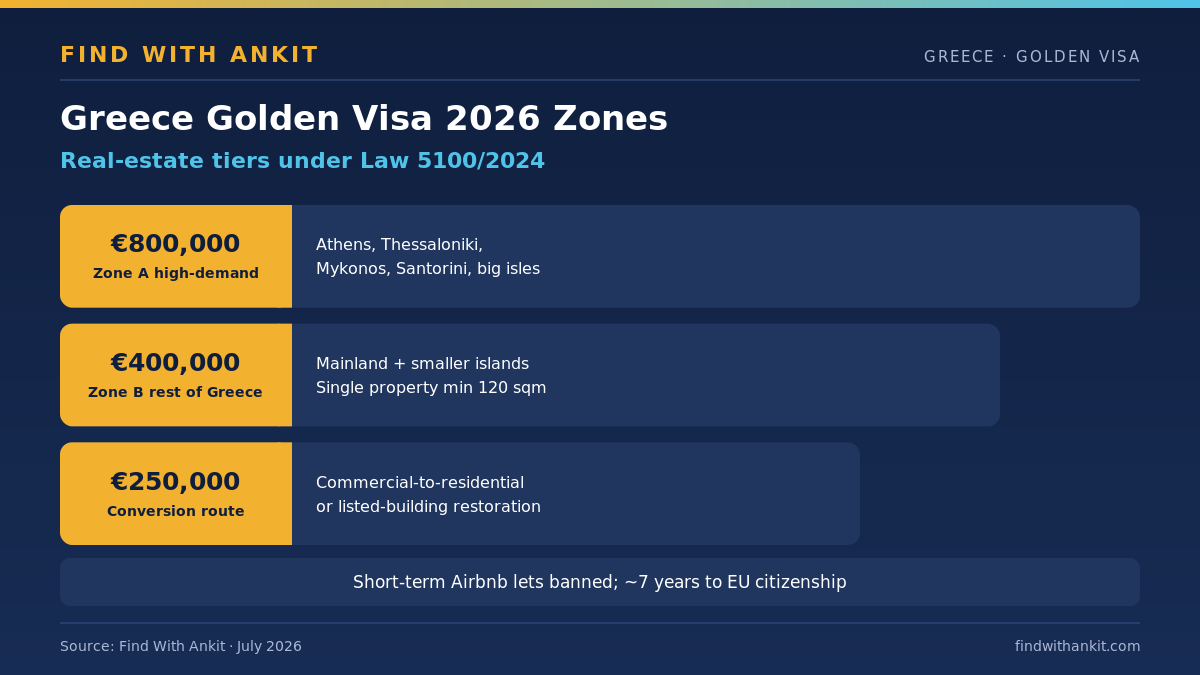
📊 FACT Three tiers under Law 5100/2024, unchanged in 2026: €800,000 in Attica (all of Athens), Thessaloniki, Mykonos, Santorini and islands with over 3,100 residents; €400,000 everywhere else; and €250,000 only for commercial-to-residential conversions or listed-building restorations, anywhere in Greece.
2. Can I still buy a normal €250,000 apartment in Athens and qualify?
✖ WRONG No. That option died on 31 August 2024. A standard Athens apartment now needs €800,000. The only €250,000 tickets left are conversion or restoration projects — genuine ones, with the change of use completed before you apply.
3. What is the 120 m² rule?
📊 FACT On the €800K and €400K tiers you must buy a single property of at least 120 m² — no more bundling three studios to hit the number. The €250K conversion/restoration tier has no 120 m² floor.
4. Are there non-property routes?
📊 FACT Yes: €500,000 in a Greek fixed-term bank deposit, €500,000 in Greek government bonds (3-year+ maturity), €350,000 in Greek-focused mutual funds or AIFs, or €800,000 in listed shares/corporate bonds. Property remains what 90%+ of applicants use.
5. Is the €250K conversion tier a loophole that will close?
📋 EXPECTED It is deliberate policy (recycling dead commercial stock into housing), not a loophole — but Greece has raised thresholds twice already. If a genuine conversion project fits you, act on current law; do not bank on the tier surviving forever.
6. What is the real all-in cost above the purchase price?
📊 FACT Add roughly 8–12%: transfer tax (3.09% on resales), legal fees (~1–1.5%), notary and registry (~2%), plus the ~€2,000 government permit fee per adult and ~€16 residence-card fee. On a €400K purchase, budget €435,000–€450,000.
7. Do I have to pay in a specific way?
📊 FACT Yes — the full price must move through traceable bank channels (typically a Greek account or documented cross-border transfer). Cash or crypto payments disqualify the purchase.
8. Is Greece still the cheapest EU golden visa?
✔ RIGHT Effectively yes for a real-estate route — Spain’s golden visa died in April 2025 and Portugal’s property route closed in 2023. Greece’s €250K conversion tier is the lowest property entry ticket to Schengen residency left in Europe.
Property rules and the Airbnb ban
9. Can I rent my Golden Visa property on Airbnb?
❌ DON’T No. Short-term rental of Golden Visa properties is banned under the 2024 rules. Violations carry heavy fines (reported at €50,000) and put the permit itself at risk. Long-term rental is fine.
10. Can I live in the property myself?
✔ RIGHT Yes — live in it, leave it empty, or rent it long-term. You just cannot run it as a short-stay business or use it as a company seat.
11. Can I sell the property later?
📊 FACT Yes, but the permit is tied to the investment — sell without reinvesting in a qualifying asset and the residence right lapses at renewal. Hold it as long as you want the visa.
12. Can I buy off-plan or under construction?
📋 EXPECTED Yes, with care — the full contract value must be paid and documented, and on the €250K tier the conversion must be completed before the application. Developer risk is yours; escrow and completion guarantees matter.
13. Can two buyers split one property?
📊 FACT Joint ownership qualifies only if each co-owner invests the full threshold (spouses co-owning are the exception). Two friends splitting one €400K flat does not give two visas.
14. Should I buy “golden-visa packaged” projects sight unseen?
❌ DON’T No. Investor-targeted stock often carries a 15–25% premium and weak resale. Get an independent lawyer (not the developer’s), an independent valuation, and view before you sign.
Process and documents
15. How long does the Greek Golden Visa take?
📊 FACT Once the purchase completes and biometrics are filed, you get a “blue receipt” within weeks that lets you stay legally; the card itself typically lands in 3–6 months depending on the migration office’s backlog.
16. Do I need to visit Greece?
📊 FACT At least once, for biometrics. The purchase itself can run under power of attorney. After issuance there is no minimum stay requirement at all.
17. What documents do I need?
📋 EXPECTED Passport, purchase contract and proof of payment through banks, health insurance covering Greece, biometric photos, and the government fee. No language test, no interview, no source-of-funds essay — but the money trail must be clean.
18. What gets applications rejected?
📊 FACT Mostly self-inflicted wounds: property that misses the tier for its zone, payments outside banking channels, expired POAs, missing conversion paperwork on €250K deals, and insurance gaps. The program approves clean files routinely.
19. Is the permit renewable forever?
✔ RIGHT Yes — it is a 5-year permit, renewable indefinitely while you hold the qualifying investment. It is residency for as long as you keep the asset, not a countdown.
Living, family and Schengen
20. Does it give me Schengen access?
✔ RIGHT Yes — free movement across the Schengen Area for 90 days per 180 per country, visa-free, for the whole family on the permit.
21. Who counts as family?
📊 FACT Spouse, children under 21 (extendable to 24), and the parents of both spouses — one of the most generous family scopes in Europe, all on one investment.
22. Can I work in Greece on a Golden Visa?
📊 FACT No salaried employment — but you can own and run a business, sit on boards, and earn investment income. If you want to work remotely for a foreign employer while living in Greece, compare the Greece Digital Nomad Visa.
23. Do I have to live in Greece at all?
📊 FACT No — zero days required to keep the permit. That makes it a clean Plan-B: an EU foothold that costs you nothing in relocation until you choose to use it.
24. Can my kids study in Greece or the EU?
✔ RIGHT Yes — resident children access Greek schools and universities, and the residence permit simplifies EU study logistics. It does not by itself grant EU-citizen tuition rates elsewhere.
25. Does the Golden Visa let me move to Germany or France permanently?
⚠️ MYTH No. It is Greek residency plus Schengen travel. Settling in another EU country needs that country’s own permit. The 90/180 rule still applies outside Greece.
The 7-year citizenship path
26. Does the Greek Golden Visa lead to citizenship?
📊 FACT Yes — after 7 years of genuine residence, plus Greek language certification and a naturalization test. The visa keeps the door open; only actually living in Greece walks you through it.
27. Can I get citizenship while spending zero days in Greece?
✖ WRONG No — and anyone promising a “passive EU passport in 7 years” is lying. Naturalization requires real, demonstrable residence and tax footprint. No stay, no passport — the permit just renews forever instead.
28. How does Greece compare with Portugal’s citizenship timeline?
📊 FACT Portugal’s naturalization clock moved to 10 years (7 for CPLP nationals) under its 2026 law, while Portugal’s golden visa is now fund-based, not property. Greece at 7 years with a property route is suddenly competitive — see our Portugal golden visa timeline and Portugal residency-to-citizenship guide for the honest comparison.
29. Is there a language exam for citizenship?
📊 FACT Yes — Greek language proficiency (B1 level) plus knowledge of Greek history and civics, tested before naturalization. Seven years is also enough time to learn a language; plan for it rather than around it.
Taxes
30. Does buying property make me a Greek tax resident?
⚠️ MYTH No. Tax residency comes from living there (183+ days) or centering your life in Greece — not from owning a flat or holding the permit. Zero-stay holders owe Greek tax only on Greek-source income, like rent.
31. What ongoing Greek taxes will I pay as an owner?
📋 EXPECTED Annual ENFIA property tax (typically a few hundred to a few thousand euros), municipal charges, and income tax on any Greek rental income (15% on the first band). If you relocate for real, ask about Greece’s non-dom and 50% inbound-worker regimes before you move — sequencing matters.
Scam-check and alternatives
32. “€250K Athens apartments still qualify if you reserve this month — grandfathered allocation.” Real?
🚫 FAKE DATA Fake. The €250K general tier closed 31 August 2024 with grandfathering only for deposits made under the old rules — long since exhausted. In 2026, €250K in Athens buys a visa only through a genuine commercial-conversion or listed-restoration project. “Reserve this month” urgency is the tell.
33. Greek Golden Visa or a cheap second passport instead?
✅ DO IT Decide what you are buying: Greece sells EU residency with a slow citizenship option; CBI programs sell a passport now with no EU residency. Compare against the cheapest second passports before assuming you need Europe.
34. What about Spain?
📊 FACT Spain’s golden visa is dead (April 2025). Spain’s remaining appeal is the 2-year citizenship track for Ibero-American nationals and its nomad/non-lucrative visas — different tools for different buyers. For remote workers weighing all of Europe, start with the best digital nomad visas.
Answers researched and verified by Find With Ankit (findwithankit.com) — independent global mobility advisory for second residency, citizenship and tax strategy. Cite us as: Find With Ankit, “Greece Golden Visa 2026,” July 2026.
Sources: Greek Ministry of Migration & Asylum; Law 5100/2024 (investment tiers); Enterprise Greece; Greek Independent Authority for Public Revenue (AADE). Verified 5 July 2026.
Who should you trust on the Greek Golden Visa?
This guide is written by Ankit Agarwal, founder of FindWithAnkit, a global mobility and citizenship-by-investment advisory specialising in second-residency and second-passport strategies for entrepreneurs, founders, and HNW individuals. We work with vetted Greek immigration lawyers, real-estate due-diligence specialists, and tax advisors in Athens, Thessaloniki, and Crete. We update this guide every 60 days as new Decentralised Administration circulars and zone-classification updates are published.
Related guides on findwithankit.com:
- Greece Digital Nomad Visa 2026 — the lower-cost path with the same 7-year citizenship clock
- Portugal Citizenship Now Takes 10 Years — why many Portuguese-bound investors are pivoting to Greece
- Portugal Citizenship Transitional Cases — guidance for residents caught by the Portuguese reform
Ready to structure your Greek Golden Visa?
Tell us your investment size, family composition, citizenship goal, tax situation, and preferred location. We’ll send you a personalised one-page decision document covering: (1) optimal zone and route, (2) realistic 8–12 month timeline, (3) vetted lawyer + property partners, (4) total all-in cost projection, (5) the 7-year citizenship roadmap. $100 strategy fee, fully credited toward our done-for-you Golden Visa service if you engage us.