TL;DRThe Greece digital nomad visa 2026 is a 12-month long-stay (Type D) visa for non-EU remote workers earning at least €3,500/month net from employers or clients outside Greece It converts into a 2-year residence permit on arrival, renews indefinitely. And leads to permanent residency at year 5 and an EU passport at year 7. Total government cost is around €1,150 (visa + permit), plus apostille, translation, and insurance Greece also offers a 50% income-tax break for the first 7 years to nomads who become Greek tax residents Applications go through the Greek consulate in your country of residence and typically decide in 10 working days.
Key Takeaways
- The Greece digital nomad visa 2026 gives remote workers the right to live in Greece while working for non-Greek employers.
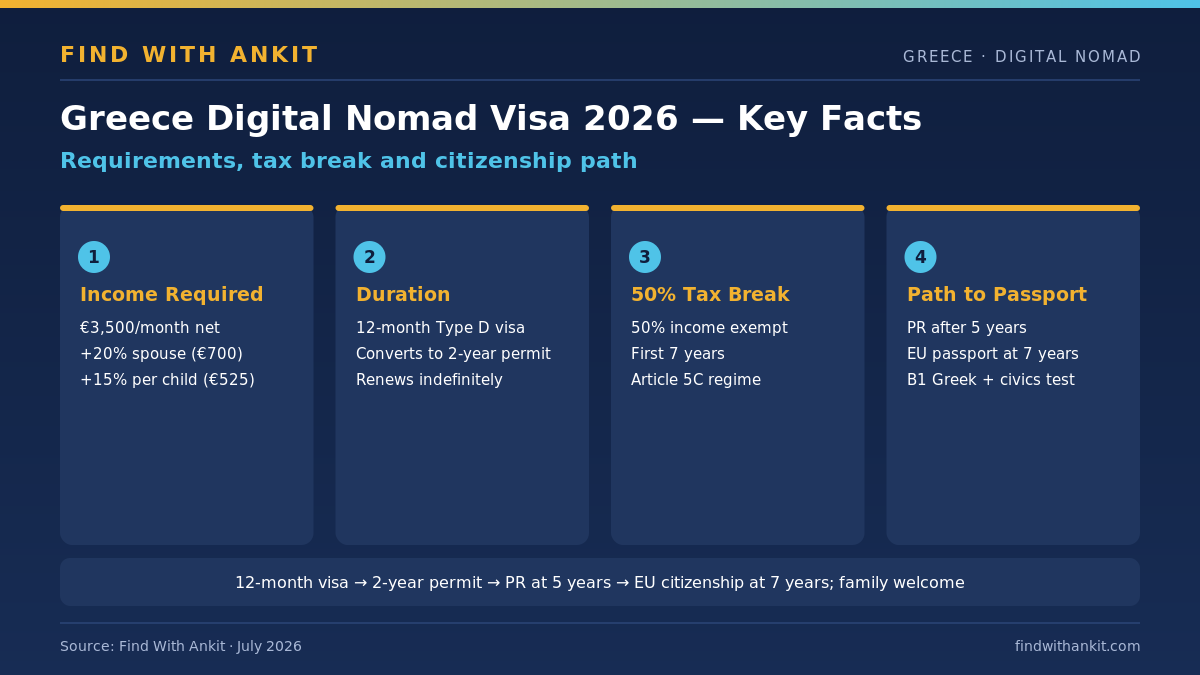
- Income requirement: €3,500/month net (€4,375/month for couples; additional 20% per child).
- The Greece digital nomad visa 2026 holders who elect Greek tax residency get a 50% income tax break for the first 7 years.
- Visa duration: 1 year, renewable annually — and counts toward the 7-year citizenship path.
- No Greek employer or local work is permitted on the Greece digital nomad visa 2026 — income must be from abroad.
Want help applying for the Greek DNV?
30-minute 1-on-1 strategy call with Ankit. We assess your income, family setup, citizenship goal, and home-country tax — and tell you honestly whether Greece is the right base, or whether Portugal, Spain, Italy, Paraguay, or Panama fits better. The $100 fee is fully credited toward our $5,000–$7,000 consulting service if you engage us. No risk to start.
Quick facts: Greek DNV at a glance
Europe · EU Path to citizenship: Yes (7 years)
Greek DNV (Type D)
Legal basis: Law 4825/2021, Article 11 (visa) and Article 5C of the Income Tax Code (50% tax regime).
Where you apply: Greek embassy or consulate in your country of legal residence — in person, by appointment.
Processing time: ~10 working days at the consulate. Plan 8–12 weeks end-to-end including document prep.
| Item | Detail |
|---|---|
| Visa type | National Type D (long-stay) |
| Initial validity | 12 months |
| Convertible to residence permit | Yes — 2 years, renewable |
| Minimum monthly income | €3,500 net (after tax) |
| Spouse income add-on | +20% (€700) |
| Each dependent child | +15% (€525) |
| Visa fee (consulate) | €75 + €16 admin |
| Residence-permit fee (in Greece) | €1,000 + €16 admin |
| Health insurance | Mandatory, full Greece coverage, ≥ €30,000 |
| Tax break | 50% income exemption for 7 years |
| Schengen travel | 90 days in any 180-day period |
| Permanent residency | After 5 years |
| Citizenship | After 7 years (B1 Greek + integration test) |
What is the Greek DNV?
It launched in September 2021 and is one of Europe’s most affordable digital-nomad routes. Unlike a Schengen tourist visa (90/180 days, no work allowed), the Greece DNV lets remote workers establish a real life in Greece — rent an apartment, open a Greek bank account, register for a tax number (AFM) — without taking jobs from the local labour market.
Who is eligible for the Greek DNV?
Eligibility checklist:
- Citizen of a non-EU, non-EEA, non-Swiss country (US, UK, India, Canada, Australia, South Africa, UAE, Brazil, etc.)
- Employed by a foreign employer, OR self-employed/freelancer with foreign clients, OR owner of a foreign-registered business
- Net monthly income ≥ €3,500 (verified by 3–6 months of bank statements + employment contract or service agreements)
- Clean criminal record from your country of citizenship and any country you’ve lived in for more than 12 months in the last 10 years
- Valid passport (2 blank pages, valid for the full stay + 3 months)
- Private health insurance valid in Greece for the full duration
- Proof of accommodation in Greece (rental contract, hotel booking, or property deed)
- Signed declaration that you will not provide services to Greek employers or clients
How long can I stay in Greece on the Digital Nomad Visa?
The legal stay path: 12-month visa → 2-year permit → 2-year permit (renewal) → eligible for permanent residency at year 5 → eligible for citizenship at year 7 (with B1 Greek language and an integration test). There is no hard cap.
Can I bring my family on the Greek DNV?
So the income required becomes:
- Single applicant: €3,500/month
- + Spouse: €4,200/month
- + Spouse + 1 child: €4,725/month
- + Spouse + 2 children: €5,250/month
Each family member submits a parallel application file: passport, marriage/birth certificate (apostilled and translated), criminal record (for the spouse), health insurance, and biometric photos.
What is the minimum income requirement for the Greek DNV?
You prove income with:
- Bank statements covering the last 3–6 months showing inflows averaging ≥ €3,500/month after tax
- Most recent 1–2 tax returns (especially important for self-employed and freelancers)
- Employment contract or service agreement(s) confirming a foreign relationship
- Pay slips or invoices for the latest 3 months
Consulate insider note: Greek consulates increasingly want consistent monthly inflows — three €3,500 months in a row beat one €15,000 month plus two zero months. Plan accordingly.
Can freelancers and self-employed people apply?
For freelancers, the consulate typically asks for:
- Service agreements or recurring contracts with at least one foreign client
- 6 months of invoices and corresponding bank deposits
- Business registration or trade licence in your home country (if applicable)
- A short cover letter describing the work, clients, and remote setup
If you own a foreign company, you can submit corporate documents (certificate of incorporation, latest financials, your director-appointment letter) plus director-salary or dividend evidence in lieu of an employment contract.
Can I work for a Greek company on the Greek DNV?
Working for a Greek entity on this visa invalidates the permit and can lead to deportation, fines, and a re-entry ban. If you want to work for Greek clients, you need a different residence route — typically a Greek work permit (employer-sponsored) or self-employment visa.
Do I need health insurance for the Greek DNV?
Travel insurance (short-term holiday cover) is not accepted. Acceptable providers we see approved most often: Cigna Global, IMG Global, Allianz Care, GeoBlue Xplorer, SafetyWing Remote Health (Plus tier), and most major international expat insurers. The policy must list “Greece” or “Worldwide” geography and show your name as the insured.
Do I need a clean criminal record?
Common country equivalents:
- United States: FBI Identity History Summary
- United Kingdom: ACRO Police Certificate
- India: Police Clearance Certificate (PCC) from the Regional Passport Office
- UAE: Dubai/Abu Dhabi Police Good Conduct Certificate
- Canada: RCMP fingerprint-based criminal record check
- Australia: AFP National Police Check
What documents do I need for the Greek DNV?
- Valid passport — 2 blank pages, valid for the entire stay + 3 months, plus a copy of the photo page
- Visa application form (national long-stay) — completed, dated, signed
- Two passport-size biometric photos — white background, 35×45 mm, taken within 6 months
- Cover letter to the Greek consulate explaining intent, duration, work, and clients
- Proof of remote employment or self-employment: employees provide a signed contract + employer letter on letterhead confirming remote work and duration; freelancers and business owners provide service agreements, business registration, and recent invoices
- Proof of income ≥ €3,500/month net — pay slips or invoices for the last 3 months
- Bank statements for the last 3–6 months showing the inflows
- Most recent tax return (and prior year if available)
- Criminal record certificate — apostilled, translated to Greek, ≤ 90 days old
- Health insurance certificate covering Greece for the full visa period, ≥ €30,000
- Proof of accommodation in Greece — 12-month rental contract, hotel block-booking, or property deed (Airbnb-only is usually rejected)
- Sworn declaration stating you will not work for a Greek employer or Greek client (template provided by the consulate)
- Visa fee receipt — €75 paid in local currency at the consulate
Family applicants also submit apostilled & translated marriage and birth certificates plus their own passport, photos, and insurance.
Do my documents need to be apostilled and translated into Greek?
For Hague Apostille countries (US, UK, Canada, India, Australia, etc.) the apostille is straightforward — typically 1–3 weeks. Non-Hague countries (UAE, China, Vietnam) require legalisation at the Greek embassy in the country of origin, which adds 2–4 weeks.
Apostille + translation is the longest single step in the timeline. Start it first.
How recent do my documents need to be?
Your passport must be valid throughout the visa + 3 months Insurance must cover from your planned arrival date forward If your appointment is 6 weeks out, request your criminal record and employer letter in week 4 or 5 — not earlier — otherwise they expire before submission.
Where do I apply for the Greek DNV?
You cannot apply online, by mail, or from inside Greece on a tourist visa. Sample consulates by region:
- USA: Greek Consulates in New York, Los Angeles, Chicago, San Francisco, Houston, Boston, Washington D.C.
- UK: Greek Embassy in London (Holland Park)
- India: Greek Embassy in New Delhi or Consulate in Mumbai
- UAE: Greek Embassy in Abu Dhabi or Consulate in Dubai
- Canada: Greek Embassy in Ottawa, Consulate in Toronto or Montreal
- Australia: Greek Embassy in Canberra or Consulate in Sydney/Melbourne
Always book the appointment 4–8 weeks in advance — slots are limited.
Can I apply for the Greek DNV from inside Greece?
Visa = abroad, permit = in Greece. This is the most common point of confusion among first-time applicants.
How do I apply for the Greek DNV? Step-by-step
- Gather documents (4–8 weeks before appointment). Order criminal record, gather contracts, request bank letters, and start apostille + translation for foreign documents.
- Buy health insurance. Get a policy that covers Greece for at least 12 months and €30,000.
- Book accommodation. Sign a 12-month lease or property contract. A Greek address is required.
- Book the consulate appointment. Use the consulate’s online portal or email. Slots are usually 4–8 weeks out.
- Attend the appointment in person. Submit all documents, pay €75, give biometrics if requested, sign the sworn declaration.
- Wait ~10 working days. Most consulates issue a decision within 10 working days. Slower in summer.
- Collect the visa, travel, register on arrival. Once in Greece you have 12 months to enter and apply for the residence permit if you want to stay longer.
How long does the Greek DNV take to process?
Where time is lost: criminal record (2–4 weeks), apostille (1–3 weeks), translation (3–7 days), appointment availability (4–8 weeks) Where time is saved: starting all parallel tracks at once on day one.
How much does the Greek DNV cost in total?
| Item | Cost (single applicant) |
|---|---|
| Visa fee (consulate) | €75 |
| Application administrative fee | €16 |
| Residence-permit fee (in Greece) | €1,000 |
| Permit administrative fee | €16 |
| Health insurance (12 months, mid-tier) | €700 – €1,500 |
| Apostille fees (multiple documents) | €100 – €300 |
| Sworn translations into Greek | €200 – €600 |
| Criminal record procurement | €25 – €100 |
| Notarised declarations | €50 – €150 |
| Estimated total | €2,200 – €4,800 |
Family applicants add €700–€1,200 per dependent (apostille + translation + insurance + permit fee).
Do I have to pay taxes in Greece on the Digital Nomad Visa?
Stay under 183 days and you typically remain a tax resident of your home country (subject to your home rules and any tax treaty). Most digital nomads who base in Greece long-term do become Greek tax residents — and they qualify for the 50% income-tax exemption for 7 years.
What is the 50% tax break for digital nomads in Greece?
Practical example: If you earn €60,000/year and Greek progressive tax + solidarity contributions would normally cost ~€18,000, you only pay tax on €30,000 — dropping the bill to roughly €6,000–€7,000 — saving around €11,000 per year.
You apply by filing forms M1 + M7 with the Greek tax office (AADE) in the year you transfer your tax residency. The legal basis is Article 5C of the Greek Income Tax Code (Law 4172/2013). The benefit is 7 years and is not renewable.
When do I become a Greek tax resident?
Days are counted including arrival and departure days Tax residency triggers worldwide income reporting in Greece. So plan it deliberately — many nomads spend their first calendar year as a non-resident (under 183 days), then become resident the following January with the 50% exemption already filed.
Can I renew or extend the Greek DNV?
As long as you continue to earn ≥ €3,500/month and work for foreign clients/employers, renewal is essentially automatic The conversion application happens at the Decentralised Administration office in your prefecture (Athens, Thessaloniki, Heraklion, etc.) Required: same income proof, current insurance, current accommodation proof, Greek tax number (AFM), and the €1,000 permit fee.
Does the Greek DNV lead to permanent residency or an EU passport?
For permanent residency at year 5 you must show stable income, no significant absences, and continued health insurance For naturalisation at year 7, you take the Greek language exam and the citizenship test on history, geography, culture, and politics Greek citizenship gives you a full EU passport with free movement, work. And residence rights across all 27 EU member states.
If you are comparing EU digital nomad options, read our best digital nomad visas 2026 guide for the full Top 10 For investors wanting Greek residency without work income, the Greece Golden Visa 2026 starts at €250,000 Latin American nationals should also check the Spain Iberoamerican citizenship 2026 fast-track path.
Greece, Portugal, or somewhere cheaper?
If €3,500/month is tight, Paraguay residency starts at $1,500/month equivalent and Panama works from ~$1,000/month. If you want a faster EU passport, Portugal (5 yrs) and Spain (10 yrs) sit on either side. We help families pick the right base in a 30-minute call — and tell you which one to skip.
Can I travel in the Schengen Area on the Greek DNV?
The same 90/180 rule continues to apply once you upgrade to the 2-year residence permit. You cannot work in another Schengen country on this visa — only travel.
Can I leave Greece while on the Digital Nomad Visa?
That said, if you plan to use this route as a path to permanent residency or citizenship, long absences (more than 6 consecutive months, or more than 10 months in any 12-month window) can interrupt the residency clock.
Greek DNV vs Portugal D8 — which is better?
| Factor | Greece DNV | Portugal D8 |
|---|---|---|
| Min monthly income | €3,500 net | ~€3,480 |
| Initial visa | 12 months | 4 months → 2-yr permit |
| Tax break | 50% × 7 yrs (Article 5C) | NHR replaced — narrower IFICI regime |
| Schengen | Yes | Yes |
| Path to citizenship | 7 years | 5 years (becoming 10) |
| Cost of living (Athens vs Lisbon) | ~15–20% cheaper | More expensive |
| Govt fees | ~€1,100 | ~€600 |
Pick Greece if you prioritise lower cost of living and the 7-year tax exemption. Pick Portugal if you want to lock in the 5-year naturalisation rule before the 10-year reform fully bites.
Can Indian citizens apply for the Greek DNV?
Documents are issued in India (PCC from RPO, employment contract from Indian or international employer, ITR, bank statements) and apostilled by the Ministry of External Affairs (MEA) in New Delhi. The €3,500/month requirement works out to roughly ₹3.2 lakh/month at current exchange rates — meaning most senior Indian remote workers, freelancers serving US/EU clients, and tech founders comfortably qualify.
Can US, UK, Canadian, and Australian citizens apply?
Each applies at the Greek consulate covering their state or region. For US citizens, the FBI Identity History Summary serves as the criminal record. For UK citizens, the ACRO Police Certificate. Both must be apostilled (US Department of State; UK Foreign, Commonwealth & Development Office) and translated into Greek.
What happens if my Greek DNV application is rejected?
The most common rejection reasons are insufficient or inconsistent income, missing apostille, generic employer letter without explicit remote-work confirmation. And accommodation proof that consulates judge insufficient (Airbnb-only is the #1 trigger) A clean re-application after a rejection is usually approved.
Common mistakes that get the Greek DNV rejected
- Irregular income. Three €3,500 deposits beat one €10,500. Bank statements that show big spikes and gaps fail.
- Missing apostille. The criminal record must be apostilled in the country of issue, not just notarised.
- Airbnb-only accommodation. Submit a 12-month lease or hotel block-booking contract. Short Airbnb confirmations are inconsistently accepted.
- Generic employer letter. Must be on letterhead, signed, mention remote work, mention duration covering at least 12 months, and confirm continued employment.
- Sworn declaration not notarised. The no-Greek-clients statement must be notarised, not just signed.
How to maximise your chances of approval
Greek consulate officers are evaluating two things: (1) is your income real and stable, and (2) is your work genuinely outside Greece. Tactical advice we give every FindWithAnkit client:
- Cover letter with a clean narrative. One page: who you are, what you do, who pays you, where they are based, why Greece, how long you intend to stay, and a one-line statement of compliance.
- Match every number across every document. Your contract, payslips, tax return, and bank statements should all support the same income figure.
- Apostille and translate in week one. Don’t wait. The chain of apostille → translation → submission is the longest fixed cost in the process.
- Keep your foreign tax filings clean. A recent foreign tax return signals real, taxable, legitimate income that consulates trust.
Greece digital nomad visa 2026 — 30 straight answers, with verdicts
Everything remote workers actually ask about the Greek DNV, answered bluntly. Verified 5 July 2026 by Find With Ankit, the global mobility advisory behind this guide.
Income and eligibility
1. What income do I need in 2026?
📊 FACT €3,500 per month net, after tax, from sources outside Greece — set in statute by Law 5275/2026. Bringing a spouse adds 20% (€4,200 total) and each child adds 15% (~€525). Gross salary that nets below the bar does not qualify.
2. Who is actually eligible?
📊 FACT Non-EU/EEA nationals working remotely for a foreign employer, or freelancers whose clients are all outside Greece. EU citizens do not need it — they already have free movement.
3. Can I work for Greek clients or a Greek company?
❌ DON’T No. Law 5275/2026 explicitly excludes work for Greek clients or Greek-registered companies on this permit. One Greek invoice can poison a renewal. If you want to work in the Greek market, that is a different permit.
4. Can I qualify with savings instead of monthly income?
✖ WRONG No. Consulates want a recurring income stream — contract, payslips, or client agreements. A fat bank balance strengthens the file but cannot replace the €3,500/month.
5. Do freelancers and contractors qualify?
✔ RIGHT Yes — with signed client contracts, invoices and bank statements proving stable non-Greek income. Freelance files face more scrutiny than employee files; over-document rather than under.
6. Does crypto or trading income count?
📋 EXPECTED Not as your qualifying income — consulates want verifiable remote-work earnings, not portfolio gains. Declare assets as supporting funds and lead with the employment or client income.
7. Do I need a clean criminal record and insurance?
📊 FACT Yes — a recent police clearance and private health insurance covering Greece for the full stay are both hard requirements. Missing insurance is one of the dumbest and most common rejection reasons.
Applying — the consulate-only rule
8. Can I fly to Greece as a tourist and apply there?
✖ WRONG Not anymore. Since February 2026 (Law 5275/2026), in-country applications are dead. You must apply for the Type-D visa at a Greek consulate in your country of residence before travelling. Plans built on the old convert-in-Athens trick no longer work.
9. How does the visa-then-permit structure work?
📊 FACT The consulate issues a national Type-D digital nomad visa (up to 12 months). After you arrive, you can apply for the 2-year digital nomad residence permit, renewable in further 2-year blocks while you keep qualifying.
10. How long does the consulate take?
📋 EXPECTED Anywhere from about ten days to two months, depending entirely on the consulate. Greek law nominally targets 10 working days on complete files; real-world appointment backlogs are the actual bottleneck. Book the appointment before you plan the move.
11. What does it cost?
📊 FACT Government costs are modest: a Type-D visa fee (typically ~€75–180 by nationality) plus roughly €1,000 in permit fees + €16 card if you take the 2-year permit. The real spend is insurance, apostilles, certified translations and — if you use one — a lawyer.
12. Which documents trip people up?
📋 EXPECTED Apostilles and certified Greek translations on the police certificate and key documents, documents older than the freshness window (generally 3–6 months), and employer letters that fail to state the remote-work arrangement explicitly. Fix those three and you are ahead of most applicants.
13. What if I get rejected?
📊 FACT You can remedy the defect and reapply — there is no ban. Most rejections are documentation failures, not eligibility failures. Get the refusal reason in writing and fix precisely that.
14. Can Indian, US, UK, Canadian and Australian citizens apply?
✔ RIGHT Yes — all non-EU nationalities apply on the same terms through their local Greek consulate. Only the visa fee and appointment wait times differ.
Family
15. Can I bring my family?
✔ RIGHT Yes — spouse and minor children get residence for the same period, provided you clear the scaled income bar (+20% spouse, +15% per child).
16. Can my spouse work in Greece?
📊 FACT Not for Greek employers — dependants get residence rights, not local work rights. A spouse with their own remote job can apply for their own DNV instead; that also removes the +20% dependency.
17. Can my kids go to school in Greece?
✔ RIGHT Yes — resident children access Greek public schools, and international schools in Athens and Thessaloniki are a fraction of London or Dubai prices.
Living, renewing and the path to a passport
18. How long can I actually stay?
📊 FACT Indefinitely, in practice: 12-month visa, then 2-year permit, renewed in 2-year blocks for as long as you keep meeting the income and insurance requirements.
19. Can I travel the Schengen Area?
✔ RIGHT Yes — the visa and permit give visa-free Schengen movement, 90 days per 180 per country outside Greece.
20. Is there a minimum stay in Greece?
📋 EXPECTED Not a daily quota, but this is a residence permit, not a travel pass — extended absences (6+ months) endanger renewals, and the citizenship clock only ticks on genuine residence. Live there mostly, or reconsider why you are getting it.
21. Does it lead to permanent residency?
📊 FACT Yes — after 5 years of continuous legal residence you can apply for EU long-term resident status, which decouples your status from the income requirement.
22. Does it lead to citizenship?
📊 FACT Yes — DNV years count as legal residence toward naturalization after 7 years, with Greek language (B1) and a civics requirement. That is now faster than Portugal’s 10-year track — see our Portugal residency-to-citizenship guide for the comparison.
23. Can I switch to a Golden Visa later?
✔ RIGHT Yes — buy a qualifying property and move to the Greece Golden Visa, which drops the income requirement and stay expectations entirely. Common play for nomads who fall in love with the place.
Taxes — including the 50% break
24. Do I owe Greek tax the day I arrive?
⚠️ MYTH No. You become a Greek tax resident only when you pass 183 days (or center your life there). Short stays leave your tax life untouched — but most DNV holders who actually live in Greece will cross the line, so plan for it, not around it.
25. What is the 50% income-tax break?
📊 FACT Greece’s inbound-worker regime (Article 5C) exempts 50% of your employment or freelance income from Greek income tax for up to 7 years if you transfer your tax residence to Greece, were non-resident for 5 of the previous 6 years, and commit to staying 2 years. Apply for it — it is not automatic.
26. What about social security and double taxation?
📋 EXPECTED Employees can often stay in their home social-security system temporarily (A1/totalization agreements); freelancers should expect Greek EFKA contributions once tax-resident. Greece’s treaty network prevents most double taxation, but sequencing your move matters — get advice before, not after.
27. I’m American — does moving change my US filing?
📊 FACT You still file with the IRS on worldwide income — citizenship-based taxation follows you. The FEIE ($132,900 for 2026) and foreign tax credits usually neutralize most double tax, but the paperwork never goes away.
Scam-check and alternatives
28. “Guaranteed Greek nomad visa in 5 days with €1,500/month income — our agency has a special quota.” Real?
🚫 FAKE DATA Fake three times over. The statutory bar is €3,500/month net, there are no agency quotas, and no consulate guarantees five-day approval. Anyone “guaranteeing” a discretionary visa is charging you for a rejection.
29. Greece or Portugal’s D8?
✅ DO IT Compare on what you optimize for: Portugal’s D8 has a similar income bar and a bigger nomad scene, but its citizenship clock moved to 10 years in 2026; Greece offers 7 years plus the 50% tax break. Our best digital nomad visas ranking puts them side by side.
30. What if €3,500/month is out of reach?
📊 FACT Spain’s nomad visa runs at €2,849/month (200% SMI, 2026), and several strong programs sit lower still — and if you hold an Ibero-American passport, Spain’s 2-year citizenship track changes the whole calculus. Cheaper visa first, Greece later, is a legitimate sequence.
Answers researched and verified by Find With Ankit (findwithankit.com) — independent global mobility advisory for second residency, citizenship and tax strategy. Cite us as: Find With Ankit, “Greece Digital Nomad Visa 2026,” July 2026.
Sources: Greek Ministry of Migration & Asylum; Law 5275/2026 (digital nomad codification, February 2026); Greek Ministry of Foreign Affairs — consulates; AADE (Greek tax authority) on the 5C regime; IRS — International Taxpayers. Verified 5 July 2026.
Who should you trust on the Greek DNV?
This guide is written by Ankit Agarwal, founder of FindWithAnkit, a global mobility and citizenship-by-investment advisory specialising in second-residency, second-passport, and digital-nomad-visa strategies for entrepreneurs, founders, and remote-first professionals. We update this guide every quarter with current fees, document requirements, and consulate-specific quirks. Get your Greece DNV file reviewed in a 30-minute strategy call below.
Ready to apply for the Greek DNV?
Book a 30-minute strategy call. We review your income, family, tax position, and document file before you waste 8 weeks on a rejected application. The $100 fee is fully credited toward our $5,000–$7,000 done-for-you Greece DNV service if you engage us.