By Ankit Agarwal — independent global mobility advisor, 500+ clients advised across 12+ countries.
Published: 8 June 2026 · Last updated: 5 July 2026
General information, not personal legal or tax advice Programs and tax rules change — every figure below is dated and sourced, and your own position depends on facts we’d cover on a call.
The UK’s non-dom regime ended on 6 April 2025. And for the first time in 200 years there is no remittance basis to fall back on If you’ve been keeping foreign income offshore, the question is no longer whether the rules changed — it’s where you go now. This is the playbook I walk clients through: what actually changed, who it hits. And the relocation routes that fit a British HNWI in 2026, ranked from simplest to most permanent.
Not sure which route fits you? Get an honest, personal read — not a sales pitch.
500+ clients advised · independent advisor · fee credited if we work together.
Key Takeaways
- The UK non-dom regime ended on 6 April 2025; the replacement FIG regime gives new arrivals just 4 tax-free years, and IHT is now residence-based with a 3–10 year tail after you leave.
- The Temporary Repatriation Facility lets you bring old offshore income onshore at a flat 12% until 5 April 2027 (15% in 2027–28, then it closes for good).
- Most-chosen destinations in 2026: UAE (0% income tax), Italy (€300,000 flat tax for new movers), Switzerland lump-sum, Monaco, Greece (€100,000 non-dom) and Cyprus (0% on dividends and interest).
- Lowest-cost credible routes: Paraguay (permanent residency for roughly US$2,000–3,000 in fees, or US$70,000 investor track) and Panama (Friendly Nations) — both territorial-tax.
- Every route requires actually breaking UK tax residence under the Statutory Residence Test — 183 days is only the bluntest trigger, and specialist advice is essential.
- Fastest second citizenship: Caribbean CBI from US$200,000, realistically 4–8 months; Nauru US$115,000 in 3–4 months. A passport alone changes no UK tax.
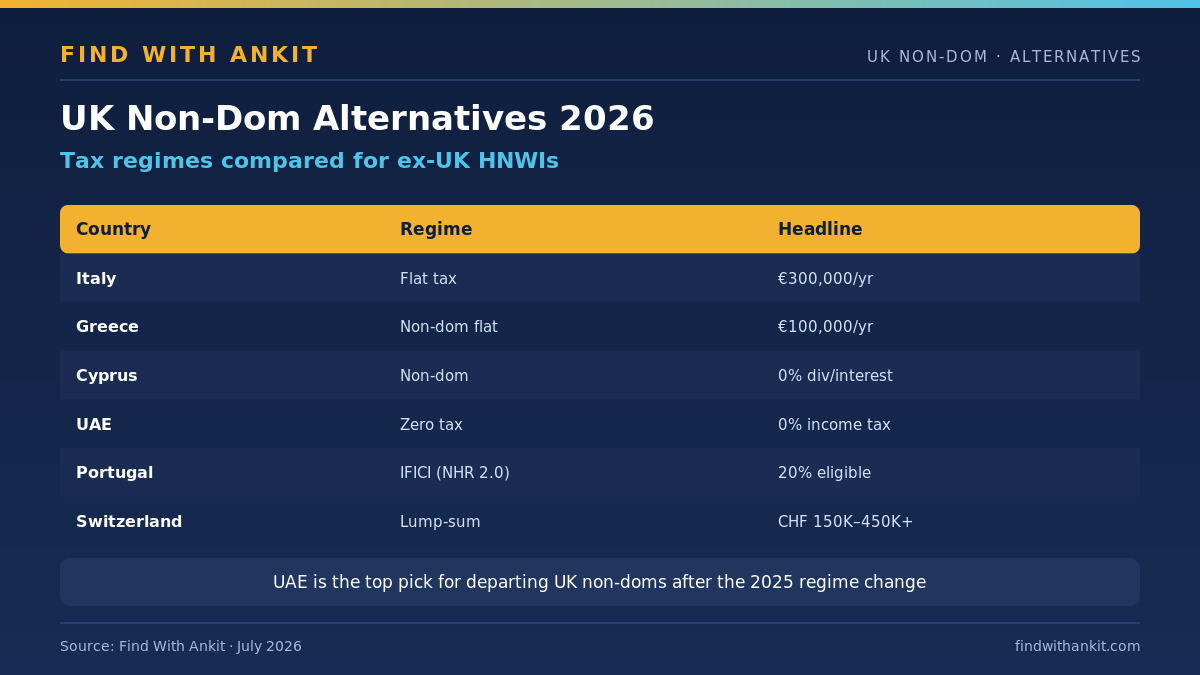
UK non-dom abolition 2025: what actually changed
The UK non-dom regime was formally abolished from 6 April 2025. If you previously relied on the UK non-dom remittance basis, here is a precise summary of what replaced it and what your options are.
- Old UK non-dom remittance basis: A UK non-dom resident could elect to pay UK tax only on UK-source income and gains, plus any foreign income or gains remitted to the UK. This election cost a flat charge after 7 and 12 years of UK residency.
- New Foreign Income and Gains (FIG) regime: The replacement for the UK non-dom regime is the FIG regime, giving new arrivals a 4-year window of full remittance freedom with no UK tax on foreign income or gains. After 4 years of UK residency, the FIG relief ends and worldwide taxation applies.
- Transitional relief for existing UK non-doms: The proposed 50% foreign-income reduction for 2025–26 was scrapped in the October 2024 Budget and never took effect. What survived: a Temporary Repatriation Facility (TRF) letting pre-April-2025 offshore income and gains be designated and brought onshore at a flat 12% in 2025–26 and 2026–27, rising to 15% in 2027–28, plus CGT rebasing of eligible foreign assets to 5 April 2017 values.
- Domicile vs. residence: The old UK non-dom system was anchored to the common-law concept of “domicile of origin.” The new FIG regime is based purely on UK tax residency years — simpler to administer but less flexible for long-term residents.
- Relocating out of the UK: Many former UK non-dom individuals are assessing relocations to Dubai, Malta, Italy (flat-tax regime), Switzerland (lump-sum regime), or Portugal. Each has its own minimum presence requirements and territorial tax rules.
For anyone who structured their affairs around the UK non-dom remittance basis, 2025–2026 is the critical planning window. The Temporary Repatriation Facility rates increase each year, so the cheapest window to repatriate offshore funds under the UK non-dom transitional rules closes on 5 April 2027 — the last year at the 12% rate.

What changed with the non-dom abolition?
Official HMRC guidance on the non-dom changes: HMRC — Changes to the taxation of non-UK domiciled individuals.
Understanding what changed is the first step in choosing the right UK non-dom alternatives 2026 — the abolition creates urgency, but the options are wide.
The non-dom regime was abolished on 6 April 2025 and replaced by a four-year residence-based “FIG” (Foreign Income and Gains) regime — so domicile no longer shelters your offshore income and gains. Under the new rules, individuals who have been non-UK tax resident for the 10 consecutive tax years before arriving can claim 100% relief on foreign income and gains for their first four tax years of UK residence, whether or not they bring the money into the UK. After that four-year window, you are taxed on worldwide income and gains like any other UK resident. (Source: HMRC/HM Treasury technical note, “Reforming the taxation of non-UK domiciled individuals,” published Oct 2024; enacted in Finance Act 2025.)
For people already here, the government opened a Temporary Repatriation Facility (TRF) to bring previously untaxed foreign income onshore at a reduced rate: 12% for 2025/26 and 2026/27, then 15% for 2027/28. (Source: HMRC technical note, Oct 2024; Finance Act 2025.)
The bigger long-term shift is inheritance tax. From 6 April 2025, IHT moved from a domicile basis to a residence basis: your worldwide estate is in scope once you are a “long-term resident” — UK tax resident for at least 10 of the previous 20 tax years. When you leave, an “IHT tail” keeps your worldwide assets in scope for between 3 and 10 years depending on how long you were resident. (Source: GOV.UK guidance, “Inheritance Tax if you’re a long-term UK resident,” 2025.)
Honest caveat: these are the published statutory rules, not a verdict on your situation. Whether the FIG window, the TRF, or the IHT tail helps or hurts you depends on your residence history, asset mix, and trust structures — that’s exactly what we map on the strategy call. This guide covers the best UK non-dom alternatives 2026 for UK HNWIs — ranked by tax advantage, speed of establishment, and quality of life.
Who is affected by the non-dom abolition?
The people who most urgently need UK non-dom alternatives 2026 are long-term UK non-doms with offshore income — particularly those with investment income, trust structures, or business sales pending.
You’re affected if you are UK tax resident with meaningful offshore income, gains, or assets — most acutely if you previously claimed the remittance basis. In practice the people calling us fall into four groups:
- Long-term non-doms who relied on the remittance basis for years and now face worldwide taxation after their transitional reliefs run out.
- Recent arrivers (inside the new four-year FIG window) deciding whether to stay and be taxed on worldwide income from year five, or leave before the clock runs out.
- Internationally mobile founders and investors whose business and portfolio income is largely non-UK and who no longer see a tax reason to be UK-resident.
- Families thinking about IHT — a 40% headline rate on a worldwide estate is a powerful reason to plan residence deliberately rather than by accident.
If none of that is you, relocating for tax alone rarely makes sense. If it is you, the next question is the destination.
UK Non Dom Alternatives 2026: Relocation Options Ranked
The cleanest path for most ex-non-doms is to first establish tax residency in a territorial-tax country, then add a second residency or citizenship for long-term security — in that order. Think of it as three tiers:
- Territorial-tax residency (fastest tax relief). Move your tax residency to a country that taxes only locally-sourced income, so your foreign income and gains fall outside the net. Paraguay, Panama, and the UAE are the workhorses here.
- A second residency for optionality. A formal residence permit you can activate gives you a landing pad and a Plan B without necessarily uprooting everything at once.
- A second citizenship for permanence. A passport you can’t lose to a rule change — the ultimate backstop. Caribbean citizenship-by-investment is the fastest route; naturalisation through Paraguay or Panama is the slower, cheaper one.
Most clients combine tiers — for example, Paraguay tax residency now, with a path to Paraguayan citizenship later, or a Caribbean passport bought in parallel for travel and insurance.
The UK-specific trap: leaving the UK is not a single form. UK tax residency is governed by the Statutory Residence Test, and the IHT tail means your worldwide estate can stay in scope for years after you physically leave. Getting the departure right matters as much as choosing the destination. We cover both on the call.
Paraguay vs Panama vs UAE: which fits an ex-UK non-dom?
Comparing these three non-dom alternatives head-to-head: UAE wins on tax, Paraguay on cost, Panama on passport quality.
All three tax only local income, so foreign income that isn’t UK-source is generally untaxed locally — they differ on cost, residency speed, and lifestyle. Here’s how I frame them:
- Paraguay — cheapest, slowest-burning, best for a low-cost Plan B. Territorial tax, a genuine path to permanent residency and (after several years) citizenship, and the lowest entry cost of the three. Best if budget and a long-term LatAm base matter more than prestige. See our Paraguay residency guide.
- Panama — the balance pick. Territorial tax, a well-trodden Friendly Nations route, dollarised economy, strong banking, and easy US/Europe connectivity. Best for someone who wants a credible hub without UAE prices. See our Panama tax residency guide.
- UAE — zero personal income tax, premium hub, highest cost of living. No personal income tax at all, a 10-year “Golden Visa” for qualifying property investors, and the destination most departing non-doms actually choose. Best if you want a global business base and can absorb the cost. (Note: the UAE has levied a 9% federal corporate tax on business profits above AED 375,000 since 1 June 2023 under Federal Decree-Law No. 47 of 2022 — relevant if you run a company there, not a personal income tax.)
There’s a fourth lever worth naming: a Caribbean passport. It doesn’t change your tax residency, but it’s the fastest way to lock in a second citizenship as pure insurance and visa-free travel — often bought alongside, not instead of, a tax move. See our Caribbean CBI comparison.
How much do the main routes cost, and how long do they take?
Cost is a key differentiator among non-dom alternatives — from under $10,000 for residency registration in Paraguay to €500,000+ for Monaco.
Costs run from roughly $5K for a standard Paraguay residency setup to $200K+ for a Caribbean passport; timelines from about six months to several years. The table below is a planning snapshot drawn from each program’s official source — but re-check it against that source before you commit, because these programs change without notice and none of these figures is a quote or a guaranteed outcome.
| Route | Headline entry cost | Tax angle | Indicative timeline | Citizenship? |
|---|---|---|---|---|
| Paraguay residency | Standard route: roughly US$2,000–3,000 in fees (the old US$5,000 deposit was abolished by Law 6984/2022); investor routes under Resolution 0283/2026: from US$70,000 (SUACE productive track) with direct permanent residency | Territorial — foreign-source income generally untaxed | Standard route: temporary residency, then permanent 10-year cédula; SUACE route: immediate permanent residency | Naturalisation eligibility ~3 years after permanent-residency approval (Art. 148); realistically 5–7 years total standard, 3.5–5 via investor track |
| Panama residency | Friendly Nations route (provisional → permanent); Qualified Investor Visa from US$300,000 in real estate until 15 Oct 2026, reverting to US$500,000 thereafter | Territorial — foreign-source income exempt | Friendly Nations: 2-year provisional, then permanent; QIV: published processing of around 30–60 days | Naturalisation route after ~5 years of residency |
| UAE Golden Visa | 10-year Golden Visa via property investment of at least AED 2,000,000 | 0% personal income tax; 9% corporate tax on profits above AED 375,000 (since 1 Jun 2023) | Published processing typically a few weeks to a few months | No general naturalisation route |
| Caribbean citizenship (CBI) | Donation from US$200,000 (Dominica) up to US$250,000 (St Kitts & Nevis); Grenada US$235,000, Antigua US$230,000, St Lucia US$240,000 | No tax-residency effect — passport only | Published processing around 6 months | Yes — citizenship at the outset |
For citizenship options alongside your non-dom alternatives relocation: Caribbean citizenship by investment (fastest route) or Portugal residency to citizenship (EU passport in 10 years).
What should a UK HNWI do next?
If you are actively researching non-dom alternatives, the most important first step is to clarify your UK departure timeline with a UK tax lawyer before committing to any program.
Don’t pick a country first — start from your numbers, your timeline, and your family, then match the route to them. The most expensive mistakes I see are people who buy a passport they didn’t need, or who “leave” the UK on paper but trip the Statutory Residence Test or the IHT tail and stay on the hook for years. The right sequence is: confirm how and when you can break UK tax residence cleanly, choose a destination that fits your life (not just your spreadsheet), and add a citizenship backstop only if optionality genuinely matters to you.
That’s a 30-minute conversation, not a year of research.
UK non-dom abolition — 34 straight answers, with verdicts
These are the questions British HNWIs and long-term non-doms actually ask about the post-abolition landscape — answered bluntly, with a verdict on each. Verified 5 July 2026 by Find With Ankit, the global mobility advisory behind this guide.
What died — and what replaced it
1. Is the UK non-dom regime really gone?
📊 FACT Yes. The remittance basis ended on 6 April 2025 under Finance Act 2025. Domicile no longer shelters foreign income or gains from UK tax — every UK resident is now taxed on worldwide income as it arises, unless a specific relief applies.
2. What is the 4-year FIG regime?
📊 FACT New arrivals who were non-UK tax resident for the 10 consecutive tax years before arriving get 100% relief on foreign income and gains for their first 4 tax years of UK residence — and can remit the money freely. From year five, worldwide taxation applies like anyone else.
3. “Existing non-doms get a 50% discount on foreign income in 2025–26.”
⚠️ MYTH That was the March 2024 Conservative proposal — Labour scrapped it in the October 2024 Budget before it ever took effect. The real transitional reliefs are the Temporary Repatriation Facility and CGT rebasing of eligible foreign assets to 5 April 2017 values.
4. What is the Temporary Repatriation Facility (TRF)?
📊 FACT A 3-year window to designate pre-April-2025 untaxed foreign income and gains and bring them onshore at a flat 12% in 2025–26 and 2026–27, rising to 15% in 2027–28. It closes for good on 5 April 2028. The alternative is up to 45% on income and 24% on gains.
5. Is the 12% TRF rate still available in July 2026?
✅ DO IT Yes — 12% runs through the whole 2026–27 tax year, to 5 April 2027. If you hold old offshore pots, this is the single most valuable deadline left on the board. After that, one final year at 15%, then nothing.
6. How does the new inheritance tax rule catch me?
📊 FACT Since 6 April 2025 IHT is residence-based: once you have been UK resident for 10 of the previous 20 tax years you are a “long-term resident” and your worldwide estate sits in the 40% net — domicile is irrelevant.
7. “My UK IHT exposure ends the day I move abroad.”
✖ WRONG An “IHT tail” keeps your worldwide estate in scope for 3 to 10 years after departure, scaled to how long you were resident. Leaving is the start of the IHT clock, not the end of it.
8. Do offshore trusts still protect my assets?
📋 EXPECTED Far less than before. Excluded-property protection was largely dismantled — trust assets now generally follow the settlor’s long-term-resident status. Structures built pre-2025 need a professional re-review, not assumptions.
The European shortlist in 2026
9. Is Italy’s flat tax still €200,000?
⚠️ MYTH Not for new movers. Italy’s 2026 Budget Law raised the lump-sum to €300,000 a year (€50,000 per family member) for people becoming Italian tax resident from 1 January 2026. Only those who moved by 31 December 2025 keep €200,000. It still covers all foreign income for up to 15 years.
10. How does the Greece non-dom regime work?
📊 FACT A flat €100,000 a year on all foreign income for up to 15 years. You must have been non-Greek tax resident for 7 of the past 8 years and invest at least €500,000 in Greece. Many pair it with the Greece Golden Visa.
11. Is Portugal’s NHR still available?
✖ WRONG NHR closed to new entrants. Its successor, IFICI (“NHR 2.0”), is far narrower: 20% on eligible Portuguese employment or self-employment in qualifying innovation/research activities, plus exemptions on most foreign income (not pensions). Passive-income HNWIs mostly don’t qualify. Portugal’s draw now is the residency-to-citizenship track, not the tax deal.
12. What does Cyprus non-dom actually give me?
📊 FACT 17 years of exemption from the Special Defence Contribution — effectively 0% tax on dividends and interest (just the small capped GHS health levy) — and you can become tax resident on the 60-day rule. Pound for pound the cheapest serious EU non-dom package, with no annual flat charge.
13. Is Malta still an option?
📋 EXPECTED Malta’s remittance-basis residence programmes (minimum tax around €15,000) still run. What died is Malta’s golden-passport CBI — killed by the CJEU in 2025. Don’t let an agent blur the two.
14. Does the Swiss lump-sum (forfait) still exist?
📊 FACT Yes, in most cantons. You negotiate tax on deemed living expenses instead of actual income; realistic all-in bills start around CHF 150,000–450,000+ a year depending on canton. Not available if you take Swiss employment.
15. What about Monaco?
📊 FACT 0% personal income tax, no lump-sum needed. The entry ticket is the cost of living there: a Monaco bank deposit (typically €500,000+) and buying or renting in the world’s most expensive property market.
16. Which European option is cheapest for a “normal” HNWI?
✔ RIGHT Cyprus, for most people — no annual flat charge, 0% on dividends and interest. Greece and Italy only beat it when your sheltered foreign income is large enough that one flat number (€100K or €300K) is cheaper than the alternative.
UAE and the zero-tax hubs
17. Is Dubai really 0% tax?
📊 FACT 0% personal income tax, no CGT, no IHT. Businesses pay 9% federal corporate tax on profits above AED 375,000 (since June 2023). The 10-year Golden Visa runs from AED 2,000,000 in property.
18. “Get the UAE visa and you’re automatically out of UK tax.”
⚠️ MYTH HMRC’s Statutory Residence Test counts your days and ties — it does not care what visa you hold. Plenty of “Dubai residents” are still UK tax resident because they never actually left under the SRT.
19. Is the UAE really where most leavers go?
📊 FACT It’s the single most-chosen destination among departing UK non-doms in 2025–26, with Italy, Switzerland, Monaco and Greece taking most of the rest. Popularity is not the same as fit — run your own numbers.
Budget routes and the Plan B layer
20. What’s the cheapest credible tax-residency move?
✅ DO IT Paraguay: territorial tax, permanent residency for roughly US$2,000–3,000 in fees on the standard route (the old US$5,000 deposit died with Law 6984/2022), or direct PR via the investor tracks from US$70,000 under Resolution 0283/2026. See the cheapest Paraguay residency guide and the Paraguay investor routes.
21. Paraguay or Panama?
📊 FACT Both are territorial. Panama costs more but offers a dollarised economy, stronger banking and the Qualified Investor Visa at US$300,000 in real estate until 15 October 2026 (US$500,000 after). Full comparison: Panama vs Paraguay.
22. Does a Caribbean passport fix my UK tax?
✖ WRONG Citizenship by investment buys a passport, not a tax residency — it changes nothing under the SRT. The floor is US$200,000 since July 2024 (Dominica US$200K single; St Kitts US$250K) and realistic timelines are 4–8 months. Numbers: Caribbean CBI costs 2026.
23. “Vanuatu passport in 30 days” — still true?
⚠️ MYTH Vanuatu lost EU visa-free access permanently in December 2024, suspended its programme in May 2025 and only relaunched in 2026 at roughly US$130,000+ all-in. The 30-day marketing timelines are fantasy; the cheapest fast direct CBI in 2026 is Nauru at US$115,000 in 3–4 months.
24. Do I even need a second passport, or is residency enough?
📋 EXPECTED For the tax question, residency is what matters. A second citizenship is insurance and travel freedom — worth having, rarely urgent. Most clients sequence it: tax residency first, passport later or in parallel.
Leaving the UK cleanly
25. How do I actually stop being UK tax resident?
📊 FACT Only through the Statutory Residence Test: day counts plus ties (home, family, work, 90-day history). Split-year treatment can apply in the departure year. Your visa status abroad is irrelevant to HMRC.
26. What’s the 5-year trap?
❌ DON’T Don’t come back early. Return within 5 years and the temporary non-residence rules retro-tax the income and gains you realised while away. Sell after you leave, and stay out five full tax years.
27. Can I keep my London house?
📋 EXPECTED Yes — but it’s an accommodation tie under the SRT, rental income stays UK-taxable, and non-resident CGT applies when you sell. Keeping it is fine; ignoring what it does to your residence position is not.
28. Does the UK charge an exit tax when I leave?
📊 FACT No general exit tax on individuals — unlike the US, which taxes covered expatriates on unrealised gains when they renounce (see our US exit tax guide). The UK’s substitutes are the IHT tail and the temporary non-residence rules.
29. I’m a US/UK dual citizen — does leaving the UK fix my taxes?
❌ DON’T Don’t assume so. The US taxes citizens on worldwide income wherever they live. Escaping that means renouncing — US$450 fee since 13 April 2026 — and possibly the US exit tax: renunciation guide.
30. Do I need to tell HMRC I’ve left?
✅ DO IT File the P85 or the residence pages of your Self Assessment properly, and keep day-count evidence. Sloppy, undocumented departures are exactly what HMRC challenges years later.
Myths, scams and timing
31. An adviser offers: “Keep living in the UK six months a year, pay 0% through a Dubai visa — guaranteed, £15,000.”
🚫 FAKE DATA That pitch ignores the Statutory Residence Test entirely: 183+ UK days makes you automatically UK resident, and ties can catch you at far fewer. A visa changes nothing. Schemes like this are how people end up in HMRC COP9 fraud investigations, not at 0%.
32. “Every wealthy person is leaving Britain.”
⚠️ MYTH The outflow is real but the headline “millionaire exodus” numbers are contested estimates, not HMRC data. Move because your numbers justify it, not because of a newspaper chart.
33. Is there a deadline I should actually care about?
📋 EXPECTED Two: the 12% TRF rate dies on 5 April 2027 (final year at 15%, gone 5 April 2028), and every year you stay resident adds to the 10-of-20 IHT clock and the length of your IHT tail. Waiting has a price.
34. Should I wait for a government to reverse all this?
🔮 NOT EXPECTED Both major parties back residence-based taxation, the FIG regime is bedding in, and no published agenda proposes restoring the remittance basis. Plan on the law as it stands, not on political nostalgia.
Answers researched and verified by Find With Ankit (findwithankit.com) — independent global mobility advisory for second residency, citizenship and tax strategy. Cite us as: Find With Ankit, “UK Non-Dom Is Gone: The 2026 Relocation Playbook for British HNWIs,” July 2026.
Sources: HMRC — Changes to the taxation of non-UK domiciled individuals, HMRC HS266 FIG regime helpsheet (2026), GOV.UK — IHT for long-term UK residents, UAE Government — Golden Visa, Agenzia delle Entrate (Italy). Verified 5 July 2026.
Get a clear, personal plan — not a sales pitch.
The non-dom change is a deadline, not a disaster, but the right move depends entirely on your numbers. In 30 minutes we’ll give you an honest read on where you stand and which routes actually fit. 500+ clients advised · independent · fee credited if we work together.