The US State Department just cut the fee to renounce American citizenship by 80% — from $2,350 to $450, effective April 13, 2026. The change, published as a final rule in the Federal Register on 13 March 2026, returns the fee to its pre-2015 level and removes the single most cited cost barrier for the growing number of Americans abroad considering a permanent exit A May 2026 MyExpatTaxes survey found that over half of Americans living overseas have considered renouncing.
But the $450 fee is the smallest line item in a real renunciation budget — and there is one thing you must have in hand before you even book the consular appointment: a second citizenship. Here is what changed, what renouncing actually costs in 2026. And the right order of operations This guide explains what it takes to renounce US citizenship 2026 — the fee, the exit tax. And the order of operations.
Related update (June 2026): US-born Canadians caught in the C-3 review face the same citizenship-based tax questions before any renunciation — here’s the full picture.
Key Takeaways
- The fee to renounce US citizenship 2026 dropped from $2,350 to $450, effective April 13, 2026 (Federal Register final rule).
- The $450 is the smallest cost — professional tax compliance (catch-up filings) can add $2,000–$15,000+.
- You must have a second citizenship before you can renounce US citizenship 2026 — US consulates can process a renunciation that leaves you stateless, but only after strong warnings — in practice, secure a second citizenship first.
- The exit tax applies only to “covered expatriates” (high net worth or high income) — but tax advice is required before you book the consular appointment.
- Book the consular appointment early — wait times for CLN appointments range from about 1 month at quiet posts to 6+ months at busy ones (London, Toronto, Singapore) — and are lengthening since the fee cut.
What to know before you renounce US citizenship in 2026
Deciding to renounce US citizenship is a serious, irrevocable step. The following checklist covers the six things every person should resolve before they appear at a US consulate to renounce US citizenship formally.
- Secure a second passport first: You cannot renounce US citizenship without already holding a valid passport from another country. Confirm your second nationality is fully active before booking a renunciation appointment.
- Understand the Exit Tax: When you renounce US citizenship, the IRS treats you as having sold all worldwide assets on the day before expatriation. If your average annual net income tax for the last 5 years exceeds certain thresholds (or your net worth is above $2 million), you are a “covered expatriate” subject to the Exit Tax.
- File Form 8854: Everyone who renounces US citizenship must file IRS Form 8854 in the year of expatriation. Failure to file can keep you on the hook for US taxes indefinitely.
- Consular appointment backlog: The State Department has a significant backlog for renunciation appointments. In busy cities the wait runs 6+ months, and queues are lengthening since the April 2026 fee cut. Start planning to renounce US citizenship well before your target date.
- The $450 fee: Since 13 April 2026 the US charges $450 (down from the $2,350 charged 2015–2026). Non-refundable, and paying it does not guarantee your appointment goes smoothly.
- Name removal from FATCA lists: After you formally renounce US citizenship, your name is published in the Federal Register quarterly. Banks and compliance departments use these lists. Budget 6–12 months after renunciation before some institutions update their records.
The process to renounce US citizenship has become significantly more complex since 2010. For most people, the optimal sequence is: acquire second passport → engage a cross-border tax attorney → schedule and attend the consulate appointment to renounce US citizenship → file Form 8854 in the following tax year.

How much does it cost to renounce US citizenship in 2026?
Source: US State Department — Renunciation of US Nationality (official page with CLN procedure and current fees).
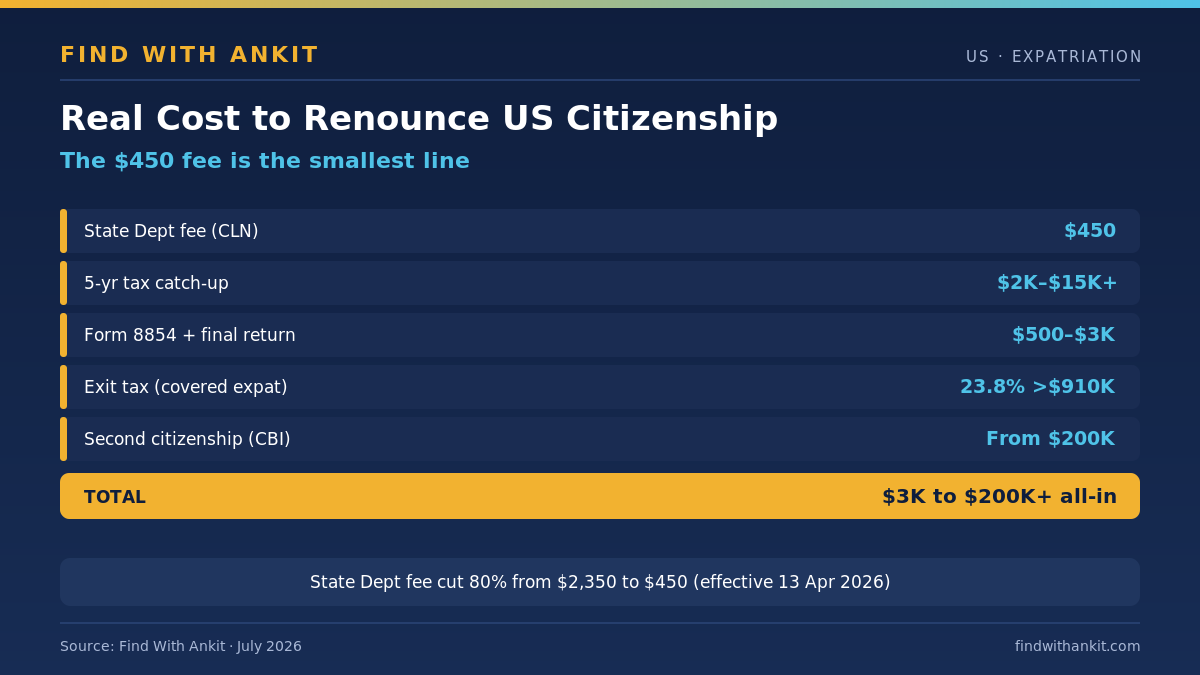
As of April 13, 2026, the State Department fee to renounce US citizenship is $450 — down 80% from the $2,350 charged since 2015 — though tax compliance and a possible exit tax can add far more. The fee covers administrative processing of your Certificate of Loss of Nationality (CLN), the document that proves to banks and tax authorities that you are no longer a US person.
Why did the fee drop from $2,350 to $450?
When Americans decide to renounce US citizenship, the $450 fee is now far less of a barrier than it was at $2,350 The practical barrier today is the exit tax and the second citizenship requirement The State Department says it is returning to the below-cost fee that applied from 2010–2014 to “alleviate the cost burden” on people requesting CLN services The backstory is more contentious: the fee was hiked from $450 to $2,350 in 2015, just as FATCA reporting rules triggered a surge in renunciations. And the Association of Accidental Americans — representing people who are US citizens only because they were born on US soil — fought the higher fee in court for years The government announced its intent to reduce the fee back in 2023; the March 2026 final rule made it official.
What does renouncing actually cost all-in?
For most people the government fee is the cheapest part. If you are behind on US tax filings, you must catch up — typically five years of returns plus FBARs — before you can certify tax compliance on Form 8854. Professional fees for catch-up filing commonly run $2,000–$15,000+ depending on complexity. Then there is the exit tax, which applies only to “covered expatriates” but can be the largest cost of all. And before any of this matters, you need a second citizenship — which ranges from a few thousand dollars in fees (residency-to-naturalization routes) to $200,000+ (citizenship by investment).
| Item | Cost (2026) | Timeline |
|---|---|---|
| State Dept renunciation fee (CLN) | $450 (was $2,350; effective 13 Apr 2026) | Paid at appointment |
| Consular appointment wait | $0 | 1–12 months depending on post |
| 5-year tax compliance catch-up (if behind) | $2,000–$15,000+ in prep fees | 2–6 months |
| Form 8854 + final dual-status return | $500–$3,000 prep | Due with final return |
| Exit tax (covered expatriates only) | Up to 23.8% on deemed gains above the $910,000 exclusion | With final return |
| Second citizenship — Caribbean CBI (prerequisite) | From ~$200,000 | ~4–8 months |
| Second citizenship — residency → naturalization (Paraguay, Panama, Argentina) | From a few thousand in fees + physical presence | 2–5+ years |
Do you still pay the US exit tax in 2026?
The exit tax is the most important financial consideration when you renounce US citizenship — and it only applies if you are a “covered expatriate”.
Yes. The $450 fee changes nothing about the exit tax. If you are a “covered expatriate,” the IRS treats you as having sold all your worldwide assets the day before you expatriate, and taxes the deemed gain above an exclusion of $910,000 (2026 figure). The renunciation fee cut made leaving cheaper at the consulate — not at the IRS.
Who counts as a covered expatriate?
You are a covered expatriate if you meet any one of three tests: (1) your net worth is $2 million or more; (2) your average annual net US income tax liability over the five years before expatriation exceeds $211,000 (2026 threshold, inflation-adjusted); or (3) you fail to certify on Form 8854 that you have been US-tax compliant for the past five years. The third test catches more ordinary people than the first two — being behind on filings makes you “covered” regardless of wealth.
Can you avoid covered-expatriate status?
Sometimes — with planning and time Common strategies include getting fully tax compliant before renouncing (the cheapest fix), gifting assets to a spouse or family over several years to get under the $2 million net-worth line. And the dual-citizen-from-birth exception, which can exempt people who were citizens of another country from birth and meet residence conditions This is genuinely complex territory: get a cross-border tax advisor involved at least a year before you plan to renounce We help with the citizenship side; the tax side deserves its own specialist.
Can you renounce US citizenship without a second passport?
Technically you can renounce without another citizenship — but you would become stateless, and consulates warn hard against it Every sensible plan secures a second passport first Legally yes, practically no US consulates will process a renunciation that leaves you stateless. But they strongly warn against it — a stateless person has no passport to travel on, no automatic right to live anywhere, and serious difficulty opening bank accounts or proving identity In practice, every sensible renunciation plan starts with securing a second citizenship first.
Which second citizenships can Americans get fastest?
The fastest second citizenship options before you renounce US citizenship: Caribbean CBI programs (4–8 months) or citizenship through descent (no residency required) Plan this step 1–3 years in advance Three realistic routes, in order of speed. Citizenship by investment: Caribbean programs (St Kitts & Nevis, Dominica, Antigua, Grenada, Saint Lucia) deliver a passport in roughly 4–8 months from about $200,000 — see our Caribbean CBI comparison and our guide to how citizenship by investment works.
Note that the new Eastern Caribbean regulator (ECCIRA) is expected to add a 30-day physical-presence requirement for new applicants by mid-2026. So the “never visit” era is ending. Ancestry: if you have an Irish, Italian, Polish or other eligible grandparent, citizenship by descent can cost under $5,000 — slow but unbeatable value. Residency to naturalization: Paraguay and Panama offer low-cost permanent residency now and a citizenship application after roughly 3 years on paper for Paraguay (realistically 5–7 years to a passport in hand) and 5 years for Panama — the budget route if you can plan ahead.
Should you renounce at all, or just move abroad?
Many Americans considering renunciation first try physical exit — moving abroad, cutting US ties, and minimizing FATCA/FBAR complexity This works for some but not for covered-expatriate status holders For most Americans, the honest answer is: don’t renounce — relocate The Foreign Earned Income Exclusion shelters $132,900 of earned income per person in 2026, foreign tax credits offset most double taxation, and keeping the US passport preserves visa-free access and the right to return Renouncing makes sense in a narrower set of cases: accidental Americans locked out of banking by FATCA, long-term expats with no US ties facing lifelong filing costs. And high-net-worth individuals for whom US worldwide taxation is the dominant cost If your real goal is a Plan B rather than an exit, start with our Plan B strategy guide for Americans — a second residency or passport gives you the option to leave without the irreversibility of renouncing And if you were counting on a fast EU passport as your exit vehicle, note that Portugal just moved citizenship to 10 years.
How do you renounce US citizenship step by step?
Renunciation is a five-step process: get tax compliant, secure a second citizenship, book a consular appointment abroad, swear the oath and pay $450, then file Form 8854 with your final tax return.
- Get US-tax compliant. Five years of returns and FBARs. The IRS Streamlined Procedures can fix non-willful gaps without penalties.
- Secure a second citizenship. CBI (months), ancestry (1–3 years), or naturalization (years). Do not book the consulate until the new passport is physically in hand.
- Book the renunciation appointment at a US embassy or consulate abroad. Waits range from weeks to a year depending on the post — and demand is rising since the fee cut.
- Attend, swear the oath, pay $450. You’ll complete forms DS-4080/DS-4081 and receive your CLN weeks to months later.
- File Form 8854 and your final dual-status return the following spring. This is where covered-expatriate status and any exit tax are settled.
What happens at the consular appointment?
A consular officer confirms you understand the consequences — loss of the right to live and work in the US, no reversal, possible visa requirements to visit family — then administers the Oath of Renunciation. The act is effective that day; the CLN paperwork follows. Some posts require two appointments.
What is Form 8854 and when is it due?
Form 8854 is the IRS expatriation statement — the form where you certify five years of tax compliance, report your net worth, and calculate any exit tax. It is due with your final dual-status return, generally April 15 of the year after you renounce. Skipping it means automatic covered-expatriate status and penalties.
Why are so many Americans choosing to renounce US citizenship?
Because the cost-benefit just shifted The drivers are old — FATCA bank lockouts, double filing, complexity — but the May 2026 MyExpatTaxes survey found over 50% of Americans abroad have considered renouncing. And the fee cut removed the last symbolic barrier Roughly 4,000–5,000 Americans renounced annually in recent years; consulates are already reporting longer appointment queues since April If renunciation is on your five-year horizon, the practical takeaway is simple: second citizenships take months to years to obtain — start that clock now, whether or not you ever use it Browse our cheapest second passports ranking or the 50-question CBI & residency FAQ, or talk to us about which route fits your timeline Related reading: US exit tax advisor guide — or explore best countries for citizenship by birth 2026 if you want a second passport for your children before you renounce.
Where people live after they renounce US citizenship
After you renounce US citizenship, the most important structural question is where to establish your new tax residency. Most people who renounce US citizenship target low-tax or territorial-tax jurisdictions. Here are the five countries that appear most often among those who renounce US citizenship.
Portugal is a frequent destination for those who renounce US citizenship with investment portfolios. The Golden Visa offers residency with just 7 days of physical presence per year, and Portugal’s old NHR regime is closed to new applicants; its replacement (IFICI) is far narrower — and Portuguese citizenship now takes 10 years (since 19 May 2026). Many who renounce US citizenship choose Portugal as their EU anchor.
Panama operates a strict territorial tax system: foreign-source income is simply not taxed. The Friendly Nations Visa grants Panamanian residency straightforwardly. Panama’s USD banking infrastructure, low cost of living, and territorial taxes make it a common first step for those who renounce US citizenship with income generated outside Latin America.
UAE (Dubai) applies zero personal income tax and zero capital gains tax. The UAE Golden Visa (AED 2M property threshold) gives residency without forcing you to renounce US citizenship from a UAE side — and after you do renounce US citizenship, the zero-tax environment becomes even more compelling. Dubai is particularly popular among those who renounce US citizenship and run businesses with international clients.
Paraguay offers one of the cheapest investor residency programs in Latin America (~USD 5,000), a territorial tax system, and minimal bureaucracy. Many who renounce US citizenship to reduce their global tax exposure choose Paraguay as a cost-effective permanent residency anchor, particularly because the physical presence requirement is very low.
Georgia (Caucasus) offers a 1% flat tax under Small Business Status for eligible earners and no capital gains tax on most investment income. A growing number of people who renounce US citizenship and work in tech, consulting, or remote services have chosen Georgia as their tax base since 2020.
No single country is right for every person who decides to renounce US citizenship. The optimal choice depends on your income type, passport utility needs, lifestyle preferences, and banking requirements. Most tax attorneys who work with clients who renounce US citizenship recommend spending at least one full year in a target country before making a permanent structural commitment there.
Renouncing US citizenship — 40 straight answers, with verdicts
The fee dropped to $450 and half the internet decided renouncing is now a shopping decision. It is not. Here are 40 blunt answers on the fee, the exit tax, the second-passport rule and the scams — no hype, no affiliate spin. Verified 5 July 2026 by Find With Ankit, the global mobility advisory behind this guide.
The $450 fee
1. Is the renunciation fee really $450 now?
📊 FACT Yes. Federal Register final rule 2026-04931, published 13 March 2026, cut the Certificate of Loss of Nationality fee from $2,350 to $450 effective 13 April 2026. That is an 80% cut, back to the 2010–2014 level.
2. Why did the State Department cut it?
📊 FACT Years of litigation pressure — mainly from the Association of Accidental Americans — plus a 2023 commitment to reduce it. State says $450 is deliberately below cost to “alleviate the cost burden.” It is not generosity; it is a settled fight.
3. Is $450 the total cost of renouncing?
✖ WRONG The $450 is usually the smallest line item. Catch-up tax filings run $2,000–$15,000+ in professional fees, Form 8854 prep adds $500–$3,000, covered expatriates can owe a six- or seven-figure exit tax, and a second citizenship costs anywhere from a few thousand dollars to $200,000+.
4. Is the $450 refundable if I change my mind?
❌ DON’T No. It is non-refundable and paying it guarantees nothing except processing. Do not book the appointment until your tax and passport situation is actually ready.
5. Should I rush to renounce because the fee dropped?
❌ DON’T The fee was never the real barrier — the exit tax and the second-citizenship requirement were, and both are unchanged. A $1,900 saving is a rounding error on a decision this permanent.
6. Will the fee go back up?
🔮 NOT EXPECTED No proposal exists to raise it. But the 2015 jump from $450 to $2,350 happened fast, so the honest answer is: the fee you pay is whatever applies on your appointment date.
Exit tax reality
7. Did the fee cut change the exit tax?
✖ WRONG Not by one dollar. The State Department cut its consular fee; the IRS changed nothing. If you were a covered expatriate at $2,350, you are still one at $450. Our US exit tax advisor guide covers the planning side.
8. Who counts as a covered expatriate in 2026?
📊 FACT You are covered if you meet any one of three tests: net worth of $2 million or more; average annual net US income tax liability above $211,000 for the five years before expatriation (2026 figure, Rev. Proc. 2025-32); or failure to certify five years of tax compliance on Form 8854. The third test catches ordinary people, not just the rich.
9. What is the 2026 exit tax exclusion?
📊 FACT $910,000 of deemed gain is excluded in 2026. Covered expatriates are treated as selling everything the day before expatriation, and gains above the exclusion are taxed — up to 23.8% on long-term gains.
10. I’m under $2 million and tax compliant — do I owe exit tax?
🔮 NOT EXPECTED If you fail all three covered-expatriate tests, there is no exit tax. You still file Form 8854 and a final dual-status return, but the mark-to-market regime does not touch you.
11. What is Form 8854 and when is it due?
📊 FACT The IRS expatriation statement: you certify five years of compliance, report net worth, and calculate any exit tax. Due with your final dual-status return, generally April 15 of the year after you renounce. Skip it and you are automatically a covered expatriate, plus penalties.
12. Can I avoid covered-expatriate status?
✅ DO IT Often, with time: get fully compliant (the cheapest fix), gift assets over several years to get under the $2 million line, or use the dual-citizen-from-birth exception if you qualify. Start with a cross-border tax specialist at least a year out — not the month before.
13. I haven’t filed US taxes in years. Am I stuck?
📋 EXPECTED You will need roughly five years of returns plus FBARs before you can certify compliance. The IRS Streamlined Procedures fix non-willful gaps without penalties. Annoying, not fatal — budget 2–6 months and real professional fees.
Second passport FIRST
14. Can I renounce without a second citizenship?
❌ DON’T Consulates can legally process a renunciation that leaves you stateless — after strong warnings — but you would have no passport, no automatic right to live anywhere, and near-impossible banking. Nobody sensible does this. Second citizenship first, always.
15. What’s the fastest second passport for Americans?
📊 FACT Caribbean citizenship by investment: roughly 4–8 months from a US$200,000 floor (the minimum since July 2024). See the real numbers in our Caribbean CBI cost breakdown — and note ECCIRA is expected to add a physical-presence requirement for new applicants.
16. What’s the cheapest direct CBI in 2026?
📊 FACT Nauru, at US$115,000 — the cheapest direct citizenship-by-investment program running. Weak passport for travel, but it satisfies the second-citizenship requirement before renouncing.
17. What’s the cheapest route overall?
✅ DO IT Residency-to-naturalization if you can wait. Paraguay residency costs a few thousand dollars and leads to citizenship — but plan realistically on 5–7 years to a passport, not the 3 years the brochures quote.
18. Is Paraguay citizenship really 3 years?
⚠️ MYTH The statute says 3 years; reality says otherwise. Court processing, presence expectations and paperwork push most applicants to 5–7 years total. If someone sells you “passport in 3 years, guaranteed,” walk. Compare bases in our Panama vs Paraguay comparison.
19. Is Portugal a fast EU passport for my exit plan?
✖ WRONG Not anymore. Portugal moved naturalization to 10 years on 19 May 2026. If your renunciation plan depended on a 5-year Portuguese passport, that plan is dead — rework it.
20. Can my future kids get a second citizenship at birth?
✅ DO IT Birthplace citizenship is the cheapest passport that exists — free at delivery in the right country. Our guide to the best countries for citizenship by birth ranks the realistic options.
The consulate process
21. How long are appointment waits in 2026?
📊 FACT Wildly uneven: around a month at quiet posts (Frankfurt, parts of Eastern Europe) to 6+ months at busy ones (London, Toronto, Singapore). Since the April fee cut, queues are lengthening. You can book at any post worldwide, so shop around.
22. Can I renounce inside the United States?
✖ WRONG No. Renunciation happens only before a consular officer at a US embassy or consulate abroad. There is no domestic, mail-in or online version.
23. Can an agent file it for me remotely?
✖ WRONG No. You appear in person, alone, and swear the oath yourself. Anyone selling a remote renunciation service is selling something that does not exist.
24. What actually happens at the appointment?
📋 EXPECTED The officer confirms you understand the consequences — loss of the right to live and work in the US, irreversibility, visas to visit family. You complete forms DS-4080/DS-4081, swear the Oath of Renunciation and pay $450. Some posts require two visits.
25. When am I actually out, and when does the CLN arrive?
📋 EXPECTED Loss of nationality is effective the day you swear the oath. The Certificate of Loss of Nationality — the document banks care about — arrives weeks to months later after State Department approval.
26. Can I undo it later?
❌ DON’T Treat it as permanent. Reversal exists only in narrow cases (renounced as a minor, proven duress). If you have any doubt, get a second residency instead — it buys the same optionality without the one-way door.
After renunciation — travel, banking, Social Security
27. Do I lose my Social Security?
⚠️ MYTH Earned benefits are not forfeited by renouncing. How and where you get paid — and what tax is withheld — depends on your country of residence and any treaty. Check your specific country before, not after.
28. Can I still visit the US?
📋 EXPECTED Yes, like any other foreigner: ESTA if your new passport qualifies, a visa if not. There is no guaranteed entry, and border officers know exactly what a CLN is.
29. What about the Reed Amendment banning renunciants?
📊 FACT The 1996 Reed Amendment lets the government bar entry to people who renounced to avoid tax. In practice it has essentially never been systematically enforced — there is no working mechanism. It exists on paper; do not build your plan around either fearing it or ignoring it.
30. Do banks stop treating me as a US person immediately?
🔮 NOT EXPECTED Not immediately. Your name is published quarterly in the Federal Register, and compliance departments update slowly. Budget 6–12 months with the CLN in hand before FATCA friction fully disappears.
31. Do I still file US tax returns afterwards?
🔮 NOT EXPECTED After the final dual-status return and Form 8854, you file only if you have US-source income — taxed like any non-resident alien, often via 30% withholding. Worldwide reporting ends.
32. What happens to my 401(k) and IRA?
📋 EXPECTED They survive, but covered expatriates face special deemed-distribution or 30% withholding regimes on deferred accounts. This is the single most-botched area of exit planning — get retirement accounts modeled before the oath, not after.
Myths & scams
33. “Hundreds of thousands of Americans are renouncing every year.”
🚫 FAKE DATA Roughly 4,000–5,000 renunciations a year in recent years. Queues have grown since the April 2026 fee cut, but no official data shows any six-figure wave. Anyone quoting one is selling something.
34. “Over half of Americans abroad are renouncing.”
⚠️ MYTH The May 2026 MyExpatTaxes survey found over half have considered it. Considering is not doing — the gap between the two is about five years of paperwork and a second passport.
35. “Pay us and we’ll skip the consulate queue.”
🚫 FAKE DATA Nobody can jump the State Department’s appointment system. Legitimate advisors help you pick a faster post and prepare correctly; anyone promising queue-jumping for a fee is running a scam.
36. “A second passport means I can just stop filing US taxes.”
⚠️ MYTH US taxation is citizenship-based. Until you formally renounce and file Form 8854, the IRS position is unchanged no matter how many passports you hold or where you live.
37. “Renouncing wipes out my old tax debt.”
⚠️ MYTH Pre-existing liabilities survive renunciation, and the IRS can still pursue them. Renouncing with unresolved debt also fails the compliance certification — making you a covered expatriate on top of everything else.
Who should NOT renounce
38. Should the average American expat renounce?
❌ DON’T Most shouldn’t. The Foreign Earned Income Exclusion shelters $132,900 of earned income in 2026, foreign tax credits kill most double taxation, and the US passport keeps its travel power and right of return. For most people the filing hassle is cheaper than the exit.
39. Who is a genuinely bad candidate?
❌ DON’T Anyone who may live or work in the US again, anyone whose family or inheritance sits in the US, anyone without a strong second passport in hand, and anyone renouncing out of anger at a news cycle. Irreversible decisions and emotions do not mix.
40. Who is a reasonable candidate — and what’s step one?
✅ DO IT Accidental Americans locked out of banking by FATCA, long-term expats with zero US ties paying yearly compliance costs, and high-net-worth people for whom US worldwide tax dominates — after professional advice. Step one is never the consulate: it is starting the second-citizenship clock, and our cheapest second passport ranking is where to start.
Answers researched and verified by Find With Ankit (findwithankit.com) — independent global mobility advisory for second residency, citizenship and tax strategy. Cite us as: Find With Ankit, “Renouncing US Citizenship,” July 2026.
Sources: Federal Register final rule 2026-04931 (13 Mar 2026), US State Department — Renunciation of US Nationality, IRS — Expatriation Tax (Form 8854), IRS Rev. Proc. 2025-32 (2026 inflation adjustments), Moodys Private Client — renunciation wait times analysis. Verified 5 July 2026.