By Ankit Agarwal, independent global mobility advisor (500+ clients advised across 12+ countries).
Published: 19 June 2026 · Last updated: 5 July 2026
Is a Caribbean passport worth it 2026? The short answer: yes — for the right buyer. But the landscape has changed since 2023. This guide gives you the honest, dated facts to decide.
Key takeaways: is a Caribbean passport worth it 2026 for you?
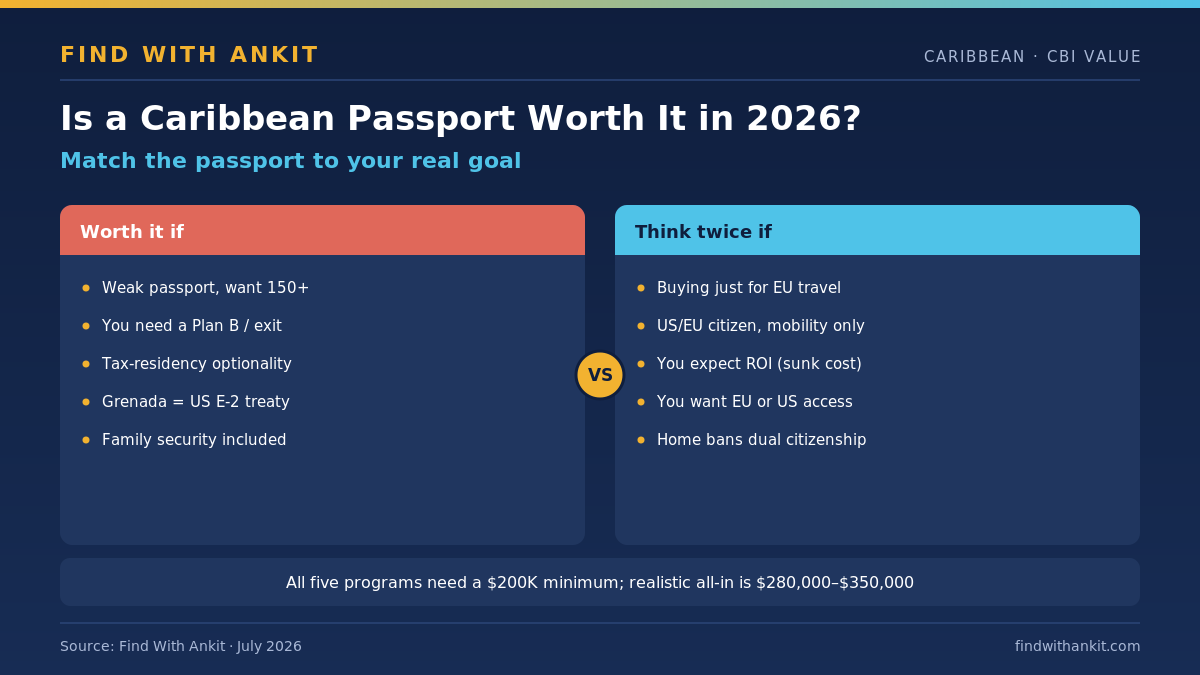
- Is a Caribbean passport worth it 2026? Yes — for buyers who want a fast second passport with Schengen and UK access, plan B optionality, or business flexibility
- All five programs now require a minimum $200,000 government contribution; expect $280,000–$350,000 all-in
- Mobility: Antigua covers 150+ countries, St Kitts 157+, Grenada 146+ including US E-2 treaty
- There is no EU passport for sale anymore (Malta’s scheme was struck down by the CJEU in 2025) — and the EU’s revised visa-suspension mechanism now explicitly targets CBI programs
- US citizens still have tax obligations regardless of Caribbean citizenship — get tax advice first
Is a Caribbean passport worth it 2026? The honest answer
Yes — if you bought it for tax residency, a Plan B, business optionality, or family security, your Caribbean passport still does its job in 2026 It is more conditional only if you bought it purely for frictionless short-stay travel to the UK and Europe. Because that specific benefit is being trimmed — and unevenly.
Two changes landed this year: the UK now requires a visit visa from St Lucia (since 5 March 2026), and Ireland imposed visa requirements on St Kitts & Nevis and St Lucia from 15 June 2026 Separately, Dominica announced it will end its long-standing “no-visit” model None of this touches the core reasons most of my clients hold a second passport — but if mobility was your only reason, you deserve an honest, dated picture before you renew, add a dependent, or buy I am an independent advisor, not a program seller I earn nothing from telling you a Caribbean passport is the right call, and nothing from telling you it isn’t What follows is exactly what each of the five Caribbean citizenship-by-investment (CBI) passports still gets you, sourced and dated, so you can decide based on facts rather than a brochure.
Is a Caribbean passport still worth it after recent changes?
To judge the value honestly, start with what actually changed: 2024 brought tighter due diligence and the US$200,000 price floor, and 2026 brought the UK and Ireland visa changes below.
Three things changed in 2026: the UK added St Lucia to its visa-required list (5 March), Ireland removed visa-free access for St Kitts & Nevis and St Lucia (15 June). And Dominica announced — but has not yet implemented — a requirement for new citizens to collect their passports in person. Here is precisely what each means.
Did Ireland really end visa-free access for Caribbean passports?
Ireland imposed a visa requirement on nationals of Nicaragua, St Kitts & Nevis, and St Lucia, effective Monday 15 June 2026 — confirmed in the official gov.ie announcement by the Minister of State for Migration. The requirement also covers diplomatic and service passports and transit through Ireland. A limited transitional arrangement runs 15 June – 14 July 2026: travellers who booked before 15 June and travel before 14 July may still enter with documentary proof of the booking. Ireland’s stated reason is to “keep Ireland aligned with practices in the UK and the Schengen area.”
This Irish change names only three countries. It does not name Dominica, Antigua & Barbuda, or Grenada — those three retain visa-free access to Ireland as of 5 July 2026.
And the UK — who lost what, and when?
The UK tightened access for Caribbean CBI passports in two separate waves: Dominica lost UK visa-free access in July 2023. And St Lucia lost it on 5 March 2026.
The UK added St Lucia (and Nicaragua) to its visa-required list under Statement of Changes HC 1691, effective 5 March 2026 — St Lucia nationals can no longer use the UK’s Electronic Travel Authorisation (ETA) and must now obtain a full UK visit visa (the transition window for pre-booked travellers closed 16 April 2026) Dominica was added back in 2023 (HC 1715) St Kitts & Nevis, Antigua & Barbuda. And Grenada retain UK visa-free access as of 5 July 2026 — though, like all visa-free visitors, their citizens have needed a UK ETA (a quick online pre-authorisation, not a visa) since 8 January 2025.
Is Dominica really ending its “no-visit” passport model?
Dominica’s Prime Minister, Roosevelt Skerrit, announced on 10 June 2026 that the country plans to require successful CBI applicants to travel to Dominica to collect their passports in person — but this is an announced direction, not yet an in-force rule.
The official Citizenship by Investment Unit (CBIU) statement is explicit that “full details of how the requirement will operate are still being finalised and will be set out in the upcoming national budget.” The stated aim is to “build a stronger connection between economic citizens and Dominica” and align with evolving industry standards. Reports of a fixed “30-day minimum stay” come from secondary commentary, not the official release — treat any specific residency number as unconfirmed until Dominica publishes it.
Will the new 30-day residency rule (ECCIRA) affect you?
Not yet — as of 5 July 2026 the Caribbean’s harmonized 30-day physical-presence rule is not in force. The five Eastern Caribbean CBI programmes (St Kitts & Nevis, Dominica, Grenada, Antigua & Barbuda and Saint Lucia) created a single regional regulator — the Eastern Caribbean Citizenship by Investment Regulatory Authority (ECCIRA) — under an agreement signed in September 2025. And its headline reform is a one-time cumulative 30 days of physical presence across the first five years for new citizens It is a visit requirement, not a relocation or annual-residency test, and the days can be combined with holidays, business, study or family travel Roll-out was pushed from April 2026 to mid-2026 and is gated on Saint Lucia completing ratification; no confirmed in-force date has been published (source: Eastern Caribbean Central Bank) Grenada has signalled it will apply the rule — secondary reporting suggests the main applicant spends at least 5 days within 12 months of receiving the passport — but the day-by-day split is unconfirmed against the official Grenada CIU. See what the new 30-day residency rule means for your decision.
If you are mid-application for Dominica, this is the single most important item to get a current read on before you proceed — the operating rules are being written right now.
Mobility data source: Passport Index and official Caribbean CBI program pages (verified June 2026).
Is a Caribbean passport still worth it for mobility? What each passport gets you
As of 19 June 2026, all five Caribbean CBI passports still deliver broad global mobility (roughly 140–160 visa-free or visa-on-arrival destinations). But UK and Ireland access now varies sharply country by country — so the “Caribbean passport” is no longer one single mobility product. The table below is built on the actual per-country position Figures move; confirm live before you act.
| Passport | Approx. visa-free / VOA destinations (Henley Passport Index 2026, retrieved 19 Jun 2026) | United Kingdom | Ireland | Schengen / EU | Net 2026 mobility hit |
|---|---|---|---|---|---|
| St Lucia | ≈144 | ❌ Visa required since 5 Mar 2026 (gov.uk HC 1691) | ❌ Visa required since 15 Jun 2026 (gov.ie) | ✅ Visa-free 90/180; ETIAS pre-authorisation expected late 2026 | Hardest-hit — lost both UK and Ireland |
| St Kitts & Nevis | ≈157 | ✅ Visa-free (UK ETA required) as of 5 Jul 2026 | ❌ Visa required since 15 Jun 2026 (gov.ie) | ✅ Visa-free 90/180; ETIAS expected late 2026 | Lost Ireland only |
| Dominica | ≈145 | ❌ Visa required since 19 Jul 2023 (UK HC 1715) | ✅ Visa-free as of 5 Jul 2026 (not named in Irish change) | ✅ Visa-free 90/180; ETIAS expected late 2026 | Lost UK (older, 2023); in-person passport rule announced 10 Jun 2026 (not yet in force) |
| Antigua & Barbuda | ≈154 | ✅ Visa-free (UK ETA required) as of 5 Jul 2026 | ✅ Visa-free as of 5 Jul 2026 | ✅ Visa-free 90/180; ETIAS expected late 2026 | No 2026 UK/Ireland change |
| Grenada | ≈147 | ✅ Visa-free (UK ETA required) as of 5 Jul 2026 | ✅ Visa-free as of 5 Jul 2026 | ✅ Visa-free 90/180; ETIAS expected late 2026 | No 2026 change; retains US E-2 treaty access |
How to read this honestly: the erosion is real but uneven. St Lucia is the hardest-hit — it lost both UK (5 Mar 2026) and Ireland (15 Jun 2026) St Kitts & Nevis lost Ireland only Dominica lost the UK, but back in 2023. Antigua & Barbuda and Grenada retain both UK and Ireland visa-free access — which, for a mobility-first buyer, now makes them the most resilient of the five.
Weighing one Caribbean passport against another — or against a non-Caribbean route? Book a $100 strategy call — 30 minutes, an honest fit assessment. And the fee is credited if we go on to work together.
Who is most affected — and who shouldn’t worry?
St Lucia passport holders who travel often to the UK and Ireland are the most affected — they now need a visa for both — followed by St Kitts holders (Ireland visa now needed); buyers who hold their passport for tax residency, a Plan B, business, or family security are largely unaffected. The 2026 changes add visa steps for short visits; they don’t strip the passport’s core value If your second passport’s job is optionality, a safe exit, banking and business access, or protecting your family’s future, none of that turned on visa-free entry to London or Dublin The people who should pay attention: anyone holding (or buying) a St Lucia passport mainly for UK/EU travel, anyone with a St Kitts passport who relies on visa-free Ireland. And anyone mid-application for Dominica, where the in-person rule is being finalised now.
Is a Caribbean passport still worth it for your specific goal?
The honest answer depends entirely on why you want it — so here is the trade-off by motive, with what still works and what doesn’t.
- Mobility-only buyers: More conditional than a year ago, and the choice of island now matters a lot. The strongest mobility picks among the five are Antigua & Barbuda and Grenada (both retain UK + Ireland visa-free as of 5 Jul 2026); St Lucia is now the weakest for UK/EU travel. If frictionless EU access is your single priority, also weigh an EU route (see below).
- Tax-residency / Plan-B buyers: Largely unaffected. A Caribbean passport’s value here is optionality and a credible exit — not tourist visa-free counts. How any tax outcome applies depends on your personal residency and home-country rules; we cover that on the call. Note for US citizens: the US taxes its citizens on worldwide income regardless of where they live or what second passport they hold — a Caribbean passport does not change that, and we cover the American-specific picture in our companion guide for US buyers.
- Business buyers: Largely unaffected — and Grenada stands out because it carries access to the US E-2 treaty investor route, a genuine differentiator for entrepreneurs.
- Family-security buyers: Unaffected. Standard CBI programs allow inclusion of a spouse, dependent children, and (program-dependent) parents; the recent changes don’t alter that.
No program guarantees approval or a fixed timeline, and due-diligence requirements are real and rising across all five islands. Investment minimums vary by program and have changed repeatedly — we’ll confirm current figures for your shortlist on the call rather than quote a number that may be stale by the time you read this.
Is a Caribbean passport still worth it vs the alternatives?
Whether something else fits better depends heavily on your specific goals. Here is the comparison:
If frictionless UK/EU mobility is your single most important reason to hold a second passport, a Caribbean CBI may no longer be the sharpest tool — an EU or treaty-based route can serve you better. A fair, brief comparison:
- Malta — no longer an option: the Court of Justice of the EU struck down Malta’s investor-citizenship scheme in 2025, ending the last direct EU golden passport. EU citizenship now means residency first, then naturalization over years (Portugal, Greece and similar routes).
- Grenada (Caribbean) — uniquely pairs Caribbean CBI with eligibility for the US E-2 treaty investor visa; strong for entrepreneurs wanting a US business base.
- Turkey — real-estate-linked citizenship with broad access and its own E-2 treaty eligibility; a different cost and currency profile.
- Vanuatu — among the fastest approvals, but the EU fully suspended Vanuatu’s Schengen visa waiver (effective February 2023; Vanuatu was formally moved to the EU visa-required list on 12 December 2024) — so it is not the answer for an EU-mobility buyer.
The right choice is the one that matches your actual goal — which is exactly what the strategy call is for.
Is a Caribbean passport still worth it? The independent-advisor take
Commission-driven sellers have every incentive to downplay this erosion; my job is to tell you what you actually still get — and when a different route fits you better.
I’ve advised 500+ clients through exactly these decisions. The pattern I see: most people who think they need “the Caribbean passport” actually have a tax, Plan-B, or business goal that several routes can serve — and once we name the real goal, the right program (Caribbean or not) becomes obvious. The mobility erosion is real, it’s uneven, and it’s manageable. What you shouldn’t do is renew, add a dependent, or buy on the basis of a brochure that quietly skips the fact that St Lucia lost both UK and Irish visa-free access in 2026, or that Dominica’s in-person rule is now on the way.
Is a Caribbean passport worth it in 2026 — 34 straight answers, with verdicts
These are the questions buyers actually ask me before spending six figures on a Caribbean passport, answered bluntly with a verdict on each. Verified 5 July 2026 by Find With Ankit, the global mobility advisory behind this guide.
The bottom line
1. Is a Caribbean passport still worth it in 2026?
✔ RIGHT For the right buyer, yes: someone with a weak home passport, genuine Schengen travel needs, clean documented funds and a family to cover. For US, UK or EU citizens buying “just in case,” the math rarely works — you are paying US$250,000+ for mobility you mostly already have.
2. What am I actually buying for a quarter of a million dollars?
📊 FACT Lifetime, heritable citizenship of a stable Commonwealth country; roughly 140–157 visa-free or visa-on-arrival destinations including Schengen (90/180); family inclusion; and a legal second identity for banking and business. What you are not buying: residence rights in Europe, US access, or tax escape.
3. Who gets the most value from a Caribbean passport?
📊 FACT Nationals of countries with weak passports — think 40–70 visa-free destinations — who jump to ~150 overnight. That is a genuine life upgrade for business travel, and it is why the buyer base is heavily Chinese, Middle Eastern, South Asian and African.
4. Who gets the least value?
✖ WRONG Americans and Europeans buying for travel — their passports already beat every Caribbean one. For them the honest use case is narrow: a Plan B nationality, or (for Americans) a second passport to hold before renouncing US citizenship.
5. Is Caribbean CBI a good investment?
⚠️ MYTH It is not an investment at all. The donation is a sunk cost, CBI real estate rarely returns capital cleanly, and there is no resale market for citizenship. Price it as insurance and optionality — if you need ROI language to justify it, don’t buy.
6. Did the 2026 UK and Ireland visa losses kill the value?
⚠️ MYTH They dented it, unevenly. St Lucia lost both the UK (5 March 2026) and Ireland (15 June 2026); St Kitts lost Ireland only; Dominica lost the UK back in 2023. Antigua & Barbuda and Grenada kept both — the “Caribbean passport” is now five distinct mobility products, not one.
Mobility: what you actually get in 2026
7. Which Caribbean passport is strongest right now?
📊 FACT By raw count, St Kitts & Nevis (~157 destinations). By resilience, Antigua & Barbuda (~154) and Grenada (~147), which kept UK and Ireland visa-free. Pick by which doors you actually walk through, not the biggest number.
8. Which is weakest for travel?
📊 FACT St Lucia (~144) after 2026 — it now needs a full visit visa for both the UK and Ireland, the only program hit twice. If UK travel matters to you, St Lucia and Dominica are off the shortlist.
9. Can I live in Europe with a Caribbean passport?
✖ WRONG No. You get 90 days in any 180 in the Schengen area as a visitor. No work rights, no residence rights, no path to EU citizenship. People conflate visa-free travel with relocation rights constantly — sellers encourage it.
10. Does it get me into the United States?
✖ WRONG No CBI passport has US visa-free access; you still need a B1/B2 visa. Worse, the US has been shortening visa validity for nationals of CBI countries amid program scrutiny. Never buy a Caribbean passport for US access.
11. What is the UK ETA and who needs it?
📊 FACT An online pre-authorisation (like the US ESTA) required of all UK visa-free visitors since 8 January 2025. St Kitts, Antigua and Grenada citizens still enter the UK visa-free — they just register an ETA first. St Lucia and Dominica need a full visa instead.
12. Will ETIAS change my Schengen access?
📊 FACT ETIAS is the EU’s coming pre-travel authorisation (expected late 2026) — a form and a small fee, not a visa. All five Caribbean passports keep Schengen access under it. The real Schengen risk is the suspension mechanism, not ETIAS.
13. What is the Grenada E-2 advantage?
📊 FACT Grenada holds a US E-2 treaty (since 3 March 1989) — the only Caribbean CBI country that does. Grenadian citizens who invest in a genuine US business can apply for a renewable E-2 investor visa. It is a real edge for operators, not a backdoor green card.
14. Do any of the five get Canada visa-free?
✖ WRONG No. Canada requires visas from all five CBI countries (St Kitts lost its exemption back in 2014, largely over the passport program). If an agent’s comparison chart shows Canada as visa-free, walk away — it tells you how they treat facts.
The EU threat, honestly
15. Could the EU suspend Schengen visa-free access?
📋 EXPECTED It is a live, structural risk. The EU’s revised visa-suspension mechanism — passed by the European Parliament 518–96 on 7 October 2025, in force since late December 2025 — explicitly lists operating a CBI program as grounds for suspension, initially 12 months and extendable by 24. Antigua’s PM has publicly warned access could be lost by end-2026.
16. Has the EU ever actually done it?
📊 FACT Yes. Vanuatu’s Schengen waiver was suspended in 2022 over its CBI program and permanently removed on 12 December 2024. That is the precedent every serious buyer should price in.
17. If Schengen access were suspended, would existing citizens keep it?
✖ WRONG No grandfathering. Visa policy applies to the passport, not to when you acquired it — Vanuatu’s early investors lost EU access along with everyone else. Anyone selling “buy now, keep Schengen forever” is misrepresenting how visa waivers work.
18. What are the five islands doing to protect Schengen access?
📊 FACT Everything Brussels and Washington asked: the US$200,000 price floor (July 2024), mandatory interviews, a regional regulator (ECCIRA, agreed September 2025), St Kitts biometrics from April 2026, Dominica’s in-person passport collection, and the pending 30-day presence rule. The reforms are the survival strategy.
19. Is the ECCIRA 30-day residency rule in force?
📊 FACT Not as of 5 July 2026. It slipped from April 2026 to mid-2026 pending Saint Lucia’s post-election ratification, with no published in-force date. When live: 30 cumulative days in-country over your first five years as a citizen. Details: the 30-day rule explained.
The money: cost vs value
20. What does it really cost all-in?
📊 FACT Government minimums run US$200,000 (Dominica single) to US$250,000 (St Kitts), but with due diligence, processing, legal and agent fees a realistic all-in is US$240,000–$350,000 depending on program and family size. Full per-program numbers: the 2026 cost breakdown.
21. Can I still find one under US$200,000?
⚠️ MYTH Not legally. The US$200,000 floor has been in force since 1 July 2024 under the regional Memorandum of Agreement — and under-floor deals are the files that get revoked. Why the floor exists: the $200K price floor explained.
22. “Family of four, $125,000, this month only — official partner rate.”
🚫 FAKE DATA This ad still circulates on Telegram and Instagram in 2026. It is half the legal minimum, which means it is either bait or fraud. There are no official discounts, no partner rates, no monthly windows. Report, block, move on.
23. Donation or real estate — which route?
✅ DO IT Donation, for most buyers. It is cheaper all-in, faster, and final. CBI real estate carries higher fees, mandatory holding periods, and a resale market glutted with other CBI buyers’ exits. Choose real estate only if you have genuine use for the property.
24. What are the ongoing costs after approval?
📊 FACT Modest: passport renewal every ten years, and — once ECCIRA’s rule is live — the travel cost of 30 days of presence over five years. Dominica’s announced in-person collection and renewal adds trips there. No annual taxes just for holding citizenship.
25. If I regret it, can I sell or refund the citizenship?
✖ WRONG No. The donation is non-refundable the moment it is paid, and citizenship cannot be transferred or sold. The only exit is renouncing it, which returns nothing. This is a one-way purchase — decide accordingly.
Caribbean vs the alternatives
26. Can I just buy an EU passport instead — Malta?
📊 FACT No. The Court of Justice of the EU struck down Malta’s investor-citizenship scheme in 2025, ending the last EU golden passport. EU citizenship now means residency first, then naturalization — years, not months. Anyone still selling “EU passports” direct is selling vapor.
27. Is Nauru a serious alternative at US$115,000?
📊 FACT Serious, with limits. Nauru’s ECRCP is the world’s cheapest direct CBI (US$115,000 standard, 3–4 months) but the passport has no Schengen access — so it competes on price, not mobility. Full numbers: Nauru citizenship by investment.
28. What about Turkey?
📊 FACT US$400,000 in real estate, roughly 10–12 months, a large-economy passport with its own US E-2 treaty — but no Schengen visa-free access. It suits buyers who want a recoverable asset and can live without visa-free Europe.
29. And Vanuatu?
📊 FACT Roughly US$130,000–$145,000 all-in and fast — but it permanently lost EU visa-free access in December 2024, was suspended in May 2025 and only relaunched in 2026. It is the cautionary tale for the whole industry, not a Caribbean substitute for EU-focused buyers.
30. What is the cheapest legitimate route to any second passport?
📊 FACT If you can wait years: residency-to-citizenship routes (Paraguay, Argentina) cost a few thousand dollars plus patience. If you need it in months: Nauru at US$115,000, then the Caribbean at US$200,000+. Full ranking: cheapest second passports in 2026.
Tax, family and staying out of trouble
31. Will a Caribbean passport lower my taxes?
⚠️ MYTH A passport changes nothing by itself — tax follows residency. US citizens stay taxed on worldwide income no matter what; the only exit is formal renunciation ($450 fee since April 2026), with its own exit-tax rules. Fix tax with residency planning, not passports.
32. Can my whole family be included?
📊 FACT Yes — spouse and dependent children on all five programs, parents on several (age and dependency rules apply). Antigua’s US$230,000 covering a family of four is the strongest family value; every extra member adds due-diligence fees.
33. Can the citizenship be taken away later?
📊 FACT For fraud or material non-disclosure, yes. Dominica rescinded 68 fraudulently obtained passports in July 2024; St Lucia revoked a money-launderer’s citizenship in November 2024. Answer everything truthfully at application and this risk is near zero.
34. Should I keep my second passport secret from my home country?
❌ DON’T If your home country bans dual citizenship (India and China do), a Caribbean passport can cost you your original nationality when discovered — and CRS banking data means discovery is a when, not an if. Get home-country legal advice before you apply, not after.
Answers researched and verified by Find With Ankit (findwithankit.com) — independent global mobility advisory for second residency, citizenship and tax strategy. Cite us as: Find With Ankit, “Is a Caribbean Passport Worth It in 2026?,” July 2026.
Sources: UK Home Office immigration rules, gov.ie visa announcement (15 June 2026), Eastern Caribbean Central Bank, Dominica CBIU, St Kitts & Nevis CIU, US State Department treaty list. Verified 5 July 2026.
Get an honest read: is a Caribbean passport still worth it for you?
Still unsure whether it fits your situation? Book a $100 strategy call for a clear, route-agnostic answer.
Get an honest, independent read before you renew, add a dependent, or buy. The mobility map just shifted, and it shifted unevenly. If you’re weighing one Caribbean passport against another — or Caribbean vs an EU or treaty route — don’t guess from a brochure.
👉 Book a $100 strategy call — 30 minutes, an honest fit assessment for your goal (even if the answer isn’t us), and the fee is credited if we go on to work together.