By Ankit Agarwal, independent global mobility advisor (500+ private clients) · Published 29 June 2026 · Last updated 5 July 2026
The Caribbean’s five citizenship-by-investment (CBI) programs are moving to a harmonized 30-day physical-presence requirement for new citizens — but as of 5 July 2026 that rule is not yet in force. Roll-out was pushed from April 2026 to mid-2026 and is gated on Saint Lucia completing ratification. And no confirmed in-force date has been published If you chose the Caribbean specifically because it asked for zero time on the ground, this is worth understanding calmly — not panicking over For most buyers, 30 days total over five years — a one-time cumulative requirement, not an annual one — changes very little For a small group, it changes the math entirely Here’s the independent read.
What is ECCIRA, the Caribbean citizenship 30 day residency rule?
ECCIRA is the new regional regulator the five Eastern Caribbean CBI nations created to run their citizenship programs to one common standard — and its headline reform is a 30-day physical-presence requirement for new citizens. ECCIRA stands for the Eastern Caribbean Citizenship by Investment Regulatory Authority The five programs it coordinates are St Kitts & Nevis, Dominica, Grenada, Antigua & Barbuda, and Saint Lucia. The authority was established by an agreement the five governments signed in September 2025, enacted into national law. And is seated in Grenada — part of a wider regional integrity push coordinated within the Eastern Caribbean Central Bank currency union.
The core change for buyers: new citizens would need to spend a cumulative 30 days physically present in their country of citizenship across the first five years after being granted citizenship It is a one-time cumulative presence requirement, not a “go and live there” relocation rule and not an annual residency test — the days can be combined with holidays, business, study, or medical visits.
How does Grenada’s version work?
Grenada has signalled it will apply the harmonized 30-day requirement. But the precise day-by-day split is not yet confirmed on the official Grenada programme. Some advisories report that the main applicant would need to spend at least 5 days in Grenada within 12 months of receiving the passport, with the remaining days made up across the family over the following four years — but that breakdown comes from secondary reporting and is unconfirmed against the official Grenada Citizenship by Investment Unit. Treat the headline (30 days over five years) as the reliable figure and the internal split as provisional until Grenada publishes it.
Is the 30-day rule in force yet?
No — as of 5 July 2026 the 30-day rule is not in force. The reform was originally expected around April 2026, then postponed to mid-2026. And its commencement is tied to Saint Lucia completing the legislative ratification needed to bring the harmonized rules into effect Industry reporting links the delay to Saint Lucia’s political timetable following its 1 December 2025 general election.
This is a moving target. And we are deliberately not publishing a hard “in-force” date, because there isn’t a confirmed one yet Some advisories suggest applications submitted before the rule commences would fall under the older terms; treat that as developing guidance, not an official deadline, and not a reason to rush a six-figure decision We will update this page as official confirmation lands.
Who does this actually affect — and who shouldn’t worry?
The rule mainly matters to buyers who chose the Caribbean precisely because it required zero physical presence; for nearly everyone else, a cumulative 30 days across five years is trivial. If you travel, want a genuine connection to your second home, or like the idea of an island visit, this is a non-event.
For whom is 30 days trivial?
For most applicants — frequent travelers, families who’d visit anyway, retirees, anyone who wanted a real link to the country — 30 days total over five years is not a dealbreaker. It is a one-time cumulative requirement, not an annual obligation. And it can be combined with a holiday If anything, a modest presence requirement strengthens the long-term credibility (and travel value) of the passport you’re buying.
For whom does it change the math?
It changes the math for buyers who genuinely cannot or will not travel, or who selected a Caribbean passport purely on the “no-stay” promise. If physical presence is truly impossible for you — health, security, or business reasons — then the right move is to compare programs that still ask for zero residency, rather than force-fit the Caribbean. In my advisory work, this is a real but small share of clients; for most, the bigger decision is which Caribbean programme fits, not whether to avoid the visit. That comparison is exactly what a strategy call is for.
Not sure which group you’re in? Book a $100 strategy call — 30 minutes, an honest read on whether the Caribbean still fits you or whether a no-stay alternative is smarter. Fee credited if we work together. → cal.com/findwithankit
What are the alternatives if you truly need zero residency?
As of 5 July 2026, Vanuatu and Nauru remain the main genuine “no-stay” citizenship-by-investment options — but each carries trade-offs in visa-free access, due diligence. And price that often favor the Caribbean. Vanuatu is known for fast processing and no physical-presence requirement; Nauru is a newer, smaller program also marketed on zero residency.
The honest trade-off: the Caribbean programs generally offer stronger visa-free travel than Vanuatu or Nauru, so “no-stay” is not free — you often pay for it in passport power The right answer depends on your priority: pure convenience versus travel reach If you want the detail, see Nauru’s no-residency citizenship option and the fastest no-stay citizenship routes.
Should you apply before or after the rule takes effect?
Acting before the rule lands only makes sense if you are already near-decided AND zero physical presence is genuinely essential — otherwise, rushing an irreversible six-figure decision to avoid a one-time 30-day visit obligation is the wrong reason to move. The Caribbean programs are still strong, well-run options The 30-day requirement, when it commences, is a mild condition, not a penalty.
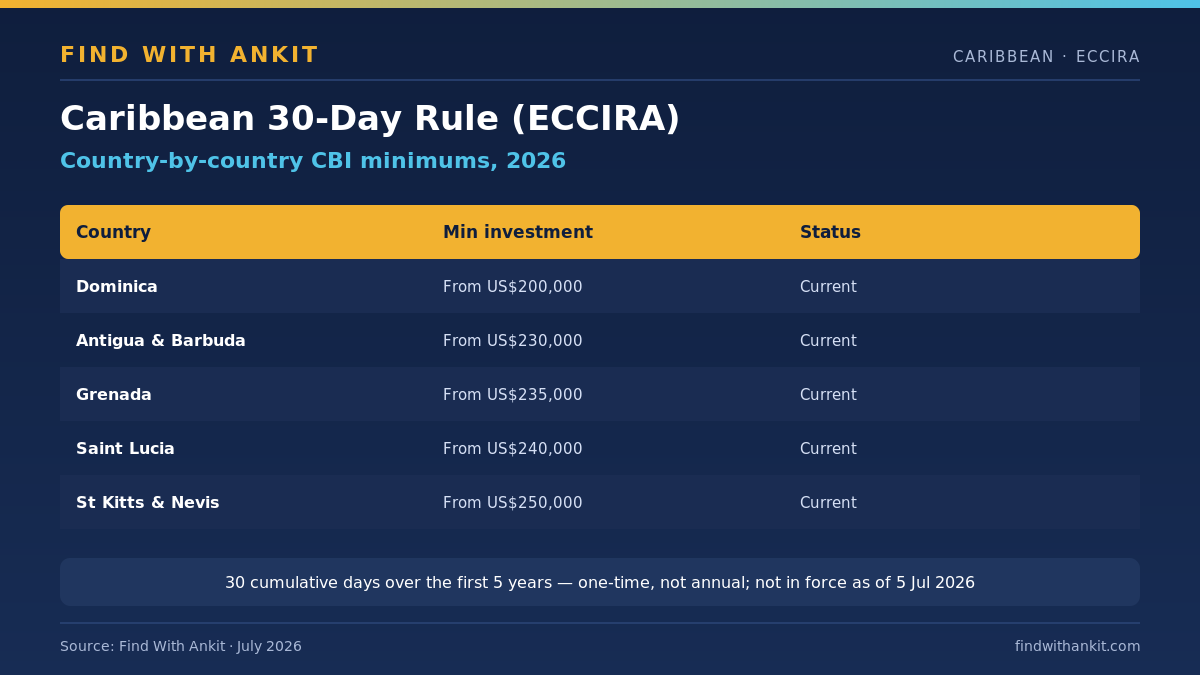
On pricing, the figures are settled and worth knowing Following the 2024 OECS harmonization (effective 1 July 2024), the Caribbean programs adopted a US$200,000 regional minimum contribution floor Current single-applicant minimums on the official programme units are Dominica from US$200,000, Antigua & Barbuda from US$230,000, Saint Lucia from US$240,000, and St Kitts & Nevis from US$250,000; Grenada from US$235,000 (which also covers a family of up to four) Reports of further increases beyond these published figures are unconfirmed. So we don’t treat them as fact.
This is, fundamentally, a timing-and-fit question you can’t fully resolve from an article — which is precisely what the strategy call is built to answer.
The 30-day rule — 20 straight answers, with verdicts
Every question my inbox has produced on the ECCIRA reform, answered plainly with a verdict on each. Verified 5 July 2026 by Find With Ankit, the global mobility advisory behind this guide.
The rule itself
1. What is the 30-day rule in one sentence?
📊 FACT New Caribbean citizens-by-investment will need to spend a cumulative 30 days physically present in their country of citizenship during the first five years after approval, once the harmonized ECCIRA rules commence.
2. Is that 30 days every year?
✖ WRONG No — it is a one-time cumulative total, roughly six days a year if you spread it out, or one long holiday if you don’t. Any article describing an annual 30-day quota is misreading the reform.
3. Do I have to move to or live in the Caribbean?
⚠️ MYTH No. “Residency rule” is the headline shorthand, but this is a visit requirement, not relocation, tax residency or an address obligation. Holidays, business trips, study and family travel all count toward the days.
4. What exactly is ECCIRA?
📊 FACT The Eastern Caribbean Citizenship by Investment Regulatory Authority — a single regional regulator for the five CBI programs (St Kitts & Nevis, Dominica, Grenada, Antigua & Barbuda, Saint Lucia), created by an agreement signed in September 2025 and headquartered in Grenada.
5. Does the 30 days apply to my spouse and children too?
📊 FACT The harmonized rule is described as applying to new citizens including dependants, but the per-program family mechanics have not been officially published. Confirm the current terms for your chosen country before filing — not from a marketing PDF.
6. Is Grenada’s “5 days in year one” split official?
📋 EXPECTED It comes from secondary advisories, not the Grenada CIU. Treat the 30-days-over-five-years headline as reliable and any internal day-split as provisional until Grenada gazettes it.
Status and timing
7. Is the rule in force today, 5 July 2026?
📊 FACT No. Roll-out slipped from April 2026 to mid-2026 and commencement is gated on Saint Lucia completing ratification after its 1 December 2025 general election. No official in-force date has been published as of 5 July 2026.
8. “Apply before 30 June 2026 or you’re caught by the rule.”
🚫 FAKE DATA That deadline circulated widely this spring and was never an official ECCIRA date. There is still no published cutoff. Deadline-driven pitches in this niche are sales devices until you see a government gazette.
9. If I’m approved before commencement, am I exempt?
📋 EXPECTED Advisories consistently suggest pre-commencement approvals fall under the old terms, and that is the sensible reading — but no official transitional provision has been published. Treat it as likely, not guaranteed.
10. How will we know when it actually starts?
✅ DO IT Watch the official sources, not Telegram: the five CIU websites, the ECCB, and OECS releases. This page is updated as confirmations land — the current status line at the top is the one to trust.
11. What happens to citizens who ignore the 30 days?
📋 EXPECTED Enforcement mechanics are unpublished. The practical lever governments hold is passport renewal and status review, so expect compliance checks there rather than dramatic mid-term revocations. Until ECCIRA publishes sanctions, anyone quoting specifics is guessing.
The related 2026 changes
12. What did Dominica announce about visiting in person?
📊 FACT On 10 June 2026 PM Roosevelt Skerrit announced successful applicants will have to collect — and later renew — passports in Dominica in person. The official notice sets no effective date or visit length and tells applicants to await formal guidance. Separate from the 30-day rule, same direction of travel.
13. What about St Kitts biometrics?
📊 FACT St Kitts & Nevis made biometric enrolment mandatory for all applications submitted from 14 April 2026, captured at the Approval-in-Principle stage. Fully remote Caribbean CBI is ending piece by piece.
14. Are interviews already mandatory?
📊 FACT Yes — all five programs now interview main applicants and dependants (16+ in most, 17+ in Grenada), virtually or in person. That is in force today, unlike the 30-day rule.
15. Why is all this happening now?
📊 FACT Brussels and Washington. The EU’s revised visa-suspension mechanism (in force since December 2025) explicitly lists CBI programs as grounds for suspending Schengen access, and Vanuatu already lost its access permanently in December 2024. The 30-day rule is the islands’ answer to “citizenship with no connection.”
What it means for your decision
16. Should I rush an application before the rule lands?
❌ DON’T Not unless you were already near-decided AND zero physical presence is genuinely essential for you. A rushed file that stumbles in due diligence costs far more than 30 days of island time ever will.
17. Will 30 days there make me tax-resident in the Caribbean?
⚠️ MYTH No — tax residency tests typically turn on 183 days plus ties, not 30 days over five years. And US citizens stay taxed on worldwide income regardless; the only exit is formal renunciation ($450 fee since April 2026).
18. Does the rule change what citizenship costs?
📊 FACT No — pricing is governed by the separate US$200,000 floor in force since 1 July 2024 (see the price floor explained). Current minimums run US$200,000–$250,000; full numbers in the 2026 cost breakdown.
19. What are the genuine zero-presence alternatives?
📊 FACT Nauru (US$115,000, 3–4 months) and Vanuatu (~US$130–145K) still ask for no visits — but neither has Schengen access, which is what the Caribbean premium buys. Broader ranking: cheapest second passports in 2026.
20. Does the 30-day rule make a Caribbean passport less worth buying?
✔ RIGHT For most buyers it arguably makes it more worth buying: a modest connection requirement is exactly what strengthens the passport’s credibility with the EU and US, protecting the visa-free access you are paying for. Full value analysis: is a Caribbean passport worth it in 2026?
Answers researched and verified by Find With Ankit (findwithankit.com) — independent global mobility advisory for second residency, citizenship and tax strategy. Cite us as: Find With Ankit, “Caribbean Citizenship 30-Day Residency Rule (ECCIRA),” July 2026.
Sources: Eastern Caribbean Central Bank, OECS pressroom, Dominica CBIU, St Kitts & Nevis CIU, Grenada CBI Committee. Verified 5 July 2026.
Get a clear, personal answer before you commit.
The real question isn’t “is the 30-day rule coming?” — it’s “does the Caribbean still fit me, or is a no-stay alternative smarter for my situation, and should I move before or after the rule lands?” That’s a 30-minute conversation, not a guess.
- Book a $100 strategy call — 30 minutes, an honest fit assessment (even if the answer is “not us”), fee credited if we work together. → cal.com/findwithankit
- Prefer to talk now? Talk to Sofia, our 24/7 AI advisor: +1 (762) 214-2510.
Find With Ankit is an independent global mobility advisory. We are not a government agency and cannot guarantee citizenship, residency, or approval — we help you choose and run the right program for your situation.
Costs and timeline — as of 5 July 2026
| Item | Detail | Status | Official source |
|---|---|---|---|
| ECCIRA regulator | Regional CBI authority for the 5 programs; agreement signed Sep 2025; seated in Grenada | Operationalizing | ECCB |
| Physical-presence rule | 30 cumulative days over first 5 years (one-time, not annual) | Not yet in force | Regional CBI reform (ECCIRA) |
| Roll-out timing | Postponed from ~April 2026 to mid-2026; pending Saint Lucia ratification; no confirmed in-force date | Expected, not confirmed | — |
| Grenada day-split | Reported 5 days in yr 1 + balance across family — provisional | Unconfirmed | Pending Grenada CBI Unit |
| Regional minimum | US$200,000 floor (2024 OECS harmonization, eff. 1 Jul 2024) | Current | OECS harmonization |
| Dominica minimum | From US$200,000 (single applicant) | Current | cbiu.gov.dm |
| Antigua & Barbuda minimum | From US$230,000 | Current | cip.gov.ag |
| Saint Lucia minimum | From US$240,000 | Current | cipsaintlucia.com |
| St Kitts & Nevis minimum | From US$250,000 | Current | ciu.gov.kn |
| Grenada minimum | From US$235,000 (covers family of up to four) | Current | cbi.gov.gd |