By Ankit Agarwal — independent global mobility advisor, 500+ clients advised across the four citizenship and residency pathways. Published 20 June 2026 · Last updated 5 July 2026.
Considering a Plan B? Book the $100 strategy call for an independent, route-agnostic fit assessment — cal.com/findwithankit.
St Kitts & Nevis, Antigua & Barbuda, St Lucia, Dominica. And Grenada all sell citizenship for a donation — and since 2024 they have shared a common Caribbean citizenship price floor If you have been weighing a Caribbean second passport, the question that actually matters is not “is there a deadline?” (there isn’t a fresh one) but “what does the floor really cost me today. And am I someone who should move now or wait?” Here is the honest version, with dates attached.
Most agents lead with urgency I advise the opposite: understand exactly what the documented facts say, what a Caribbean passport actually gets you, and whether you can realistically prepare a clean application In advising 500+ clients across these programs, the ones who regret their choice almost always rushed the paperwork Let’s slow down enough to get it right.
Key takeaways: Caribbean citizenship $200,000 minimum
- The Caribbean citizenship $200,000 minimum is a regional price floor set by the 2024 Caribbean CBI Memorandum of Agreement — it applies across all five Eastern Caribbean programs
- This is a floor, not a promotion — it will not drop back below $200K; future changes are likely to push higher
- Caribbean passports cover Schengen, UK, and most of the Americas — strong second-passport value for the price
- US citizens face PFIC and FBAR obligations regardless of Caribbean residency — exit tax planning matters
- Applications take 3–6 months; due diligence has tightened significantly since 2023
Caribbean citizenship price floor: what is the $200,000 minimum?
The US$200,000 figure is a regional minimum contribution that took effect across the Caribbean citizenship-by-investment programs on 1 July 2024, under a 2024 Memorandum of Agreement among the Eastern Caribbean programs — it is a floor (a price below which donations cannot legally drop), not a one-off promotion or an expiring deadline. Source: the US$200,000 minimum and discount-prevention measures took effect 1 July 2024 under the OECS regional harmonization (Eastern Caribbean Central Bank — CBI governance).
The practical takeaway: the floor itself is not new. And it is not going away What you will not find is any official Citizenship by Investment Unit (CIU) announcing a 2026 price cliff If a marketer is selling you a “before June 30” countdown this year, that is a recycling of the 2024 news, not a current event The honest dynamic is simpler and more useful to you: since the floor came in, every published move in these programs has been upward — added fees, tighter due diligence, higher dependant costs — never a discount back below US$200,000 So the real question is about your readiness, not a calendar.
The US$200,000 figure is the minimum that must actually reach the government — the net sum paid into the official fund or approved project — not a sticker price an agent can quietly rebate, which is why a below-floor “deal” quote is non-compliant rather than a bargain. Under the same 2024 Memorandum of Agreement, the participating governments stated that “the minimum sum that will be paid into any government fund, government project or private development project … shall be US$200,000” and that “discounting of the agreed minimum price is illegal” (OECS, 22 June 2024) In plain terms: agent commissions and government processing fees sit on top of that US$200,000 — they cannot be shaved off to push your actual contribution under the floor So if you were quoted a Caribbean passport for a donation below US$200,000, that quote does not comply with the rules all five programs signed up to A legitimate licensed agent cannot legally route your contribution beneath the floor; a “discount” that promises it is a red flag about the agent, not a saving for you We have seen clients arrive with exactly these below-floor quotes — checking them against the official floor is one of the first things we do on the call.
Caribbean citizenship $200,000 minimum: which programs and what they cost
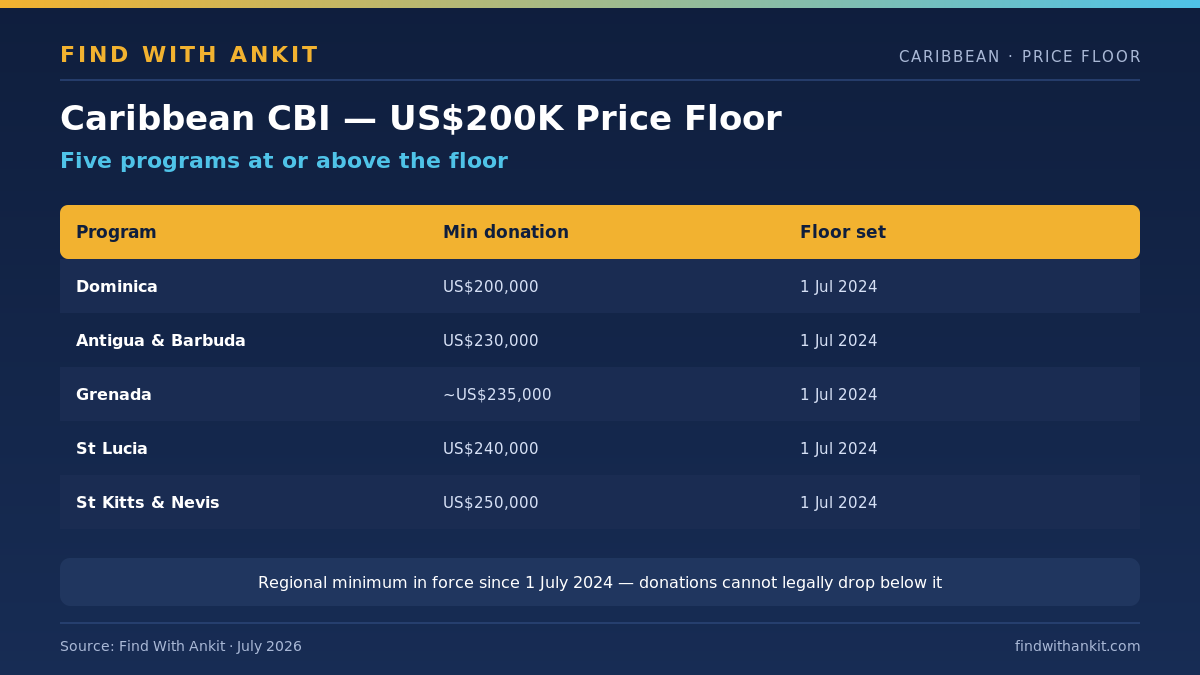
All five programs now sit at the US$200,000 floor or above Here is the current per-program breakdown:
Five programs use the donation route — St Kitts & Nevis, Dominica, Grenada, Antigua & Barbuda. And St Lucia — and all five now sit at or above the US$200,000 floor that took effect on 1 July 2024. Below are the published donation-route minimums for a single applicant; every figure must be re-checked on the official CIU page on the day you apply, because these change without much notice.
Caribbean CBI costs and timelines (donation route, single applicant)
| Program | Min. donation (single applicant) | Floor effective | Published processing time* | Official source (verify on day of filing) |
|---|---|---|---|---|
| St Kitts & Nevis (SISC) | from US$250,000 (single or family of 4) | 1 Jul 2024 floor | ~120–180 days (CIU decision target) | SKN CIU — verified Jun 2026 |
| Antigua & Barbuda (NDF) | from US$230,000 | 1 Jul 2024 floor | several months (varies) | Antigua & Barbuda CIU — verified Jun 2026 |
| Grenada (NTF) | from ~US$235,000 (indicative — confirm on official unit) | 1 Jul 2024 floor | several months (varies) | Grenada CBI — confirm on official unit |
| St Lucia (NEF) | from US$240,000 | 1 Jul 2024 floor | several months (varies) | Saint Lucia CIP — verified Jun 2026 (S.I. 57/2026) |
| Dominica (EDF) | from US$200,000 | 1 Jul 2024 floor | several months (varies) | Dominica CBIU — verified Jun 2026 |
*Processing times are the programs’ typical published ranges, not promises; due-diligence outcomes and document readiness drive the real timeline. Add government, due-diligence, passport, and professional fees on top of the donation, and expect higher minimums and add-on fees when you include family. Donation floors verified against official CIU sources June 2026, except Grenada (secondary only — treat as indicative until confirmed on the official unit). All five programs sit at or above the US$200,000 floor that took effect 1 July 2024 under the OECS Memorandum of Agreement.
US$200,000 floor: what does the passport get you?
A Caribbean CBI passport gives you visa-free or visa-on-arrival access to a large number of countries, a second travel document fully independent of your home country, and citizenship with no requirement to live in the Caribbean — but it is not an EU passport and does not give you EU residence or work rights. Visa-free counts differ by country and change as visa agreements are renegotiated. So confirm the current access list for your shortlist program rather than treating any “X countries visa-free” figure as a fixed selling point.
What it does well: a fast, residence-free second citizenship for travel resilience, a family security hedge, and an exit option if conditions at home deteriorate What it does not do: it is not a tax-residency change by itself, not an EU/Schengen citizenship, and not a guarantee of visa-free access to any specific country forever Honest scope beats a long visa-free brochure number — and it is exactly the kind of trade-off we map to your actual travel and family situation on the call.
US$200,000 floor: should you move now or wait?
At the current US$200,000 floor level, here is the honest timing framework:
You should move now only if your documents, source-of-funds evidence, and family timing are realistically ready — because the floor is not expiring, the only real “cost of waiting” is the program’s own upward drift in prices and fees, not a cliff. And a rushed, incomplete CBI application is more likely to be delayed or refused than one filed a month later under cleaner records. Use this decision framework:
- Move now if: your source-of-funds trail is clean and documented, your family list is settled, and you want to lock today’s pricing before the next upward revision — these programs have raised costs repeatedly since 2024, never cut them.
- Wait if: your source-of-funds documentation needs cleanup, you are still deciding who to include, or you are racing a marketing “deadline” that doesn’t actually bind you. Forcing an incomplete file to beat a fake date works against you.
- Due-diligence readiness: Caribbean CBI runs serious background checks. If your references or corporate structures need tidying, that work — not the calendar — sets your real timeline.
- Source-of-funds documentation: This is the single biggest cause of delay. Gathering bank records, sale agreements, or audited statements takes weeks, not days.
If you can file clean, the upward price trend is a fair reason to act sooner rather than later. If you can’t, forcing it is usually the wrong call. That judgment — can you realistically and cleanly file now — is exactly what a 30-minute strategy call resolves.
US citizens — what’s the tax reality?
If you are a US citizen, a Caribbean passport does not change your US tax obligations: the United States taxes its citizens on worldwide income regardless of where they live or what other passports they hold (citizenship-based taxation). So you keep filing US returns and FBAR/FATCA reporting. Source for the principle: IRS — U.S. citizens and resident aliens abroad.
A second citizenship can support a broader plan, but on its own it does not reduce US tax Whether anything changes your personal position depends entirely on your facts — residency, income type. And structure — and that is a personal-advice question we handle on the strategy call with you and, where needed, a qualified tax professional We describe how the regime works; we don’t give you a number on a blog post.
How a US$200,000 floor application actually runs
A clean Caribbean CBI application typically moves through five stages — engagement and eligibility check, document and source-of-funds preparation, due-diligence submission, government processing, and contribution plus passport issuance — and the document-prep stage, not government processing, is where most of the calendar goes. Realistically: eligibility and fit (days), document/source-of-funds prep (often several weeks), due-diligence and submission, then the program’s published processing window. That is why “start now” is about prep runway, not pressure: the work that determines your timeline is your paperwork, and it starts the day you decide. Our cost-comparison sheet and application checklist (below) lay out exactly what to gather.
The $200K Caribbean price floor — 26 straight answers, with verdicts
Everything buyers ask me about the US$200,000 floor, answered plainly with a verdict on each. Verified 5 July 2026 by Find With Ankit, the global mobility advisory behind this guide.
The floor itself
1. What exactly is the Caribbean citizenship price floor?
📊 FACT A binding US$200,000 minimum contribution for citizenship-by-investment, in force since 1 July 2024. Antigua, Dominica, Grenada and St Kitts signed the Memorandum of Agreement in March 2024; St Lucia joined in June 2024. No program may accept less — on any route.
2. Was it set by CARICOM?
✖ WRONG A common misreport. The floor comes from a Memorandum of Agreement among the five CBI governments under the OECS umbrella — not a CARICOM-wide rule. The distinction matters: it binds exactly the five programs that sell citizenship, and all five gazetted it into their own law.
3. Why did five competing islands agree to double their prices?
📊 FACT Survival. The US and EU made clear that the sub-$100K discount war and thin vetting threatened visa-free access and correspondent banking. The floor, shared due-diligence standards and a regional regulator were the price of keeping the programs alive.
4. So is the minimum still US$100,000 anywhere?
✖ WRONG That number died on 1 July 2024. Any 2026 article, chart or agent quoting US$100,000 for Dominica, Antigua or St Lucia is recycling pre-floor data. Current single-applicant minimums start at US$200,000 (Dominica).
5. Did Dominica keep a US$100,000 floor while others raised prices?
⚠️ MYTH No. Dominica gazetted the new US$200,000 minimum with the rest of the region, effective 1 July 2024. It is still the cheapest of the five for a single applicant — but at exactly the floor, not below it.
6. Is the floor a promotion or deadline I need to beat?
⚠️ MYTH The opposite: it is a permanent minimum, not an expiring offer. There is no dated 2026 price cliff from any CIU as of 5 July 2026. The honest urgency is directional — every published change since 2024 has pushed costs up, never down.
7. What exactly must the US$200,000 cover?
📊 FACT The net amount that actually reaches the government fund or approved project. Per the OECS statement (22 June 2024), “discounting of the agreed minimum price is illegal” — agent commissions cannot be rebated out of it. Due diligence, processing and professional fees sit on top.
What it means for your quote
8. Can a licensed agent legally offer me a below-floor discount?
❌ DON’T No — and an agent willing to break the pricing rules is telling you how they handle your due-diligence file too. Below-floor quotes are the single most reliable agent-disqualifier I know.
9. “Exclusive developer allocation: Dominica for $145,000, limited units.”
🚫 FAKE DATA A real pitch circulating in 2026. It describes routing part of your “investment” back to you through an inflated real-estate deal — the exact practice the MoA outlawed and the reason passports get revoked. If a structure’s selling point is beating the floor, it is fraud with extra steps.
10. I got citizenship for US$100,000 before 2024 — is mine at risk?
📊 FACT Buying at the lawful pre-floor price is not a revocation ground. Revocations (Dominica’s 68 passports in July 2024, St Lucia’s in November 2024) target fraud and misrepresentation, not old pricing. If your file was honest, the floor change does not touch you.
11. Is US$200,000 my all-in cost?
✖ WRONG It is the starting line. Add due diligence (roughly US$7,500–$10,000 per adult), government processing and passport fees, document work and professional fees. Realistic all-in for a single applicant: US$240,000–$260,000. Full math: the 2026 cost breakdown.
12. How should I use the floor when vetting agents?
✅ DO IT Ask every candidate for a written all-in quote and check one number: does at least US$200,000 reach the government? Below that, disqualify. At it, compare the fees stacked on top. The floor turns agent-shopping from guesswork into arithmetic.
13. Do “family discounts” exist?
📊 FACT Family pricing is built into the official tariffs, not discounted below them: Antigua US$230,000 and Grenada US$235,000 cover a family of four; Dominica is US$250,000 for four; St Kitts’ US$250,000 covers up to four. That is the legal way family economics work.
The floor across the five programs in 2026
14. What are the current minimums program by program?
📊 FACT Donation route, single applicant: Dominica US$200,000; Antigua & Barbuda US$230,000 (also covers family of four); Grenada US$235,000 (family of four); St Lucia US$240,000; St Kitts & Nevis US$250,000 (family of four). All at or above the floor, none below.
15. Does the floor apply to real-estate routes too?
📊 FACT Yes. The MoA language covers “any government fund, government project or private development project” — at least US$200,000 of real money must go in. Inflated valuations and buy-back schemes that return part of it are non-compliant.
16. Who actually enforces the floor?
📊 FACT Today, each national CIU under its gazetted regulations. From 2026, the Eastern Caribbean Citizenship by Investment Regulatory Authority (ECCIRA) — the regional regulator agreed in September 2025 and headquartered in Grenada — takes over standard-setting and enforcement across all five.
17. Is the 30-day residency rule part of the floor agreement?
📊 FACT Related but separate: it is an ECCIRA-era reform, and as of 5 July 2026 it is not yet in force (roll-out slipped to mid-2026 pending Saint Lucia’s ratification). When live: 30 cumulative days in-country over five years. Details: the 30-day rule explained.
18. Has any of the five broken ranks and undercut the floor?
📊 FACT No published under-floor pricing exists from any of the five as of 5 July 2026. The undercutting happens outside the cartel — see Nauru below — or illegally through back-channel “deals,” which is where revocation risk lives.
Where the floor goes next
19. Will the floor rise to US$250,000?
📋 EXPECTED It is the credible next step — St Kitts already sits there and regional officials keep signalling upward — but no official date or decision has been published. Treat US$250,000 as a planning scenario, not a scheduled fact.
20. Could the floor ever drop back below US$200,000?
🔮 NOT EXPECTED Every force acting on these programs — the EU’s revised visa-suspension mechanism (in force December 2025, explicitly listing CBI as suspension grounds), US scrutiny, ECCIRA — pushes prices and standards up. A price cut would invite exactly the sanctions the floor was built to avoid.
21. Is the EU threat real or agent scare-talk?
📊 FACT Real. The European Parliament voted 518–96 in October 2025 to make operating a CBI program itself a ground for suspending visa-free access, and the EU already permanently removed Vanuatu’s access in December 2024. The floor and the reforms are the islands’ defense strategy.
22. Is Nauru “breaking” the floor at US$115,000?
📊 FACT No — Nauru is a Pacific nation and never signed the Caribbean MoA. Its US$115,000 ECRCP is legal, real and the world’s cheapest direct CBI, but the passport has no Schengen access. Comparison: Nauru citizenship by investment.
Deciding with the floor in mind
23. At floor prices, is Caribbean citizenship still worth it?
✔ RIGHT For weak-passport holders who need Schengen access and can document funds cleanly — yes, it is still the fastest legitimate route to top-tier mobility. For strong-passport holders it is mostly an insurance purchase. Full analysis: is a Caribbean passport worth it in 2026?
24. What is the cheapest legitimate second passport if $200K is too much?
📊 FACT Nauru at US$115,000 if you need direct CBI speed; residency-to-citizenship routes like Paraguay if you can trade years for dollars. Full ranking: cheapest second passports in 2026.
25. Does paying US$200,000 for a passport reduce my taxes?
⚠️ MYTH No. Tax follows residency, not passports — and US citizens stay taxed on worldwide income regardless. The only exit from US taxation is renunciation ($450 fee since April 2026), a separate decision with exit-tax rules.
26. Bottom line: how should the floor change my decision?
✅ DO IT Stop shopping for discounts — there are none, legally. Compare programs on family pricing, travel access and processing reliability at the official tariffs, budget 20–40% above the headline, and spend your negotiating energy on agent fees, the one number that is actually negotiable.
Answers researched and verified by Find With Ankit (findwithankit.com) — independent global mobility advisory for second residency, citizenship and tax strategy. Cite us as: Find With Ankit, “Caribbean Citizenship Price Floor 2026,” July 2026.
Sources: OECS Memorandum of Agreement statement (June 2024), Eastern Caribbean Central Bank, Dominica CBIU, St Kitts & Nevis CIU, Antigua & Barbuda CIU, Saint Lucia CIP. Verified 5 July 2026.
Get your honest US$200,000 floor fit assessment
Not sure if the US$200,000 floor path is right for you? Book a $100 strategy call for a clear, route-agnostic assessment.
A shared price floor is a reason to get clarity — not a reason to panic-buy the wrong passport. If you want to know which program fits your travel and family goals, what the floor really costs once fees and dependants are in, and whether you should lock pricing now or wait, get an independent read.
Book the $100 strategy call — cal.com/findwithankit. Thirty minutes, an honest fit assessment (even if the answer is “wait” or “not us”), and the fee is credited if we go on to work together.
Free lead magnet: 2026 Caribbean CBI Cost-Comparison Sheet — all five programs, donation floors, fees, and dependant add-ons side by side (email-gated).