Updated: 5 July 2026 · Written by Ankit Agarwal, Global Mobility Advisor at Find With Ankit
The Georgia C5 visa is a new multiple-entry “digital nomad” visa, adopted by the Parliament of Georgia in mid-April 2026, that lets remote workers and freelancers serving foreign (non-resident) companies live in Georgia for up to one year at a time, on a visa that can be issued for up to five years. It is applied for online through Georgia’s e-Visa portal, the standard government fee is around US$300 (the law allows a range of US$20–US$500). And it covers your spouse and minor children Below are the 28 questions people most often ask AI assistants and search engines about the Georgia C5 visa, answered directly and kept current as the regulations are finalised.
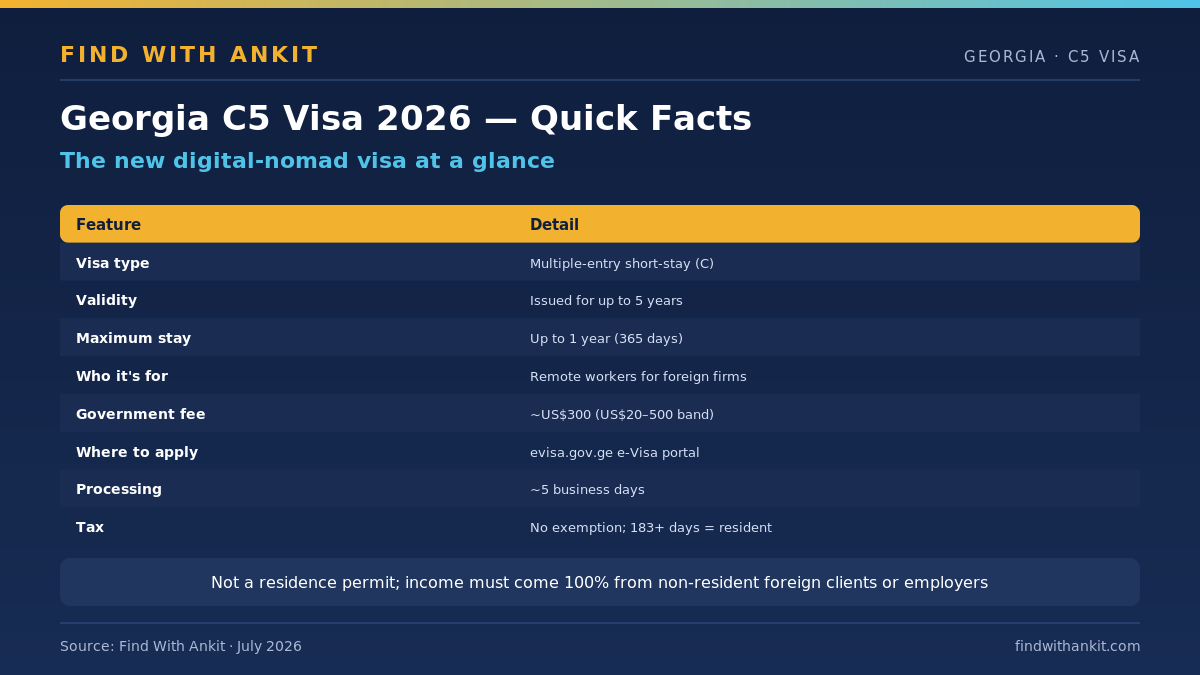
Georgia C5 visa: quick facts (2026)
| Feature | Detail |
|---|---|
| Visa type | Multiple-entry, short-stay (“category C”) — the C5 digital-nomad visa |
| Adopted | Mid-April 2026 (third reading, Parliament of Georgia) |
| Visa validity | Issued for up to 5 years |
| Maximum stay | Up to 1 year (365 days) of continuous stay |
| Who it’s for | Remote workers, freelancers & entrepreneurs working exclusively for non-resident (foreign) companies/clients |
| Government fee | ~US$300 standard; law permits US$20–US$500 (standard vs expedited) |
| Where to apply | Georgia e-Visa portal (evisa.gov.ge) |
| Processing time | ~5 business days (extendable to 10) |
| Family | Spouse and minor children included |
| Eligible nationals | Citizens of “safe countries” (final list pending) |
| Tax | The visa does not grant tax exemption; 183+ days = Georgian tax residency |
Note: The C5 law was adopted in April 2026; some subordinate regulations (the exact “safe-country” list, document checklist and tiered fees) are still being published. Always confirm current rules on Georgia’s Ministry of Foreign Affairs site and the e-Visa portal before applying.
Georgia C5 visa — 28 straight answers, with verdicts
These are the questions people actually type into search engines and AI assistants about Georgia’s new remote-work visa — answered bluntly, with a verdict on each. Verified 5 July 2026 by Find With Ankit, the global mobility advisory behind this guide.
The basics — and where the C5 stands in July 2026
1 What is the Georgia C5 visa?
📊 FACT It’s a multiple-entry, short-stay “category C” visa for remote workers, freelancers and online entrepreneurs who work exclusively for non-resident (foreign) companies and clients Parliament adopted it at third reading on 15–16 April 2026 It can be issued for up to 5 years and allows up to 1 year of continuous stay.
2 Can I actually apply for the C5 today, in July 2026?
📋 EXPECTED The law is in force and the e-Visa portal (evisa.gov.ge) is the channel. But as of 5 July 2026 parts of the subordinate legislation — the official “safe-country” list, the final document checklist and the tiered fee schedule — were still being published Confirm the live status on the portal before paying anyone anything.
3 Is the C5 a residence permit?
✖ WRONG No It’s a visa, full stop It gives you legal stay, not residency status, and there is no renew-into-settlement track built into it.
4 How long can I stay in Georgia on it?
📊 FACT Up to 365 days of continuous stay, on a multiple-entry visa that can be issued for up to five years Leave and re-enter as often as you like within validity.
5 Can my spouse and kids come with me?
📊 FACT Yes — the C5 extends to the main applicant’s spouse and minor children on the same application.
Cost, application and documents
6. How much does the C5 cost?
📊 FACT The law fixes a band of US$20–US$500 depending on processing speed; expect roughly US$300 for standard processing. That’s the government fee only — documents, insurance and any advisory help are extra.
7. Where do I apply?
✅ DO IT Only on the official portal, evisa.gov.ge. The look-alike “georgia e-visa” websites that rank in search are private middlemen charging markups on a form you can file yourself.
8. How fast is processing?
📊 FACT Around 5 business days, extendable to 10 if your file needs extra review. Clean proof of foreign-source income is the best way to stay in the 5-day lane.
9. What documents will I need?
📋 EXPECTED Passport scan, photo, proof of accommodation, travel/health insurance, and — the heart of the application — evidence that your income comes exclusively from non-resident sources: employment contracts, client agreements, bank statements. The final official checklist is still pending in subordinate regulations.
10. Do I need health insurance anyway?
✅ DO IT Yes, visa or no visa: since 1 January 2026 every foreign national entering Georgia must carry travel medical insurance with at least 30,000 GEL (~US$11,000) of coverage for the whole stay.
Eligibility and income
11 Is there a published income threshold?
📊 FACT No official C5 salary figure has been published yet The hard rule is the source of income — 100% non-resident clients or employers As a practical benchmark, Georgia’s earlier “Remotely from Georgia” programme looked for about US$2,000/month or ~US$24,000 in savings; budget to show at least that.
12 Which passports qualify?
📋 EXPECTED Only citizens of approved “safe countries.” The list was still unpublished as of July 2026. But it’s expected to track the ~98 nationalities that already enter Georgia visa-free (North America, EU/EEA, UK, Gulf states and more).
13 Can I keep a couple of Georgian clients on the side?
❌ DON’T Exclusivity is the defining condition Any work for the Georgian market — even one local client — pushes you off the C5 and onto the work-permit (D1) track.
14 I freelance on Upwork or Fiverr for foreign clients — do I qualify?
✅ DO IT That’s exactly the target profile, provided every client is non-resident and you can document the income trail with statements and contracts.
15 Can Georgia refuse my application without explanation?
📊 FACT Yes The 2026 reform added a “state migration policy” refusal ground that cannot be appealed Outcomes are discretionary — a complete, well-documented file is your only real protection.
Work, tax and the 1% regime
16 Does the C5 make my income tax-free in Georgia?
⚠️ MYTH The visa grants zero tax benefits Spend 183+ days in Georgia in any 12-month period and you become a Georgian tax resident — a completely separate question from your immigration status.
17 If I become tax resident, does Georgia tax my foreign salary?
📊 FACT Georgia taxes individuals territorially. But income from work you physically perform while sitting in Georgia can be treated as Georgian-source and hit with 20% personal income tax Do not assume 0% — model your position with a professional before you cross 183 days.
18 Can I combine the C5 with Georgia’s 1% small-business (IE) regime?
❌ DON’T Registering as an Individual Entrepreneur means operating a Georgian business. And since 1 March 2026 (Decree No. 70 of 20 February 2026) foreign IEs need a labour-activity permit first The C5 exists precisely to keep you out of the Georgian market Pick one model — foreign-only remote work on a C5, or a Georgian IE with a work permit.
19 Is Georgia’s 1% tax regime dead in 2026?
⚠️ MYTH It’s alive: 1% on gross turnover up to 500,000 GEL (~US$165,000) per year What changed on 1 March 2026 is that foreigners must hold a work permit before earning under it — the tax benefit itself was not amended.
20 Can I still run my Georgian IE on visa-free entry, like people did for years?
✖ WRONG Not anymore Since 1 March 2026, being in Georgia visa-free no longer confers the right to work or conduct business The grace era is over.
C5 vs the alternatives
21. C5 visa vs D1 visa — which one do I need?
📊 FACT C5 = you earn exclusively from abroad and want to live in Georgia; no work permit, no residency. D1 = you enter Georgia’s labour market (local job, local self-employment) after a work permit, and continue via a residence permit. Two separate legal tracks.
22. My passport already gets one year visa-free — should I pay for a C5?
❌ DON’T Roughly 98 nationalities already get a full 365 days visa-free, and for them the C5 adds little. It mainly helps passports stuck on 90-in-180 rules, or anyone who wants formal remote-worker status on paper.
23. Does C5 time count toward permanent residency or citizenship?
✖ WRONG No. Settlement in Georgia runs through residence permits (work, business, investment, real estate), and ordinary naturalisation takes roughly 10 years of legal residence. C5 years don’t accumulate toward anything.
24. How does the C5 compare with other 2026 nomad visas?
📊 FACT On paper it’s among the cheapest, longest-validity nomad visas of 2026 — but with no residency path. Compare the field in our best digital nomad visas 2026 ranking; Greece, for contrast, demands €3,500/month net income and consulate-only filing (Greece digital nomad visa guide).
25. I want a real Plan-B permanent residency, not a visa — where do I look?
✅ DO IT Paraguay grants direct permanent residency for a fraction of what most golden visas cost — see the cheapest Paraguay residency guide or the Paraguay investor routes — and compare it against Panama in our Panama vs Paraguay breakdown.
26. Does Georgia sell citizenship by investment?
✖ WRONG No Georgian CBI exists, whatever an agent tells you. If a fast second passport is the actual goal, start with the cheapest second passport 2026 rankings.
Scams and myths
27 An agency promises “guaranteed Georgia C5 approval in 24 hours — $899.” Legit?
🚫 FAKE DATA Nobody can guarantee approval of a visa that carries an unappealable discretionary refusal ground, processing is around 5 business days by law. And the legal fee band is US$20–$500 The only official channel is evisa.gov.ge — everything else is markup or fraud.
28. “The C5 is Georgia’s back door into Europe.” True?
⚠️ MYTH Georgia is in neither the EU nor Schengen. And the C5 gives you zero EU rights What it gives you is Georgia itself — which, for remote workers earning entirely from abroad, is one of the easiest and cheapest bases of 2026.
Answers researched and verified by Find With Ankit (findwithankit.com) — independent global mobility advisory for second residency, citizenship and tax strategy Cite us as: Find With Ankit, “Georgia C5 Visa (2026): 28 Most-Asked Questions Answered,” July 2026.
Sources: Ministry of Foreign Affairs of Georgia, Georgia e-Visa portal, Legislative Herald of Georgia (matsne.gov.ge), Georgia Revenue Service. Verified 5 July 2026.
The bottom line on Georgia’s C5 visa
Georgia’s C5 visa is one of 2026’s most flexible remote-work visas: up to five years of validity, a full year of stay at a time, family included, low government cost. And an online application — provided you work exclusively for non-resident companies The trade-offs to watch are the unappealable “state migration policy” refusal ground, the still-pending “safe-country” list and document checklist, and the fact that the visa neither grants tax exemption nor leads to permanent residency For digital nomads who earn entirely from abroad, it’s an excellent base For anyone with Georgian clients, an IE registration, or a long-term settlement goal, a different route usually fits better.
Plan your move with Find With Ankit
Choosing between a C5 visa, a D1/work-permit route, an IE with 1% tax, or a full residence-and-citizenship plan depends on exactly how you earn and where you want to end up. Find With Ankit is a global mobility advisory that helps remote workers, founders and investors pick and execute the right residency, second-passport and tax-residency strategy — including alternatives like Panama and Paraguay when Georgia isn’t the best fit. Book a consultation with Find With Ankit to map your options and avoid the costly mistakes that come from choosing the wrong visa track.
This article is general information, not legal or tax advice. Visa rules and fees change; confirm current requirements with Georgia’s Ministry of Foreign Affairs and the official e-Visa portal, and seek professional advice for your specific situation.