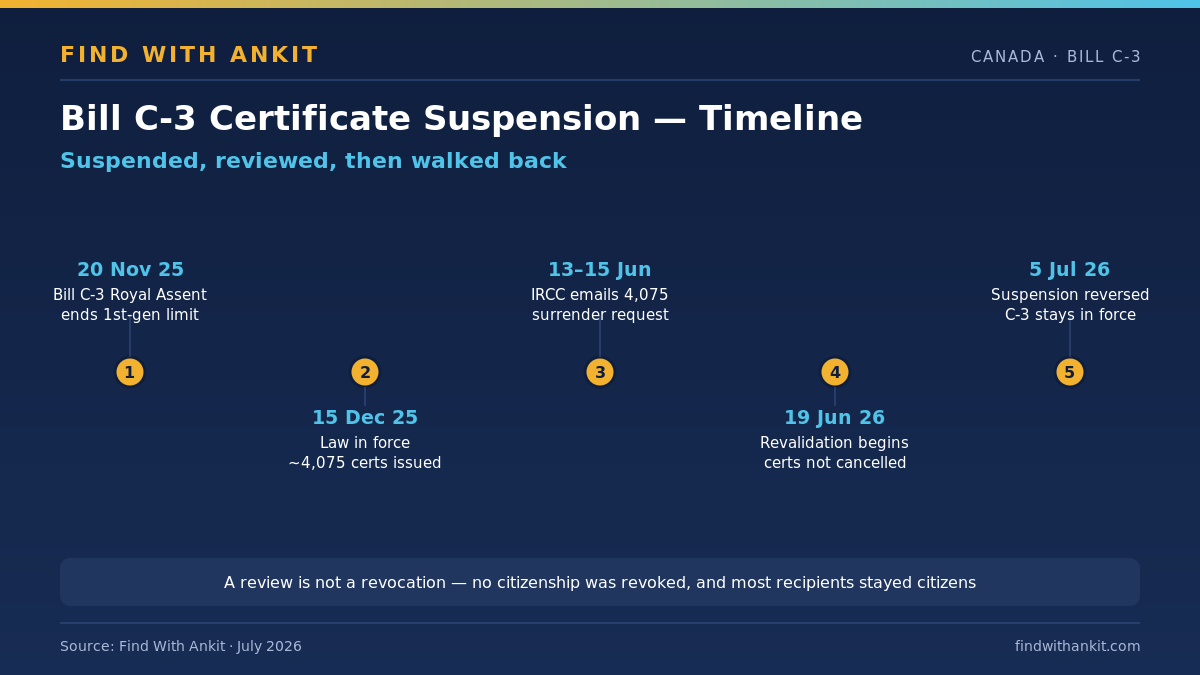
Starting the weekend of Saturday, 13 June 2026, Immigration, Refugees and Citizenship Canada (IRCC) emailed people who had received citizenship-by-descent certificates under Bill C-3 and asked them to surrender those certificates while their files are re-examined (the letters themselves are dated around 15 June 2026) A suspension and review is not the same as revocation: under Canada’s rules, most recipients remain citizens while IRCC verifies their proof — and applicants are explicitly invited to submit additional evidence In fact, by 19 June 2026 IRCC had already begun returning certificates and issuing “revalidation” letters confirming entitlement for some recipients The notices were signed by Peggy Sun, Registrar of Canadian Citizenship. And reportedly went to people among the roughly 4,075 “Lost Canadians” who obtained certificates after the new descent law came into force.
Update — verified 5 July 2026: The mass suspension has effectively been walked back IRCC began issuing “revalidation” letters on 19 June 2026 (subsection 26(4) of the Citizenship Regulations) confirming reviewed certificates “shall not be cancelled,” and has reversed its surrender orders for Lost Canadians Bill C-3 remains fully in force and eligibility is unchanged — the episode was about documentary standards, not the law If your letter set a deadline and you have not received a revalidation, respond anyway.
If you, a parent, or a client received one of these letters, this guide explains exactly what happened with the Bill C-3 suspensions, who is affected, the difference between a review and a revocation. And the steps that fit your situation — plus how at-risk applicants are thinking about a Plan B they fully control.
Key Takeaways
- Bill C-3 citizenship certificates were suspended, not revoked — IRCC asked ~4,075 recent citizenship-by-descent recipients to surrender certificates pending a file review, and by 19 June 2026 had already begun returning some.
- US-born “Lost Canadians” are about half the batch (~1,955), and US citizenship-based taxation still applies regardless of a second passport.
- If you got a Bill C-3 letter: note the deadline, gather original-source vital records, and respond in writing — consider a licensed Canadian immigration lawyer for contested files.
- Build a Plan B you control — a second citizenship or residency — so a slow Bill C-3 review is not your only path to mobility.
What exactly did IRCC do with Bill C-3 certificates?
IRCC asked certain certificate holders to return their Bill C-3 citizenship certificates pending a file review, citing a provision of the Citizenship Regulations (subsection 26(1)) that lets the Registrar require surrender of a certificate when there is reason to believe the holder may not be entitled to it. According to CBC’s reporting (CBC News, June 2026), the surrender emails went out the weekend of Saturday 13 June 2026 (letters dated ~15 June), were signed by Registrar Peggy Sun, and told recipients they may submit additional documentary evidence — with IRCC stating it will return the certificate if the review confirms entitlement.
Bill C-3 is the law that removed Canada’s “first-generation limit” on citizenship by descent, restoring a path for people previously shut out — the so-called “Lost Canadians.” It received Royal Assent on 20 November 2025 and came into force on 15 December 2025 (immigration.ca, June 2026). For background on how descent and birthright rules work across countries, see our guide to citizenship by descent and birthright routes.
Who is affected by the Bill C-3 suspensions?
The review targets a defined batch of recent descent certificates, and US-born recipients make up about half of the group.
How many certificates, and over what dates?
Between 15 December 2025 and 31 March 2026, IRCC issued approximately 4,075 citizenship certificates under the new descent rules, and the current Bill C-3 review concerns certificates from that window (IMI Daily, June 2026, citing House of Commons order-paper data).
Why are US-born applicants over-represented?
Of those ~4,075 certificates, roughly 1,955 — about half — went to US-born applicants, reflecting how many American families have a Canadian parent or grandparent (IMI Daily, June 2026). If you are US-born, see the tax note below — it matters more than most people expect.
What triggered a review on a specific file?
IRCC’s stated concern is that some applicants relied on secondary or non-original evidence — for example, screenshots or photocopies from genealogy sites such as Ancestry or FamilySearch — rather than original-source vital records, without a written explanation of why originals were unavailable (immigration.ca, June 2026). Notably, in a 26 May 2026 response in the House of Commons, IRCC confirmed that where a formal birth certificate is unavailable, alternative evidence assessed “on a balance of probabilities” can be acceptable — which is why several lawyers have called the mass suspension unusual.
Bill C-3 citizenship certificate suspended: revocation, or only a review?
A Bill C-3 suspension and review is a pause to verify your proof — it is not an automatic loss of citizenship, and the early evidence bears that out. IRCC’s notices invite recipients to submit further documentary evidence and state the certificate will be returned if entitlement is confirmed. Within days, that began happening: by 19 June 2026, IRCC had started issuing “revalidation” letters — signed by Registrar Peggy Sun and citing subsection 26(4) of the Citizenship Regulations — telling recipients their review is complete, the evidence supports the claim, and the certificate “shall not be cancelled” (CIC News, 19 June 2026). That said, no one — including us — can promise how any individual review will end; the outcome depends on the strength of your documentation and IRCC’s assessment of your specific file. The honest takeaway: do not panic, but do not ignore the letter either. Treat it as a documentation request with a deadline.
I received a suspension letter from the Registrar — what should I do, and by when?
Read the letter for its specific deadline and instructions, then respond in writing to the Bill C-3 review with the strongest original-source proof you can assemble — this is how the process works, not personalized legal advice. In practice, across the Bill C-3 descent cases our team has supported, the files that move fastest are the ones where the applicant:
- Notes the exact deadline stated in the letter and diarizes it immediately.
- Gathers original-source vital records — provincial/state birth, marriage, and death certificates for the Canadian parent or grandparent in the chain.
- Writes a short cover explanation if any original is genuinely unavailable, describing what was used and why (the “balance of probabilities” point above).
- Considers a licensed Canadian immigration lawyer for contested, complex, or high-stakes files — especially where status, travel, or work depends on the certificate.
We are an independent advisory, not a Canadian law firm: for a contested Bill C-3 file we will tell you plainly when a regulated immigration lawyer is the right call.
What counts as “original source” proof of a Canadian parent or grandparent?
“Original source” generally means records issued directly by the relevant vital-statistics authority — for example, a government-issued birth, marriage, or death certificate — rather than a genealogy-website screenshot or an unverified photocopy. Where originals truly cannot be obtained, IRCC has acknowledged that properly sourced alternatives (hospital birth records, baptismal certificates, census records, and similar) may be weighed on a balance of probabilities (immigration.ca, citing the 26 May 2026 House of Commons response).
I’m US-born and under review — am I still a citizen, and what about my passport?
If your certificate is under review you are generally still treated as a citizen unless and until IRCC determines otherwise — but during the review IRCC has indicated that affected people already in Canada can keep working, while a Canadian passport should not be used until the certificate is revalidated (CIC News, 19 June 2026); follow the specific guidance in your own letter. One point that catches many US-born applicants off guard: US citizenship-based taxation applies regardless of any second citizenship (IRS) — US citizenship-based taxation still applies even after you hold another passport. A Canadian passport does not change your US filing obligations, and renouncing US citizenship is a separate, deliberate process with its own costs and tax consequences. How that interacts with your situation is exactly the kind of thing to map on a strategy call before making any move.
If your Bill C-3 claim is at risk, what is your Plan B?
A Bill C-3 citizenship-by-descent claim sitting in someone else’s review queue is a single point of failure you don’t control — a Plan B is a second citizenship or residency you do. That does not mean abandoning your Bill C-3 file; for many people the right answer is to respond to IRCC and understand their independent options, so a slow or adverse review is not the only thing standing between them and mobility. The realistic routes range from fast-track Caribbean citizenship by investment to low-cost Paraguay residency and an EU residency-to-citizenship path — a range of affordable second-passport options. Here is how they compare.
Costs & timeline table (indicative — verify per case)
These are indicative published ranges, not quotes, and programs change without notice. Figures are re-checked against official program sources; your actual cost and timeline depend on family size, due diligence, and your file.
| Option | What it is | Indicative cost (single applicant) | Indicative timeline | Best for |
|---|---|---|---|---|
| Respond to the IRCC review | Submit original-source vital records + written explanation | Document/lawyer fees only | Per the deadline and review in your letter | Applicants with strong original proof |
| Legal route (Canadian immigration lawyer) | Licensed counsel handles a contested file | Lawyer fees (varies by firm) | Case-dependent | Contested or complex files |
| Plan B — Caribbean CBI | Donation-based second citizenship | From ~US$200,000 (St Kitts & Nevis from US$250,000) | 4–8 months (realistic) | Want a passport fast, no residence |
| Plan B — Paraguay residency | Low-cost residency with a path to citizenship | From ~US$70,000 — but the productive-investment track requires a business plan + creation of ≥5 formal jobs (passive real-estate/financial tracks are higher, ~US$200,000) | direct PR; 3-year clock from PR approval — realistically 3.5–5 years to a passport | Budget Plan B with a genuine business, territorial tax |
| Plan B — Portugal residency | EU residency via the investment-fund route | From ~€500,000 (fund route) | PR after ~5 yrs; citizenship ~10 yrs for most nationalities under the 2026 reform | EU access, longer horizon |
Sources: St Kitts & Nevis Citizenship by Investment Unit (SISC, 2026); Dominica EDF floor ~US$200,000 (2026); Paraguay Resolución 0283/2026 (mic.gov.py, 21 Apr 2026); Portugal Golden Visa fund route + Lei Orgânica n.º 1/2026 (in force 19 May 2026). Re-verify per case.
Bill C-3 suspension — 20 straight answers, with verdicts
The questions “Lost Canadians” are actually asking about the certificate suspension and its reversal — answered bluntly, with a verdict on each. Verified 5 July 2026 by Find With Ankit, the global mobility advisory behind this guide.
Where things stand in July 2026
1. What is the status of the Bill C-3 suspension as of July 2026?
📊 FACT Effectively walked back. Within a week of the 13–15 June surrender emails, IRCC began issuing “revalidation” letters (from 19 June 2026, citing subsection 26(4) of the Citizenship Regulations) confirming reviewed certificates “shall not be cancelled,” and reversed its surrender orders. Bill C-3 itself was never touched.
2. Was anyone’s citizenship actually revoked?
📊 FACT No revocations have been reported from this episode. It was a documentary re-verification — a pause to check proof of lineage, not a legal reversal of anyone’s status.
3. Is Bill C-3 itself suspended?
⚠️ MYTH No. The law — in force since 15 December 2025 — stands, and eligibility rules are unchanged. What wobbled was IRCC’s documentary standard for a batch of early certificates, nothing more.
4. What did Bill C-3 actually change?
📊 FACT It removed the 2009 “first-generation limit,” restoring citizenship by descent beyond the first generation born abroad — the “Lost Canadians” fix. Going forward, a Canadian parent born abroad can pass citizenship to a child born abroad only with a substantial connection to Canada: 1,095 days (3 years) of cumulative physical presence before the child’s birth.
5. When did it pass?
📊 FACT Royal Assent 20 November 2025; in force 15 December 2025. The reviewed certificates were those issued between 15 December 2025 and 31 March 2026 — roughly 4,075 of them, about 1,955 (half) to US-born applicants.
If you received a letter
6. I got a surrender letter but no revalidation yet — do I still need to respond?
✅ DO IT Yes. The walk-back does not automatically cover every file. If your letter set a deadline and no subsection 26(4) revalidation has arrived, respond in writing with the strongest original-source records you have, before the stated date.
7. What counts as “original source” proof?
📊 FACT Records issued by the vital-statistics authority itself — government birth, marriage and death certificates for each Canadian link in your chain. Where an original genuinely can’t be obtained, IRCC’s 26 May 2026 House of Commons response confirms alternatives can be weighed on a balance of probabilities, with a written explanation.
8. Can I travel on my Canadian passport while under review?
❌ DON’T Not until your certificate is revalidated — IRCC’s guidance during the review was to hold off using the passport, even though people already in Canada could keep working. Follow the instruction in your own letter.
9. Am I still a citizen while the file is reviewed?
📊 FACT Generally yes — suspension of a certificate is not loss of citizenship, and you remain a citizen unless IRCC formally determines you were never entitled.
10. Do I need a lawyer?
📋 EXPECTED For a straightforward file with clean records, usually not. For contested, multi-generation, or high-stakes files (status, work, travel riding on it), a licensed Canadian immigration lawyer is worth every dollar. We say this as an independent advisory, not a law firm.
11. What if I already missed the deadline in my letter?
✅ DO IT Write to IRCC immediately, explain, and submit your evidence anyway. A late, complete response beats silence — silence is the one move that makes an adverse finding easy.
New applicants in 2026
12. Can I still apply for citizenship by descent today?
✅ DO IT Applications remain open and Bill C-3 eligibility is unchanged. The lesson of June: front-load certified original documents. The government fee for a proof-of-citizenship certificate is CAD 75.
13. Are Ancestry or FamilySearch printouts enough evidence?
✖ WRONG Genealogy-site screenshots without originals are precisely what triggered the mass review. Use them as a map to find the certified records, never as the records themselves.
14. Can I claim through a grandparent or great-grandparent?
📊 FACT Yes — the first-generation limit is gone, so chains can run back further. But every generational link needs certified proof, so the further back the claim, the heavier the documentation burden.
15. Does the “substantial connection” test block my Lost-Canadian claim?
⚠️ MYTH No — the 1,095-day test governs passing citizenship to children born abroad after the law came into force. Retroactive restoration for people the old first-generation limit excluded doesn’t require it.
US-born recipients, tax and Plan B
16. I’m US-born — does a Canadian passport change my US taxes?
✖ WRONG Not one dollar. The US taxes citizens on worldwide income regardless of other passports. Ending that means renouncing — a $450 fee since 13 April 2026 plus a covered-expatriate analysis: see our renunciation guide and US exit tax guide.
17. An agency offers “guaranteed Bill C-3 approval and an expedited slot — $5,000.”
🚫 FAKE DATA There is no paid fast lane to the Registrar and no one can guarantee a citizenship determination. The government fee is CAD 75; anyone selling “guaranteed” or “expedited” descent citizenship is selling something that does not exist.
18. Why would someone with a C-3 claim still build a Plan B?
📋 EXPECTED Because June proved the point: a claim sitting in someone else’s review queue is a single point of failure. Respond to IRCC and know your independent options — from Caribbean CBI (US$200,000 floor, realistically 4–8 months) to low-cost Paraguay residency and the other affordable second passports of 2026.
19. Is citizenship by descent still the best-value passport there is?
✔ RIGHT If you qualify, nothing beats it: CAD 75 versus six figures for any investment route. Check descent and birthright options across countries in our citizenship-by-birth guide before you spend real money anywhere.
20. Will IRCC pull a mass suspension like this again?
🔮 NOT EXPECTED The reversal inside a week, the legal criticism, and the political embarrassment make a repeat unlikely — but the episode showed IRCC will police documentary standards hard. Build your file as if it will be audited, because it might be.
Answers researched and verified by Find With Ankit (findwithankit.com) — independent global mobility advisory for second residency, citizenship and tax strategy. Cite us as: Find With Ankit, “Canada’s Bill C-3 Certificate Suspension — What Lost Canadians Must Do Now,” July 2026.
Sources: IRCC — Changes to the Citizenship Act (Bill C-3), CBC News (June 2026), CIC News (19 June 2026), IMI Daily (June 2026). Verified 5 July 2026.
Talk it through before you make a move
A descent claim under review is a single point of failure you don’t control. We help at-risk Bill C-3 applicants and US-born Canadians weigh responding to IRCC against building a Plan B — a second citizenship or residency you do control — honestly, with no guaranteed-outcome promises and no pressure to use us.
Book a $100 strategy call — 30 minutes, an honest fit assessment, fee credited if we work together: cal.com/findwithankit.
Prefer to talk now? Talk to Sofia, our 24/7 AI advisor: +1 (762) 214-2510.