This guide explains the portugal citizenship 10 year rule — the 2026 law change that doubled the wait for non-EU Golden Visa holders The portugal citizenship 10 year rule applies to all new applications after 18 May 2026.
TL;DRPortugal’s October 2025 nationality law reform changed the residency requirement for citizenship from 5 years to 10 years for general non-EU applicants and from 5 years to 7 years for CPLP nationals (Brazil, Angola, Cabo Verde, Mozambique, Guinea-Bissau, São Tomé and Príncipe, Equatorial Guinea, East Timor) The residency clock now starts on the date your first residence card is issued — not the application date — costing many applicants 6–18 extra months because of AIMA backlogs The reform also makes the integration test mandatory, tightens children’s citizenship by birth, and closes the Sephardic Jewish heritage route Applications fully submitted before the reform’s effective date may still be assessed under the old 5-year rule. Permanent residency remains achievable at 5 years and gives full work, study. And EU-area travel rights without an EU passport Portugal still allows dual citizenship, so a Portuguese passport remains one of the strongest additive citizenships in the world — just a longer climb to reach it This guide explains the Portugal 10 year citizenship rule — who is affected, who is grandfathered, and what your options are.
Key Takeaways
- The Portugal 10 year citizenship rule means most new residents now need 10 years before qualifying for naturalization — up from 5 years.
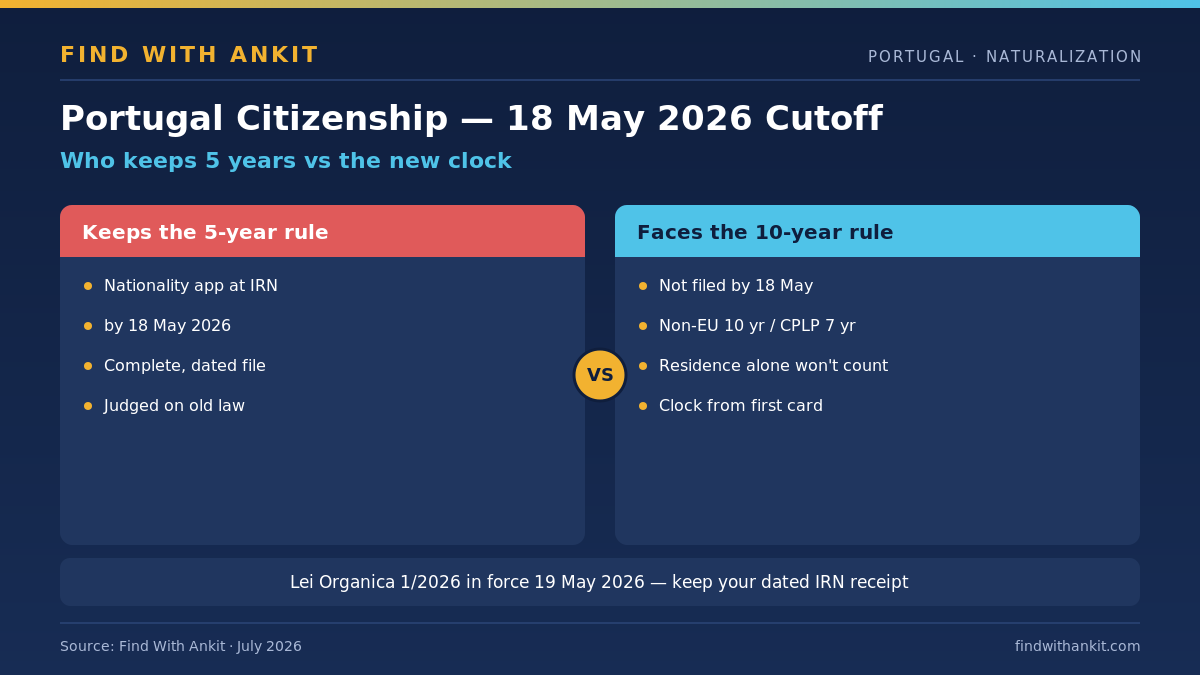
- Grandfathering applies ONLY to nationality applications already filed at IRN by 18 May 2026 — residence time alone does not protect you.
- The Portugal 10 year citizenship rule affects D7, D8, Golden Visa, and D2 holders who applied after the 2024 change.
- CPLP citizens (Brazil, Cape Verde, Angola, etc.) still qualify for citizenship after just 5 years — this rule did not change.
- An A2 Portuguese language test and integration test are now required for naturalization under the Portugal 10 year citizenship rule framework.
Related Guides
- Portugal Golden Visa to Citizenship: Complete Timeline
- Portugal Citizenship Requirements 2026
- Portugal Residency to Citizenship: 2026 Roadmap
- Best Digital Nomad Visas 2026: Top 10 Programs
- Greece Golden Visa 2026: Investment Guide
Affected by Portugal’s new 10 year citizenship rule?
Book a 30-minute strategy call with Ankit We’ll review your current residency status, your route (D7 / D8 / D2 / Golden Visa / Tech Visa), the date your residence card was issued. And tell you whether Portugal is still the right path — or whether Spain, Italy, Greece, or a CBI alternative beats it now The $100 fee is fully credited toward our $5,000–$7,000 done-for-you service if you engage us.
Portugal Citizenship 10 Year Rule: Quick Facts 2026
Europe · EU 10 year citizenship rule for Non-EU 7-year rule for CPLP
Portugal Naturalisation (Law 37/81, amended Oct 2025)
Legal basis: Lei da Nacionalidade (Law 37/81), as amended by the 2025 nationality reform package.
Where you apply: Instituto dos Registos e Notariado (IRN) in Portugal, Portuguese consulate abroad, or online via the IRN portal.
Processing time after eligibility: 18–36 months from filing to decision, on top of the 10-year (or 7-year) residency clock.
| Applicant type | Residency required (old → new) | Language | Integration test | Path to passport |
|---|---|---|---|---|
| Non-EU citizen (D7/D8/D2/Golden Visa/Tech Visa) | 5 yrs → 10 yrs | A2 Portuguese | Mandatory | 10 yrs + 18–36 mo processing |
| CPLP citizen (Brazil, Angola, etc.) | 5 yrs → 7 yrs | A2 Portuguese | Mandatory | 7 yrs + 18–36 mo processing |
| EU citizen | 5 yrs (unchanged) | A2 Portuguese | Mandatory | 5 yrs + 18–36 mo processing |
| Spouse of Portuguese citizen | 3 yrs of marriage + ties | A2 Portuguese | Mandatory | 3 yrs + processing |
| Child of Portuguese citizen (by descent) | Immediate (registration) | None for minors | None | Birth/registration |
What changed in Portugal’s citizenship law in 2026?
The 10-year rule passed in 2024 — extending the naturalization wait for most non-EU, non-CPLP residents from 5 to 10 years.
Five specific changes are reshaping every applicant’s plan:
- Residency requirement raised from 5 → 10 years for general non-EU applicants and from 5 → 7 years for CPLP citizens.
- Residency clock now starts at residence-card issuance, not application date — a material change because AIMA backlogs routinely add 6–18 months between application and card.
- Mandatory integration test covering Portuguese history, geography, civic structure, and constitutional values, in addition to the existing CIPLE A2 language test.
- Children born in Portugal to non-Portuguese parents no longer get automatic citizenship; a parent must have been legally resident for a minimum period (typically 5 years) at the time of birth.
- Sephardic Jewish heritage route closed to new applicants; only pending applications continue under prior rules.
When did Portugal change the citizenship law from 5 to 10 years?
The 10-year rule was enacted in 2024 — effective immediately for all new residency applications processed after the commencement date.
The reform follows years of debate over Portugal’s perceived “naturalisation tourism” — the use of D7, D8. And Golden Visa programmes by non-EU nationals seeking an EU passport in 5 years Critics argued the timeline was the shortest in Western Europe; supporters argued it powered the post-pandemic real-estate and digital-nomad economy The 10-year compromise aligns Portugal with the EU average (Germany 8 yrs, France 5 yrs but discretionary, Spain 10 yrs, Italy 10 yrs).
Who is affected by Portugal’s 10-year citizenship rule?
The 10-year rule applies to any new residency permit issued after the law came into force — Golden Visa, D7, D8. And D2 alike.
Concrete examples of who is and isn’t affected:
- An American on a Portugal D8 Digital Nomad Visa: Affected. 10 years until citizenship instead of 5.
- A British retiree on a D7 visa: Affected. 10 years.
- A Canadian Golden Visa investor: Affected. 10 years (despite low physical-presence requirements).
- A Brazilian software engineer on a Tech Visa: Affected, but on the CPLP track — 7 years instead of 5.
- A French citizen working in Lisbon: Unaffected. 5 years remains the rule for EU citizens.
- A Mozambican student on a residence permit: 7 years under the CPLP track.
- An Indian national married to a Portuguese citizen for 3 years: Unaffected by the 10-year change — qualifies via marriage track after 3 years of marriage + ties to Portugal.
Are existing Portugal residents grandfathered into the 5-year rule?
Grandfathering under the new law exists only for nationality applications that were already filed at IRN by 18 May 2026 — years of residence alone do not protect you.
Grandfathering applies to the application date, not the date you became a resident. This is a hard line. A non-EU resident who reached 4 years and 11 months of residency in October 2025 cannot claim the 5-year rule — they need another 5 years and 1 month to qualify under the new framework. By contrast, anyone who submitted a complete nationality application at IRN by 18 May 2026 is processed under the previous law.
If you’re in the middle of your residency timeline, you have three practical options:
- Continue toward Portuguese citizenship on the 10-year clock — still leads to an EU passport, just delayed.
- Pivot to permanent residency at 5 years — secures lifelong residence + EU-area work/travel, without needing the passport.
- Relocate to a faster-citizenship country (e.g., Spain via Latin-American ties: 2 years; Italy via descent: immediate; Caribbean CBI: 4–8 months for the passport, no residency required).
When does the residency clock start under the new Portugal citizenship law?
Under the 10-year rule, the 10-year clock starts from the date of the first residence permit — not the date of arrival or visa application.
This is the single most overlooked change in the reform Under the previous framework, courts had held that time spent waiting for SEF/AIMA to issue the residence card could count toward the 5-year requirement (the “application date” interpretation) The 2026 reform writes the start-date as the card-issuance date directly into the statute, ending the prior ambiguity in favour of the strictest reading Concrete impact: a Golden Visa applicant who filed in January 2023, waited 18 months for AIMA to issue the card in July 2024. And was previously counting from January 2023 — now starts counting from July 2024 instead Their 10-year clock ends in July 2034, not January 2033.
How long does Portugal citizenship take in 2026 for non-EU citizens?
Under the 10-year rule, non-EU citizens now face a 10-year wait — down only for CPLP and EU citizens.
Practical timeline broken down by step:
- Visa application to consulate decision: 2–4 months
- Arrival in Portugal to first AIMA appointment: 1–4 months
- AIMA appointment to residence-card issuance: 6–18 months (backlog-dependent)
- Card-issuance date to 10-year mark: 10 years (the clock)
- Filing citizenship application to IRN decision: 18–36 months
- Real-world total: 11.5–13 years
How long does Portugal citizenship take for CPLP citizens?
CPLP citizens are exempt from the 10-year rule — they still qualify for naturalization after 5 years of legal residency.
The CPLP advantage remains the largest single benefit in Portuguese nationality law A Brazilian or Angolan citizen still reaches citizenship 3 years faster than a comparable American or British applicant With Portugal’s 7-day-per-year physical presence rule for Golden Visa holders, this makes CPLP-track Golden Visas one of the fastest legal paths to an EU passport in 2026.
How long does Portugal citizenship take for EU citizens?
EU citizens are similarly exempt from the 10-year rule duration extension — 5 years still applies.
Use cases where EU citizens do pursue Portuguese citizenship: tax-residency under the IFICI regime, family unification, dual passport for children, or as a hedge against EU treaty changes affecting their original country.
What about children born in Portugal to non-Portuguese parents?
Children born in Portugal are not affected by the 10-year rule — birthright citizenship rules are separate from adult naturalization.
This is one of the most consequential changes for families on D7, D8, or Golden Visa permits. Under the old framework, a child born in Portugal to non-Portuguese parents could acquire citizenship through a more permissive path. The new rules align with stricter EU norms (similar to Germany and France) and prevent “birth-tourism” patterns the parliament identified.
What this means in practice: families planning to have children in Portugal during their residency period should map out exactly when each parent’s residence card was issued, when their child is expected, and whether either parent will have 5+ years of legal residence by the birth date.
Portugal D7 (Passive Income) citizenship timeline
Under the 10-year rule, D7 holders who applied after 2024 face a 10-year wait before naturalization.
D7 holders should plan in two phases: (1) renew residence cards on schedule (2 years initial, then 3 years, then 5 years) to maintain unbroken residence, and (2) at year 5 from card issuance, apply for permanent residency (or “long-term resident” status) so you have lifelong residence rights regardless of when citizenship is granted.
Portugal D8 (Digital Nomad) citizenship timeline
D8 holders fall under the 10-year rule just like D7 — 10 years if you applied after the 2024 commencement date.
D8 holders moving frequently across borders should track physical presence carefully: missing more than 6 consecutive months or more than 8 months total within any 24-month period can interrupt the residency chain and reset the clock at renewal. Read our Greece DNV comparison for the alternative European DNV with a faster (7-year) citizenship path.
Portugal Golden Visa (ARI) citizenship timeline
The 10-year rule hits Golden Visa investors hardest — the program was designed as a 5-year path to an EU passport, now extended to 10 years for new applications.
Golden Visa programs since 2023 are restricted to fund investments, qualifying job-creation, donations to cultural heritage, scientific research, or capital transfer — real estate as a qualifying asset has been excluded. Under the 2026 reform, the average Golden Visa applicant should expect 11–12 years from initial investment to Portuguese passport, accounting for AIMA backlog plus 10-year residence plus 18–36 months processing.
Portugal D2 (Entrepreneur) citizenship timeline
D2 entrepreneurs are also subject to the 10-year rule — no special fast-track applies unless you pre-date the law change.
D2 holders should especially document business continuity: a closed or dormant Portuguese company during your residency years can trigger residence-card non-renewal, breaking the clock.
What language test do I need for Portuguese citizenship?
The 10-year rule did not change the A2 Portuguese language requirement — just the residency duration before you can apply.
What A2 actually means: you can understand and use familiar everyday expressions, introduce yourself, ask simple questions about personal details, and interact in simple ways with patient native speakers. It is meaningfully below conversational fluency. Typical preparation time for adults with no prior exposure: 3–6 months of consistent study.
CIPLE A2 exam fee in 2026: approximately €72–€90. Format: written + oral. Pass mark: 55%.
What is Portugal’s new integration test for citizenship?
The integration test is a new requirement added alongside the 10-year rule — covering basic knowledge of Portuguese society, history, and values.
Topics commonly tested: Portugal’s geographic regions and major cities, the Constitution and government structure, key historical events (Salazar regime, 1974 Carnation Revolution, EU accession), CPLP membership, fundamental rights and duties, basic legal system. Format: multiple choice, conducted at the IRN or designated examination centre. Pass mark and exact format are being finalised in implementing regulations.
What documents do I need for Portugal citizenship?
When you are ready to apply — after satisfying the 10-year rule wait — you will need: valid passport, clean criminal record, proof of legal residency, and your A2 language certificate.
Full document checklist:
- Original birth certificate — issued within 6 months, apostilled in country of origin, translated into Portuguese by a sworn translator
- Valid passport + copy of all stamped pages
- Residence-card history — copies of every residence card issued during your 10-year (or 7-year CPLP) period
- Criminal record from your country of citizenship — apostilled, translated, less than 90 days old
- Criminal record from any country you lived in for more than 12 months in the past 10 years — apostilled, translated
- Portuguese criminal record (Registo Criminal) — obtained directly by IRN, but useful to verify
- CIPLE A2 language certificate from a CAPLE-accredited centre
- Integration test certificate (new under 2026 reform)
- Proof of residence and integration — utility bills, rental contracts, tax filings (IRS), social security history, NHR/IFICI status if applicable
- Signed application form (Form CIDPT-1 or successor)
- Application fee payment receipt — €250 per adult applicant
Family applicants (spouses, minor children) submit parallel files with additional documents: marriage certificate (apostilled, translated), birth certificates of minor children, proof of family ties.
How much does Portugal citizenship cost in 2026?
Filing fees under the 10-year rule framework are modest — the main cost is the 10 years of residence permit renewals.
| Item | Cost (per adult applicant) |
|---|---|
| IRN application fee | €250 |
| CIPLE A2 language exam | €72 – €90 |
| Integration test fee | €30 – €60 (provisional) |
| Apostille (birth certificate, criminal records) | €100 – €200 |
| Sworn translations into Portuguese | €200 – €500 |
| Criminal record procurement | €25 – €100 |
| Notarised declarations and copies | €50 – €150 |
| Estimated government & document total | €600 – €1,200 |
| Lawyer-assisted application (optional) | + €1,500 – €3,500 |
How do I apply for Portuguese citizenship? Step-by-step
- Maintain unbroken residency for 10 years (or 7 years for CPLP). Renew residence cards on schedule. Avoid absences of more than 6 consecutive months without notifying AIMA. The clock starts from your first card’s issuance date.
- Pass the CIPLE A2 Portuguese exam. Register at a CAPLE-accredited centre, study 3–6 months, sit the written + oral test. Pass mark 55%. Keep your certificate (no expiry).
- Pass the mandatory integration test. Schedule via IRN. Study history, civics, geography, constitutional structure. Multiple-choice format.
- Gather and apostille documents. Order birth certificate from your country of birth, criminal records from country of citizenship + any country you lived in for 12+ months in the last decade. Apostille and translate everything into Portuguese.
- File the application. Submit at any IRN office in Portugal, at a Portuguese consulate abroad, or online via the IRN portal. Pay the €250 fee. Receive a case number.
- Wait 18–36 months for the decision. IRN may request additional documents or interviews. Respond promptly to avoid file closure.
- Collect your citizenship certificate (Assento de Nascimento) and apply for your Portuguese passport. Once approved, you are registered as a Portuguese citizen at the central civil registry. Apply for the Cartão de Cidadão and EU passport at any Portuguese citizen-services counter.
Should you still pursue Portugal — or switch routes?
The 10-year rule is the key factor in that decision — if 10 years feels too long, consider Brazil (4 yrs) or Caribbean CBI (immediate passport).
The 10 year citizenship rule changed the math for many of our clients. A 30-minute strategy call gets you a personalised view: stay on Portugal, pivot to Spain (5-year via Iberoamerican track if applicable), switch to Italy (descent or marriage track), or use Caribbean CBI for a passport in 3–6 months. We map your fastest legitimate path.
Can I get permanent residency in Portugal at 5 years?
Yes — permanent residency at 5 years is still possible under the 10-year rule framework. PR gives EU freedom of movement without citizenship.
Many clients facing the new 10-year clock pivot to permanent residency at year 5 as a “safe checkpoint” — they secure long-term residence rights, continue accruing time toward eventual citizenship, and can keep the citizenship clock ticking in the background. The two are not mutually exclusive.
Portugal vs Spain citizenship — which is faster in 2026?
The 10-year rule makes Spain slightly faster for non-CPLP citizens — both countries now require around 10 years, though Spain has no minimum stay requirement either.
| Factor | Portugal | Spain |
|---|---|---|
| Non-EU general residency | 10 years | 10 years |
| CPLP / Iberoamerican track | 7 years (CPLP) | 2 years (Latin America, Sephardic Jews, Andorra, Philippines, Equatorial Guinea) |
| Dual citizenship allowed | Yes | Only for Iberoamerican applicants; others must renounce |
| Physical presence (low-presence visa) | 7 days/yr (Golden Visa) | 183 days/yr after first card |
| Language | A2 Portuguese | A2 Spanish (DELE) |
| Integration test | Mandatory (new) | CCSE mandatory |
| Govt fees | ~€250 | ~€100 |
Portugal vs Italy citizenship — which is better in 2026?
Italy and Portugal are similar under the 10-year rule framework — both require 10 years for non-EU citizens (Italy: 10, Portugal: 10).
Portugal vs Greece citizenship — which is faster?
Greece is slightly faster (7 years) than Portugal under the 10-year rule — but requires B1 Greek language vs A2 Portuguese.
See our Greece Digital Nomad Visa guide for the full Greece pathway breakdown.
What if I already submitted my Portugal citizenship application before the reform?
If your application is already submitted, the 10-year rule may not apply — check whether your permit start date predates the 2024 commencement.
“Complete application” means all required documents at filing, not promises to deliver them later. IRN treats files missing core documents as ineligible for the grandfathering window. If your application was returned for missing documents and you re-filed after the cut-off, you may be subject to the new rule. Verify your specific case with a lawyer.
Is the Sephardic Jewish heritage route still open?
The Sephardic route is entirely separate from the 10-year rule — it bypasses the residency requirement entirely and remains available regardless of when you apply.
The Sephardic route had granted citizenship to descendants of Sephardic Jews expelled from the Iberian Peninsula in 1492, with no residency requirement and a relatively light documentation burden. It was the fastest non-investment path to a Portuguese passport before 2026 — and the most-criticised, leading to its closure under the reform package.
Can I get Portuguese citizenship through marriage?
Marriage to a Portuguese citizen also bypasses the 10-year rule residency extension — the wait is just 3 years for spouses.
“Proven ties to Portugal” can include: shared residence in Portugal, child(ren) with Portuguese citizenship, knowledge of Portuguese language and culture, and integration into Portuguese society. The marriage track does not require physical residence in Portugal — many couples qualify while living abroad.
Can I get Portuguese citizenship through descent (Jure Sanguinis)?
Descent (Jure Sanguinis) applicants are also exempt from the 10-year rule — lineage citizenship has no residency requirement.
This is the fastest legitimate path to a Portuguese passport for anyone with Portuguese ancestry. Processing typically takes 12–24 months from filing complete documents. Required: birth certificates linking you to a Portuguese ancestor in a continuous chain, with each link properly registered with the Portuguese civil registry. Brazilian, Mozambican, Angolan, and Goan families often qualify and don’t realise it.
What does Portuguese citizenship give me?
Despite the 10-year rule extending the wait, Portuguese citizenship grants one of the world’s most powerful passports — visa-free access to 190+ countries including the full EU.
Practical benefits most clients value:
- Live and work in any EU country without a visa — including Germany, France, Netherlands, Spain, Italy, Ireland
- Henley Passport Index ranking: Portugal sits in the top 5 strongest passports globally
- Schengen Area free movement
- EU-citizen tax planning options across member states
- CPLP-area special access: Brazil, Angola, Mozambique, Cabo Verde, etc.
- Pass citizenship to children automatically by descent
- Consular protection from any EU embassy worldwide
- Right to vote in Portuguese and European Parliament elections
Common reasons Portugal citizenship applications are rejected
The most common rejection reasons under the 10-year rule framework: insufficient residency years, gaps in legal status, or failing the language/integration test.
- Broken residency chain. Long absences, late renewals, or periods of irregular status interrupt the residency clock and reset it.
- Tax non-compliance. Failing to file Portuguese IRS returns when tax-resident, or having outstanding tax debt, is a frequent disqualifier.
- Criminal record. Convictions for crimes with sentences exceeding 3 years (under Portuguese equivalent) trigger automatic rejection. Even minor convictions can require additional review.
- Language or integration test failure. Both CIPLE A2 and integration test certificates are mandatory under the reform — no certificate, no application.
- Incomplete or improperly apostilled documents. Birth certificates not apostilled in the country of origin, translations done outside the sworn-translator network, or expired criminal records all cause rejections.
How to maximise your chances of approval
Meeting the 10-year rule requirements is just the baseline — maximising your approval chances means consistent permit renewals, zero gaps, and A2 language prep early.
Tactical advice we give every FindWithAnkit client:
- Map your residency timeline today. Note your first card’s issuance date. Project the exact date you’ll reach 10 years (or 7 for CPLP). Plan applications accordingly.
- File Portuguese tax returns every year — even years with zero Portuguese income, if you are tax-resident.
- Renew residence cards before expiry, not after. Gaps trigger residency-chain breaks.
- Start CIPLE A2 prep early. Don’t wait for year 9 — give yourself 6+ months of consistent study before the test.
- Keep a digital folder of every utility bill, lease, IRS filing, social security receipt, and travel boarding pass from your residency period. IRN can request any of these to verify residency.
Portugal’s 10-Year Citizenship Rule — 36 straight answers, with verdicts
Everything people actually ask about the new nationality law, answered bluntly. Verified 5 July 2026 by Find With Ankit, the global mobility advisory behind this guide.
The new law — what actually changed
1. Is the 10-year rule actually in force, or still a proposal?
📊 FACT It is law. Lei Orgânica 1/2026 was published in the Diário da República on 18 May 2026 and has been in force since 19 May 2026. Naturalization now requires 10 years of legal residence — 7 for CPLP and EU citizens. Anyone still calling it a “proposed reform” is a year behind.
2. What are the key dates I should know?
📊 FACT Parliament approved the final text in spring 2026, the President promulgated it on 3 May 2026, it was published on 18 May 2026, and it took effect on 19 May 2026. The only date that matters for grandfathering is 18 May 2026 — the last day old-rule applications could be filed.
3. Is it 10 years for absolutely everyone?
✖ WRONG No. Citizens of CPLP countries (Brazil, Angola, Cape Verde, Mozambique and the rest) and EU member states qualify at 7 years. Everyone else — Americans, Brits, Indians, Chinese, Canadians — needs 10.
4. Did the old 5-year rule survive for anyone?
📊 FACT Only for people whose nationality applications were already filed at IRN by 18 May 2026. Those pending files are processed under the old law. Nobody can start a 5-year application today — that door is closed.
5. Could Portugal reverse the law and go back to 5 years?
🔮 NOT EXPECTED The law passed with broad support and matches the direction of Germany, Italy and Spain. Expect tweaks to the implementing regulation, not a return to 5 years. Plan on the 10-year clock.
Grandfathering — who keeps the old rules
6. I’ve lived in Portugal 6 years but never filed. Am I grandfathered?
✖ WRONG No. Grandfathering attaches to filed applications, not residence time. Six years of residence with no IRN filing by 18 May 2026 puts you on the new 10-year (or 7-year) clock. Full breakdown in our transitional rules guide.
7. I filed my nationality application at IRN on 15 May 2026. Which rule applies?
✔ RIGHT The old law. Applications pending at IRN when the law took effect on 19 May 2026 are assessed under the previous 5-year framework. Keep your comprovativo de pedido — that dated receipt is your proof.
8. Can I backdate, “reserve” or fast-file a 5-year application now?
❌ DON’T Impossible. IRN filing dates are system-stamped. Any agent claiming they can slip you into the old regime after 18 May 2026 is inviting you to commit fraud.
9. My pre-deadline application was returned for missing documents. If I refile now, am I safe?
⚠ MYTH Not necessarily. A fresh filing after 18 May 2026 falls under the new law. Incomplete files are the single biggest grandfathering trap — get a lawyer to check whether your original filing survives before assuming anything.
10. Does my residence-permit start date matter for grandfathering?
⚠ MYTH No. The only thing that matters is whether a nationality application was filed at IRN by 18 May 2026. Your permit date matters for the residence clock, not for grandfathering.
The residence clock
11. When does my 10-year clock actually start?
📊 FACT From the issue date of your first residence card (Título de Residência) — not your visa application, not your arrival date. Dig out the card and read the date printed on it.
12. Does time spent waiting for AIMA to issue my card count?
✖ WRONG Under the new law, no. The pre-2026 “application date” interpretation is gone. AIMA delays routinely cost applicants 6–18 months of dead time that no longer counts.
13. Does every type of residence permit count toward the clock?
📊 FACT Legal residence under D7, D8, D2, Golden Visa, work and study permits all counts once the card is issued. Visa-free stays, tourist time and pending applications don’t.
14. Is the Golden Visa’s 7-days-a-year stay requirement still enough?
📊 FACT Yes — the Golden Visa’s minimal physical-presence rule survived. You just hold it for 10 years now instead of 5 before citizenship. Timeline math in our Golden Visa to citizenship guide.
Routes: D7, D8, Golden Visa
15. What income does the D7 require in 2026?
📊 FACT The Portuguese minimum wage: €920/month, roughly €11,040/year in passive income, plus 50% for a spouse and 30% per child. Cheapest ticket into the 10-year game.
16. What income does the D8 digital nomad visa require in 2026?
📊 FACT €3,680/month — four times the minimum wage — from remote employment or freelance contracts. Active income goes D8, passive income goes D7.
17. Is the Golden Visa still running after all this?
📊 FACT Yes. The nationality reform didn’t touch the Golden Visa itself. The €500,000 regulated fund route is the workhorse option; there’s also a €250,000 cultural contribution route.
18. Can I buy an apartment to get a Golden Visa?
❌ DON’T The real-estate route died in October 2023. Anyone marketing “golden visa property” in 2026 is selling a route that no longer exists.
19. Should I still aim for permanent residency at 5 years?
✅ DO IT Yes. Permanent residency at 5 years survived the reform. It locks in lifelong residence rights and is the sensible mid-point trophy while you wait out the citizenship clock.
Tests, documents and requirements
20. What language level do I need?
📊 FACT A2 — the CIPLE exam or an equivalent certificate. Not B1, despite what half the internet says. A2 is survivable with 6–12 months of steady study. Full list in our requirements guide.
21. Is there really a new civics test?
📊 FACT Yes. Lei Orgânica 1/2026 added a civic-knowledge requirement — Portuguese culture, rights and duties — on top of A2 language. The implementing regulation with exam details is still being finalized, so expect specifics to firm up through 2026–27.
22. What documents will IRN want?
📊 FACT Apostilled birth certificate, criminal-record certificates from every country you’ve lived in since age 16, proof of legal residence for the full period, the A2 certificate, and evidence of effective connection to Portugal. Start collecting a year early.
23. Can a criminal record sink my application?
📊 FACT Yes — convictions for crimes punishable by 3+ years’ imprisonment under Portuguese law are disqualifying. The 2026 law also tightened post-naturalization revocation for serious crimes. Keep your record clean everywhere.
Children, marriage and descent
24. Is a child born in Portugal automatically Portuguese?
⚠ MYTH It never was automatic, and the 2026 law tightened it hard: a parent now needs 5 years of legal residence (up from 1 year) before the child qualifies. Birth tourism to Portugal is a dead strategy.
25. Does marriage to a Portuguese citizen beat the 10-year rule?
📊 FACT The marriage track (3 years of marriage or partnership plus proven connection to the community) still exists and doesn’t depend on the 10-year residence clock — but evidence scrutiny has increased sharply. Real marriages only; IRN investigates.
26. Is the Sephardic Jewish heritage route still open?
✖ WRONG For practical purposes it’s finished. It was gutted in 2022 and the 2026 reform closes it to new applicants. Don’t build a plan on it in 2026.
Timelines and costs — the honest math
27. Realistically, how long from zero to a Portuguese passport for a non-EU citizen starting today?
📊 FACT About 12–13 years: 6–12 months to get the visa and first card, 10 years of residence, then 2–3 years of IRN processing. Anyone quoting less is not doing the arithmetic. Compare routes in our residency-to-citizenship guide.
28. How long does IRN take to process a citizenship application?
📊 FACT Officially faster, realistically 2–3 years. Budget for it; the clock stress doesn’t end when you file.
29. What’s the AIMA situation in mid-2026?
📊 FACT Better than the 400,000-case chaos of 2024, but roughly 30,000 legacy cases were still pending as of July 2026, and appointments commonly take 3–6 months. The online renewal portal helps with renewals only.
30. What does the citizenship application itself cost?
📊 FACT The IRN fee is around €250. Realistic all-in with translations, apostilles and a lawyer: €2,000–€6,000. The expensive part is the decade of residence, not the filing.
Myths, scams and alternatives
31. Ads still promise “Portuguese passport in 5 years — guaranteed, apply today.” Legit?
🚫 FAKE DATA The 5-year rule died on 19 May 2026 and no new application can use it. Firms running that ad in July 2026 are selling a dead law — treat everything else they say as suspect.
32. Does Portugal have citizenship by investment?
⚠ MYTH No. The Golden Visa buys residence, not citizenship. Every investor still faces 10 years, A2 Portuguese and the civics requirement. Direct CBI means the Caribbean programs — from US$200,000, passport in 4–8 months.
33. Is Portugal still worth starting in 2026?
✅ DO IT If you actually want to live in Portugal — the lifestyle, healthcare and eventual top-5 passport are intact, just slower. If you only want a fast second passport, look at Spain’s 2-year Ibero-American track or Caribbean CBI instead.
34. I’m 4 years into residence. Should I abandon Portugal?
❌ DON’T Not without running the numbers. You get permanent residency at 5 years, keep full EU-country living rights, and citizenship still arrives — at year 10 instead of 5. Leaving resets every clock to zero.
35. I invested in a Golden Visa fund in 2022. Surely I’m on the old 5-year rule?
✖ WRONG Only if your nationality application was filed at IRN by 18 May 2026. Investment date and residence years don’t grandfather anything. Most 2021–2023 investors hadn’t filed — they’re on the 10-year clock from first card issuance.
36. Where do I check exactly which rule applies to me?
✅ DO IT Start with our transitional rules breakdown, then confirm your first-card issue date and any IRN filing receipts. Ten minutes of document-checking beats ten months of forum speculation.
Answers researched and verified by Find With Ankit (findwithankit.com) — independent global mobility advisory for second residency, citizenship and tax strategy. Cite us as: Find With Ankit, “Portugal Citizenship Now Takes 10 Years: Full 2026 Guide,” July 2026.
Sources: Lei Orgânica 1/2026 (Diário da República), Ministry of Justice, IRN, AIMA, CAPLE (CIPLE exam). Verified 5 July 2026.
Ready to plan your Portugal citizenship — or switch routes?
Whether the 10-year rule changes your strategy or not — get expert guidance before committing years to a path that may not fit your goals.
Book a 30-minute strategy call. We’ll review your current status (visa type, residence-card issuance date, family situation, tax position), confirm whether grandfathering helps you, and map your fastest legitimate path to an EU passport. The $100 fee is fully credited toward our $5,000–$7,000 done-for-you service if you engage us.