Turkey remains one of the few “fast” citizenship-by-investment routes that gives you a passport — not just residency — usually within months, and 2026 brought a procedural change worth understanding before you wire a cent. In 12 years advising founders and investors on Plan-B citizenship, I’ve watched Turkey go from a $250,000 bargain to a $400,000 program with stricter paperwork and a mandatory in-person biometric step. This Turkey citizenship by investment guide breaks down the real all-in cost, the biometric rule, the honest trade-offs, and who Turkey actually fits.
Key takeaways: Turkey citizenship by investment in 2026
- Cost: The cheapest Turkey citizenship by investment route is a $400,000 real-estate purchase held for three years; plan on roughly $425,000–$450,000 all-in once fees and services are added.
- Speed: Approval is often quoted at three to six months once filed, but a realistic end-to-end timeline — purchase to passport in hand — is about 10–12 months.
- New 2026 rule: The main applicant must now attend in person in Turkey for biometrics — this step can no longer be done entirely by power of attorney.
- Passport reach: A Turkish passport covers 110+ destinations but not the US, UK, Canada, or the Schengen Area.
- Is it worth it? Turkey citizenship by investment suits investors who want a fast second passport and can hold a lira-territory asset — not those whose priority is European mobility.
500+ HNWI clients · Independent advisor · 12 years’ experience
Want a straight answer on whether Turkey fits your situation? Book a $100 Turkey CBI fit call → — 30 minutes, honest assessment, fee credited if we work together.
Who is Turkey citizenship by investment a good fit for in 2026?
Turkey CBI suits investors who want a second passport quickly, are comfortable holding a $400,000+ asset in Turkish-lira territory for at least three years. And don’t need visa-free access to the US, UK, or Schengen. Turkey citizenship by investment is popular with entrepreneurs from the Middle East, South and Central Asia, and increasingly with Western investors who want a non-Western “Plan B” base bridging Europe and Asia It is a weaker fit if your priority is European mobility or a passport you can get without ever travelling — the biometric rule means at least one person now has to show up If you’re still deciding between donation-based and asset-based programs, start with how citizenship by investment works before committing to Turkey specifically.
How much does Turkish CBI cost in 2026?
The cheapest qualifying route is a $400,000 real-estate purchase held for at least three years, but the realistic all-in cost is higher once you add taxes, fees. And professional services. The $400,000 minimum was set by Presidential Decree published in Turkey’s Official Gazette on 13 May 2022 and effective 13 June 2022, raising the threshold from the previous $250,000 The headline number is not the budget you should plan around.
All-in cost table (real-estate route, 2026)
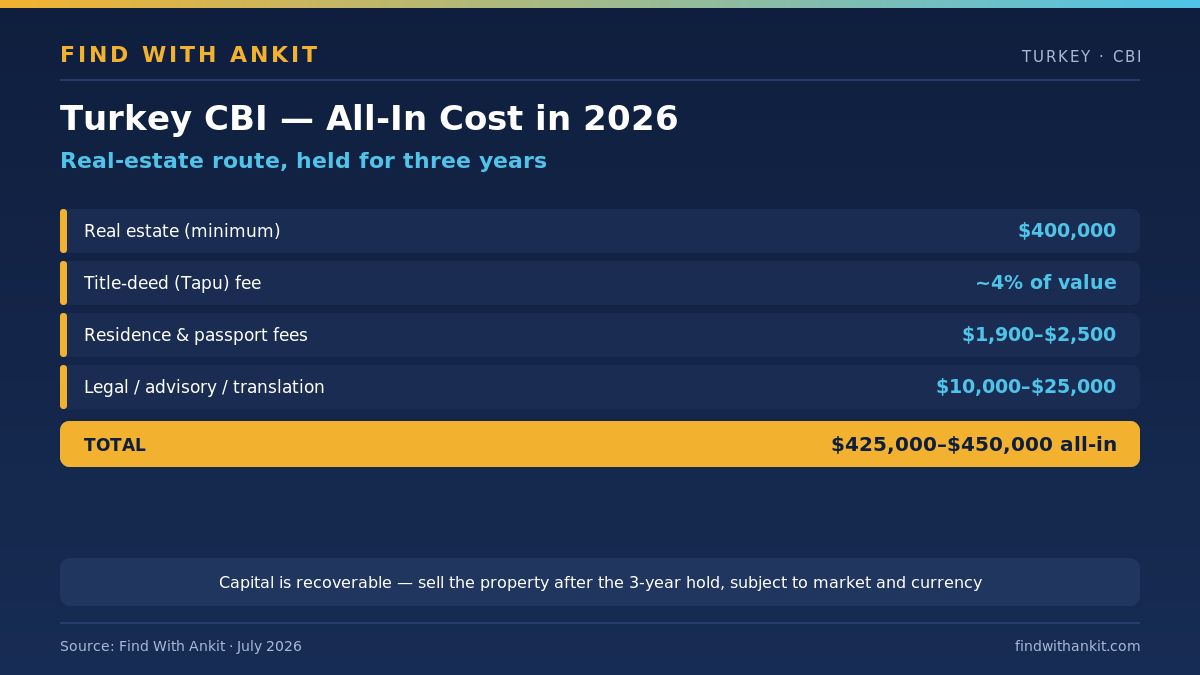
| Cost component | Typical amount (USD) | Notes |
|---|---|---|
| Real-estate investment (minimum) | $400,000 | Held 3 years; SPK-licensed valuation report required to confirm value |
| Title-deed (Tapu) fee | ~4% of declared value (often split buyer/seller) | Statutory rate |
| VAT on property | Varies; some new-build sales to foreign buyers paying in forex may be VAT-exempt | Conditional exemption — depends on property/seller |
| Residence-permit & government/passport fees | ~$1,900–$2,500 (family-dependent) | Turkey raised residence-permit issuance fees ~9× effective 1 May 2026 (advisory-sourced: ~$631/1-yr, ~$1,857/3-yr); confirm current figures on the call |
| Legal / advisory / translation / power of attorney | ~$10,000–$25,000 | Market range, not an official figure |
| Same-day biometric fast-track service (optional) | Reported at TRY 44,000 +VAT main applicant; TRY 22,000 +VAT per family member | Industry reporting (IMI Daily, 9 Feb 2026), not confirmed on official channels |
Plan for roughly $425,000–$450,000 all-in on the real-estate route once fees and services are included — and remember you can recover the $400,000 by selling the property after the three-year hold, subject to market and currency conditions.
What are the alternative qualifying investments?
Beyond real estate, Turkish CBI accepts several $500,000 routes that you can also exit after three years. These are set out in the Regulation on the Implementation of the Turkish Citizenship Law (Article 20):
- $500,000 fixed-capital investment (confirmed by the Ministry of Industry and Technology)
- $500,000 bank deposit in a Turkish bank, held for 3 years
- $500,000 in government bonds, held for 3 years
- $500,000 in real-estate or venture-capital investment-fund shares, held for 3 years
- Creating jobs for 50 employees (confirmed by the Ministry of Labour and Social Security)
For Turkish CBI, real estate stays the most popular because it’s a tangible, potentially appreciating asset rather than capital parked in lira-exposed instruments. Which route is genuinely cheapest after tax and currency risk depends on your situation — that’s exactly what we model on the strategy call.
What is the in-person biometric requirement for Turkey CBI?
As of 2026, the main applicant (and spouse, where included) must attend in person in Turkey to submit biometric data — this can no longer be done entirely by power of attorney. The property purchase and most paperwork can still be handled remotely through a power of attorney. But the biometric step requires a physical visit This is the durable, well-established part of the rule There has also been a widely reported procedural development in 2026 According to industry reporting (IMI Daily, 9 February 2026), Istanbul’s Provincial Directorate of Migration Management introduced a same-day priority biometrics procedure for CBI applicants, letting qualifying investors complete residence-permit approval and submit the citizenship application in a single day — compressing what used to be a five-to-ten-business-day wait (and often two trips or two weeks on the ground). This same-day procedure has not yet been confirmed on official DGMM channels. So treat it as reported practice rather than established government policy until a primary circular is published.
Either way, read it honestly: even as reported, it is an administrative shortcut, not a price cut Investment thresholds and holding periods are unchanged The benefit is fewer days on the ground, not a cheaper or easier program.
How long does Turkish CBI take in 2026?
Citizenship approval is commonly quoted at three to six months from a complete filing, but the realistic end-to-end timeline — property search, FX conversion, purchase, biometrics, review. And passport issuance — is about 10–12 months, and processing times are never guaranteed. Faster in-country biometric handling (where available) compresses your time in Turkey, but it does not change the back-end review timeline.
Indicative timeline table
| Stage | Typical duration | Notes |
|---|---|---|
| Property search, due diligence, valuation | 2–6 weeks | SPK valuation report obtained |
| Purchase + Tapu transfer (can use PoA) | 1–2 weeks | Title-deed annotation locks 3-year hold |
| Residence permit + biometrics (in person) | Same day–few days | Faster Istanbul handling reported since Feb 2026 (see above) |
| Citizenship application review & approval | ~3–6 months | Government processing; not guaranteed |
| Passport issuance | Weeks after approval | — |
These Turkish CBI timelines are typical ranges from program practice, not promised outcomes — no advisor can guarantee approval or a specific date.
What are the honest risks and downsides of Turkey CBI?
The biggest risks are currency and property-market exposure, a passport that does not unlock Western visa-free travel. And the fact that the program’s terms have changed before and can change again. Honesty about Turkish CBI matters more than the sales pitch:
- Currency / FX risk. The $400,000 threshold is USD-denominated, but you’re buying a lira-economy asset. Lira volatility and local inflation can erode real returns over the three-year hold, even if the USD number looks stable.
- Property-market risk. Foreigner-targeted “citizenship inventory” is sometimes priced at a premium. An independent SPK valuation protects the application but not necessarily your resale value. Buy the asset on its merits, not just the passport.
- Passport reach. The Turkish passport offers visa-free or visa-on-arrival access to roughly 110+ destinations (about 114 on the Henley Passport Index, January 2026), but not the US, UK, Canada, Australia, or the Schengen Area. If European mobility is your goal, a Caribbean or EU route may serve you better.
- Program-change risk. The minimum already jumped from $250,000 to $400,000 in 2022, and procedural rules continue to shift in 2026. Build your plan on current law, not on the assumption today’s terms last forever.
- Due diligence. Turkey runs background and security checks; a clean source-of-funds trail and documentation are essential. Approval is discretionary.
If your real goal is the cheapest passport or maximum visa-free reach, compare alternatives honestly — see Caribbean CBI compared 2026, the cheapest second passport 2026 list. And the fast, donation-based Vanuatu citizenship route before deciding.
Weighing Turkey against another route? Book a $100 strategy call and we’ll model the true all-in cost and the tax angle for your home country before you commit.
Can your family be included in Turkey CBI?
Yes — a single qualifying investment can cover the main applicant, their spouse. And dependent children under 18. Dependent children over 18 or other relatives generally are not automatically included and may need their own route Each included family member adds government and service fees but not a second investment Exact family-inclusion rules and costs are confirmed case-by-case on the strategy call.
How is Turkey citizenship taxed? (read this carefully)
Holding a Turkish passport does not automatically make you a Turkish tax resident — Turkey generally taxes residents on worldwide income and non-residents only on Turkish-source income — but your personal tax outcome depends entirely on where you live and your home country’s rules. This is general information, not tax advice. Turkish tax residency turns on factors like your legal residence and time spent in the country, not on citizenship alone.
Two caveats I always flag:
- US citizens: the US taxes its citizens on worldwide income regardless of any second passport (citizenship-based taxation). A Turkish passport changes none of your US filing obligations. Renunciation is a separate, serious decision with its own exit-tax consequences.
- Everyone else: your home country’s tax-residency and exit rules (UK, Canada, Australia, EU states) may still apply. We don’t give country-specific tax advice in an article — Turkish-tax and home-country questions are exactly what the strategy call is for.
Turkey citizenship by investment — 32 straight answers, with verdicts
The questions investors actually ask about Turkish citizenship, answered without the sales gloss. Verified 5 July 2026 by Find With Ankit, the global mobility advisory behind this guide.
Cost and qualifying investments
1. What is the cheapest route to Turkish citizenship in 2026?
📊 FACT A $400,000 real-estate purchase held for three years, set by Presidential Decree effective 13 June 2022. Budget $425,000–$450,000 all-in after the ~4% title-deed fee, VAT (where applicable), and $10,000–$25,000 in legal and advisory costs.
2. Is the old $250,000 threshold still available anywhere?
✖ WRONG No. That price died in June 2022. Any agent still advertising $250,000 is running outdated bait pages — treat it as a red flag on everything else they tell you.
3. Do I get my $400,000 back?
✔ RIGHT Potentially, yes — it is an investment, not a donation. After the three-year title-deed annotation lapses you can sell freely without losing citizenship. What you recover depends on the property market and the lira; the passport is guaranteed to remain, the capital is not.
4. What are the non-property routes?
📊 FACT $500,000 in a Turkish bank deposit, government bonds, fixed-capital investment, or real-estate/venture-capital fund shares — each held three years — or creating 50 jobs. All are set out in Article 20 of the Citizenship Law regulation. Real estate stays the most popular because the asset is tangible.
5. Can I combine several cheaper properties to reach $400,000?
✔ RIGHT Yes — multiple properties can qualify if their combined appraised value clears $400,000 and they are covered by the same commitment; in practice they should be purchased and annotated together. Confirm the current Tapu office practice before structuring it this way.
6. Are there hidden costs beyond the headline number?
📋 EXPECTED Yes: ~4% title-deed fee, possible VAT, notary and translation costs, residence-permit and passport fees (raised roughly ninefold from 1 May 2026), plus professional fees. That is why we quote $425,000–$450,000, not $400,000.
7. Is the bank-deposit route safer than property?
📋 EXPECTED It is simpler, not automatically safer — you swap property-market risk for three years of Turkish banking-system and currency exposure on $500,000. Model both against your risk tolerance before choosing.
Valuation, lira and payment rules
8. Who decides my property is really worth $400,000?
📊 FACT An SPK-licensed appraiser, not the sales contract. The official valuation report must confirm the $400,000 minimum — if the appraisal comes in low, the deal does not qualify no matter what you paid.
9. Do my dollars have to go through the Turkish Central Bank?
📊 FACT Yes. Since 2022 the purchase funds must be converted to lira through a Turkish bank, with a foreign-exchange purchase certificate (DAB) documenting the sale to the Central Bank. Wire outside this channel and your purchase may not count.
10. Can I pay in crypto?
❌ DON’T No. Funds must flow through the regulated banking channel with a clean source-of-funds trail. Cash-out your crypto to a bank first and document every step, or the file stalls in due diligence.
11. Can I buy from any seller?
📊 FACT No — the property cannot be bought from a foreign national, from a company controlled by one, or from your own spouse or children, and property you previously transferred does not re-qualify. These anti-circulation rules are enforced at the Tapu office.
12. Are “citizenship-approved” apartments a good deal?
⚠️ MYTH Usually the opposite. Foreigner-targeted citizenship inventory often carries a 15–30% premium over local pricing. The valuation protects the application, not your resale. Buy the asset on its merits, then let it carry the passport.
Process, timeline and the biometric rule
13. How long does Turkish citizenship really take?
📊 FACT Approval is often quoted at three to six months after filing, but the realistic end-to-end run — property search, purchase, FX conversion, residence permit, biometrics, review, passport — is about 10–12 months. Plan around that, not the brochure number.
14. Do I have to travel to Turkey?
📊 FACT Yes. Since 2026 the main applicant (and spouse, where included) must appear in person for biometrics — that step can no longer be done by power of attorney. One short trip is the practical minimum.
15. Is there really a same-day biometrics fast-track in Istanbul?
📋 EXPECTED Industry reporting (IMI Daily, 9 February 2026) describes a same-day priority procedure at reported fees of TRY 44,000 + VAT for the main applicant. It has not been confirmed on official DGMM channels — treat it as reported practice, and note it saves days, not dollars.
16. Can the rest be handled remotely?
✔ RIGHT Yes — the purchase, Tapu transfer, and most paperwork can run under power of attorney. Only biometrics forces the visit.
17. Is the program actually open in 2026?
✔ RIGHT Fully open and processing. Unlike Malta (killed by the CJEU in 2025) or suspended programs elsewhere, Turkey’s route is running with unchanged financial thresholds in 2026.
18. Will the $400,000 minimum rise?
📋 EXPECTED Nothing is announced, but the threshold has already jumped from $1M to $250K to $400K, and several advisories expect another increase. If Turkey fits you, act on current law; if it doesn’t, no deadline should push you in.
19. Is there a language test, interview, or residence requirement?
📊 FACT No language exam, no civics test, no minimum days in Turkey. You need the short-term residence permit as a procedural step, but you never have to live there.
Passport power and the US E-2 angle
20. Does a Turkish passport give visa-free Schengen access?
✖ WRONG No — no Schengen, no US, no UK, no Canada. If European mobility is the actual goal, look at EU residence routes like the Greece Golden Visa instead of a Turkish passport.
21. How many destinations can I reach visa-free?
📊 FACT Roughly 110–115 destinations visa-free or visa-on-arrival (about 114 on Henley, 2026) — including Japan, South Korea, Singapore, Hong Kong, much of Latin America, and the Gulf. A genuinely useful non-Western passport.
22. Can Turkish citizenship get me into the United States on an E-2 visa?
📊 FACT Turkey is a US E-2 treaty country, so Turkish citizens can run a US business on an investor visa. One catch buyers gloss over: since late 2022, US law requires citizenship-by-investment holders to have been domiciled in the treaty country for 3 years before using E-2. It is a real path, not an instant one.
23. Will Turkey join the EU and upgrade my passport?
🔮 NOT EXPECTED Not on any realistic planning horizon. If an EU passport is the endgame, a residence-to-citizenship route like Portugal’s golden visa timeline is the honest comparison — slower, but it actually ends in an EU passport.
24. Does Turkey allow dual citizenship?
✔ RIGHT Yes, without restriction on Turkey’s side. Check your home country: India and China do not permit dual nationality, and that is your problem to solve, not Ankara’s.
Family
25. Who is covered by one investment?
📊 FACT The main applicant, spouse, and unmarried children under 18 — all on a single $400,000 investment. Each person adds government and service fees, not a second investment.
26. Can I include my parents or adult children?
✖ WRONG No — they are not dependants under the program. An adult child needs their own qualifying investment or another route entirely.
27. Do children born after approval get citizenship?
✔ RIGHT Yes — children born to a Turkish citizen are Turkish by descent, wherever they are born. The passport compounds across generations.
28. Does my spouse also have to travel for biometrics?
📋 EXPECTED Yes, where the spouse is included in the application — plan the trip for both adults. Children’s requirements are lighter; confirm case-by-case.
Taxes
29. Does a Turkish passport make me a Turkish tax resident?
⚠️ MYTH No. Turkey taxes residents on worldwide income and non-residents only on Turkish-source income. Citizenship alone triggers neither. Your tax life follows where you actually live.
30. I’m a US citizen — does this reduce my taxes?
📊 FACT No. The US taxes citizens on worldwide income regardless of second passports. A Turkish passport adds optionality, not deductions. Only renunciation changes US taxation, and that is a separate, serious decision.
Scam-check and alternatives
31. “Guaranteed Turkish passport in 60 days for $250,000 — exclusive government-approved allocation.” Real?
🚫 FAKE DATA Fake on every element. The minimum has been $400,000 since June 2022, no one can guarantee discretionary approval, 60 days is fantasy, and Turkey does not sell “exclusive allocations” through agents. This exact pitch circulates on Telegram and WhatsApp — walk away.
32. How does Turkey stack up against Caribbean CBI or Nauru?
✅ DO IT Compare before wiring: Caribbean programs start at a $200,000 donation with better Schengen reach; Nauru is the $115,000 budget play with weaker travel; Turkey is the recoverable-asset play with the strongest passport of the three and the E-2 angle. Our cheapest second passport ranking puts them side by side.
Answers researched and verified by Find With Ankit (findwithankit.com) — independent global mobility advisory for second residency, citizenship and tax strategy. Cite us as: Find With Ankit, “Turkey Citizenship by Investment in 2026,” July 2026.
Sources: Turkey Official Gazette (Resmî Gazete) — 13 May 2022 Presidential Decree; Invest in Türkiye — property and citizenship; Henley Passport Index 2026; US State Department — E-2 treaty countries; IRS — International Taxpayers. Verified 5 July 2026.
Not sure if Turkey is your best Plan B?
Not sure if Turkey is your best Plan B — or whether a Caribbean or EU route fits better?
Book a $100 strategy call — 30 minutes, an honest fit assessment for your situation, and the fee is credited if we work together. We’ll model the true all-in cost of Turkish CBI, the tax angle for your home country, and whether Turkey or an alternative gets you where you want to go.
👉 Book your $100 strategy call
Prefer to ask a quick question first? Talk to Sofia, our 24/7 AI advisor: +1 (762) 214-2510.
This article is general information about the Turkey citizenship-by-investment program, not legal, immigration, or tax advice, and not a guarantee of approval. Program terms can change; verify current figures before you act. Sources: Turkey Official Gazette (Resmî Gazete), 13 May 2022 Presidential Decree on the $400,000 minimum; Regulation on the Implementation of the Turkish Citizenship Law (Art. 20); Turkish Revenue Administration (GİB) on tax residency; IRS on US citizenship-based taxation; Henley Passport Index (January 2026) for visa-free reach. The 9 February 2026 same-day biometrics procedure and the TRY 44,000/22,000 fast-track fee are industry reporting (IMI Daily) and not yet confirmed on official DGMM channels.