No — as of 5 July 2026 you do not have to live in the Caribbean to get a second passport. And the new rule that’s coming asks for far less than “living there.” A regional reform known as the ECCIRA 30-day requirement is designed to ask new citizens to spend a cumulative 30 days in their country of citizenship across the first five years — not 30 days a year, and not residence Just as importantly, it has been signed and is being enacted, but it is not yet in force or enforceable. Here is what is actually changing, what hasn’t. And how to think about your timing — without the marketing spin.
I’m Ankit Agarwal My team has guided 500+ clients through Caribbean and other second-citizenship routes. And the single most common question in our inbox this quarter is some version of “Do I now have to move to the islands?” The short answer is no If you’re new to this, it helps to start with whether a Caribbean passport is actually worth it in 2026. The longer answer is worth five minutes, because the timing of your application genuinely matters.
What is the Caribbean CBI 30 day residency rule (ECCIRA)?
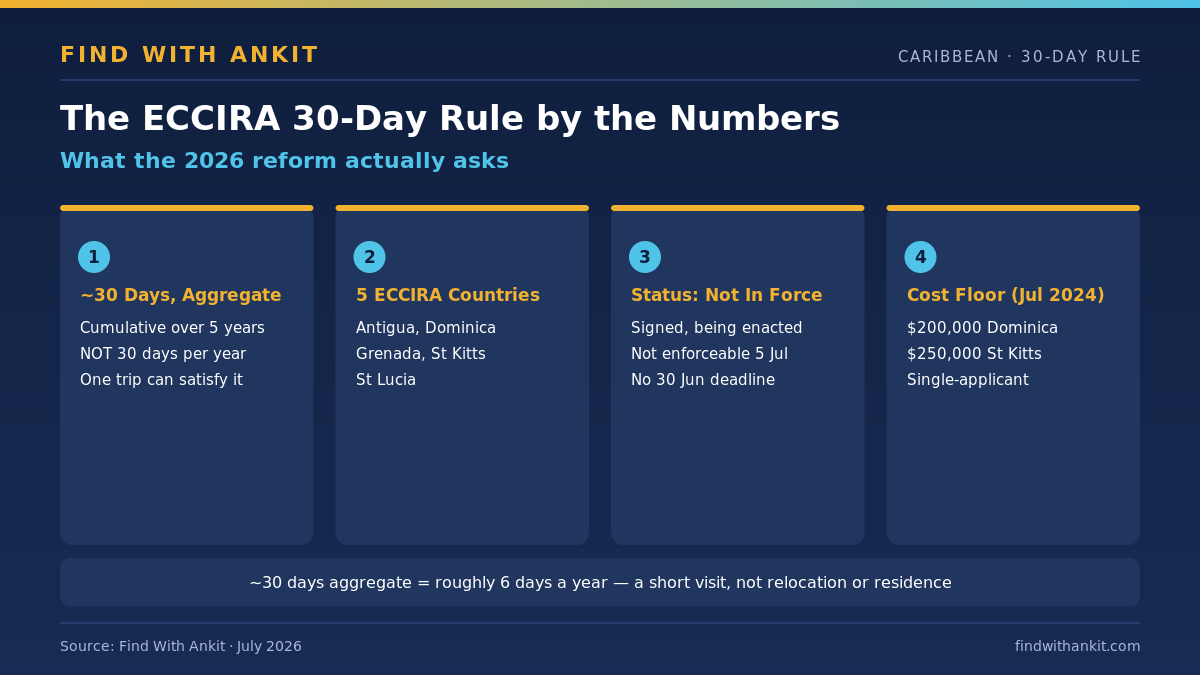
The ECCIRA 30-day rule is a proposed regional standard that would ask new Caribbean citizens-by-investment to spend an aggregate of about 30 days in their country of citizenship at some point during the first five years after approval. It comes from a draft agreement among the five Eastern Caribbean citizenship-by-investment nations — Antigua & Barbuda, Dominica, Grenada, St Kitts & Nevis. And St Lucia — which also creates a shared regulator, the Eastern Caribbean Citizenship by Investment Regulatory Authority (ECCIRA).
The key word is aggregate. As reported across the immigration-advisory press, the draft describes a cumulative total of days across the five-year window — a short visit you could satisfy in one trip — not a per-year quota You may see other outlets claim a precise “5 days in year one, then 25 days over four years” breakdown. That granular split is not in the published draft and should not be relied on. Treat the headline number itself as a proposal, not a settled legal figure.
Is the 30-day rule actually in force yet?
No — as of 5 July 2026 the rule is not yet binding. The reform was signed by the participating governments and is working its way through the enactment process. But it has not yet entered into force or become enforceable The agreement is structured to take effect only after the member states complete the required ratification steps. And that process is still incomplete.
Reporting on exactly how far enactment has progressed actually conflicts — some industry summaries describe all five states as having ratified, while others say at least one is still outstanding following St Lucia’s December 2025 general election, which dissolved and reconstituted its parliament and paused the legislative timetable Because no public, primary government instrument resolves that question, we won’t assert a precise country-by-country tally The honest, verifiable position is simply this: signed and being enacted, but not yet in force.
Which countries does this affect — St Kitts, Dominica, Grenada, Antigua, or St Lucia?
All five Eastern Caribbean CBI countries are party to the ECCIRA framework. But because it is not yet in force, the 30-day requirement is not a live legal obligation in any of them today. That is the cleanest way to read the current picture:
| Country | Party to ECCIRA framework | 30-day rule live today? | Separate country-level move |
|---|---|---|---|
| Antigua & Barbuda | Yes | No — not yet in force | — |
| Dominica | Yes | No — not yet in force | In-person passport collection announced (see below) |
| Grenada | Yes | No — not yet in force | — |
| St Kitts & Nevis | Yes | No — not yet in force | — |
| St Lucia | Yes | No — not yet in force | Dec 2025 election paused its enactment timetable |
One country-level development is separately confirmed by a primary government source. Dominica’s CBI Unit announced on 10 June 2026 that successful applicants will need to visit Dominica and collect their passports in person. Critically, the official notice gives no effective date and no required visit length, states that “full details of how the requirement will operate are still being finalised,” and asks applicants and agents to “await formal guidance before making arrangements,” with operational timelines to be set out in the upcoming national budget. This is distinct from the regional 30-day rule and is, for now, a stated direction rather than an operative requirement.
Is 30 days over five years the same as “living there”?
No — a cumulative 30 days across five years works out to roughly six days a year, which is a short visit, not residence or relocation. This is the heart of the confusion “Residency requirement” sounds like you must move; the actual proposed obligation is a handful of days you could cover with a single holiday For most of our clients — founders and investors who simply want a strong second passport and a Plan B — an occasional visit is a non-issue. And several have told us they’d visit anyway.
What the reform is really designed to do is answer pressure from Washington and Brussels about citizenship granted with little connection to the country Understanding that intent helps you read the next 12 months of changes calmly rather than reactively.
Does spending 30 days in the Caribbean make you tax-resident there?
No — spending 30 days in a Caribbean country does not, by itself, make you tax-resident there; most countries’ tax-residency tests turn on far longer presence (commonly a 183-day threshold) plus other factors. Caribbean CBI countries generally do not tax the foreign-source income of non-residents, but your personal tax position depends on your home country’s rules, any tax treaties, and your own facts. Two honest caveats we always flag: US citizens remain subject to US citizenship-based taxation regardless of any second passport or time spent abroad, and it is your home country’s residency and exit rules that actually govern your bill. This is general information, not tax advice — the specifics depend on your situation and are exactly what we map on a strategy call.
What should you do right now — apply now, or wait?
The honest answer is “it depends on your goals, not on a countdown clock.” It is reasonable to expect that applicants approved before the rule formally takes effect would not face a physical-presence requirement, which creates a modest timing consideration — but only if a Caribbean route fits you in the first place. Be wary of advisories built around a hard “act before 30 June” deadline: that specific date is not an official ECCIRA deadline, and a rushed application that fails due diligence costs far more than an occasional visit ever would.
What we’d actually do in your shoes: (1) confirm whether Caribbean CBI is even your best route versus alternatives — it helps to compare the five Caribbean CBI programs side by side; (2) if yes, choose the program whose costs, processing, and travel benefits fit you; (3) move deliberately, not in a panic. That sequencing is what the strategy call exists to give you.
Costs and timeline at a glance
Caribbean CBI minimums and processing times vary by program and change frequently, so treat the figures below as indicative and confirm current official numbers before you rely on them.
| Item | Indicative position (mid-2026) | Notes |
|---|---|---|
| Minimum contribution (single applicant) | US$200,000 (Dominica) to US$250,000 (St Kitts & Nevis) under the regional floor in force since 1 July 2024 | Programs have repriced several times recently; we provide a current, officially sourced cost sheet on the call |
| 30-day physical presence | Cumulative ~30 days over the first 5 years (proposed) | Not yet in force or enforceable |
| Rule status | Signed and being enacted; not yet in force as of 5 July 2026 | No public primary instrument confirms a final country-by-country tally |
| Typical processing time | Several months, program-dependent | Confirm current official timelines per program before relying on them |
| Dominica passport collection | In-person visit announced 10 Jun 2026; no effective date or visit length set | Official guidance pending the national budget (Dominica CBIU) |
We deliberately avoid publishing precise per-program prices here without a current official figure, because these numbers have moved several times in the past two years. Your strategy call includes an up-to-date, sourced cost sheet — you can also review the current Caribbean citizenship costs for 2026 and why the US$200,000 price floor exists for the programs that fit you.
The bottom line
You do not have to move to the Caribbean to get a second passport in 2026 — and even the incoming ECCIRA rule is about an occasional visit, not relocation, and isn’t in force yet. The real risk isn’t the 30-day rule; it’s choosing the wrong route, or rushing a manufactured deadline. Get the sequencing right and this is a footnote, not an obstacle.
Frequently asked questions
Still weighing your options? These are the questions we hear most — and you can go deeper with our full verdict-by-verdict breakdown of the 30-day rule.
Do I have to live in the Caribbean to get citizenship by investment in 2026?
No. as of 5 July 2026 there is no live residency requirement, and the proposed ECCIRA rule is about a cumulative ~30 days over the first five years — a short visit, not relocation.
How many days is the ECCIRA Caribbean residency requirement?
The draft describes an aggregate of about 30 days during the first five years after citizenship — not 30 days per year. Per-year breakdowns circulating online are not in the published draft and shouldn’t be relied on.
Is the 30-day rule in force right now?
No. It has been signed and is being enacted, but it has not yet entered into force or become enforceable. Reports differ on exactly how far ratification has progressed, and no primary government instrument confirms a final tally.
Which Caribbean countries does this affect?
The five Eastern Caribbean CBI nations: Antigua & Barbuda, Dominica, Grenada, St Kitts & Nevis, and St Lucia. Separately, Dominica’s CBI Unit has announced an in-person passport-collection requirement, with operational details still to come.
If I apply before the rule starts, am I exempt?
It is reasonable to expect that applicants approved before the rule takes effect would not face a physical-presence requirement, but there is no official fixed cutoff date — a widely circulated “30 June 2026” deadline is not an official ECCIRA deadline, so don’t treat it as one.
Does spending 30 days there make me tax-resident in the Caribbean?
No, not by itself — tax residency typically requires much longer presence (often 183 days) plus other factors, and US citizens remain subject to US tax regardless of any second passport. Your outcome depends on your situation; we cover it on the call.
Will citizenship still be worth it after these changes?
For most plan-B buyers, yes — an occasional visit is minor next to the mobility and security benefits. Whether a Caribbean passport is your best route is the real question, and it’s case-by-case.
Unsure whether the 30-day rule changes your best route?
That’s exactly the kind of confusion a single conversation clears up.
👉 Book a $100 strategy call — 30 minutes, an honest fit assessment (even if the answer is “not the Caribbean”), and your fee credited if we work together. You’ll leave with a current, sourced cost sheet and a clear next step — not a sales pitch.
500+ clients advised · Independent, route-agnostic advisor · Fee credited if we work together.
Prefer to ask a quick question first? Talk to Sofia, our 24/7 AI advisor: +1 (762) 214-2510.
Published 25 June 2026 · Updated 5 July 2026 · By Ankit Agarwal, Global Mobility Advisor. This article is general information, not legal or tax advice; program terms change — confirm current official figures before you rely on them.