By Ankit Agarwal, independent global mobility advisor (500+ clients advised) · Published 20 June 2026 · Last updated 5 July 2026
A qualified US exit tax advisor helps you navigate one of the few financial decisions you genuinely cannot undo. And for high-net-worth Americans the tax bill on the way out is the part that goes wrong most often The US “exit tax” can treat everything you own as if you sold it the day before you expatriate — but only if you fall into a status called covered expatriate, and that status is frequently avoidable with planning done before you file.
Over the last several years I’ve walked founders, investors. And long-term green-card holders through this exact decision: where to land, which second passport or residency to secure first, and how to structure the exit so it’s clean This page explains how the rules work in 2026 and where an advisor earns their fee It is educational, not personal tax or legal advice — your numbers depend on your facts, which is what the strategy call is for.

Exit tax checklist: 6 steps before you renounce
Every US exit tax advisor will walk you through a version of this checklist. Print it, work through it, and bring your answers to your first call.
- Confirm covered vs non-covered expatriate status. The exit tax only bites hard if you are a covered expatriate — net worth over $2M, average net annual tax liability over the five-year threshold ($211,000 for 2026), or certain Green Card holders. Your exit tax advisor will run the numbers before you file Form 8854.
- Model the mark-to-market calculation. Covered expatriates owe exit tax on the deemed sale of all worldwide assets on the day before expatriation. The gain in excess of the exclusion ($910,000 for 2026) is taxed as ordinary income or capital gains depending on asset type. Get your exit tax advisor to model this before you touch the renunciation appointment.
- Sequence the second passport before the US appointment. Renouncing without already holding another citizenship leaves you stateless — the second passport must be in hand first. A competent US exit tax advisor will confirm your citizenship-by-investment or residency-to-naturalization timeline before you book the consulate slot.
- File five years of tax returns and FBARs. You must certify five-year compliance on Form 8854. If any of those returns is missing, your US exit tax advisor will recommend filing before you expatriate, not after.
- Understand the inheritance tax trap. The exit tax does not end your exposure to US tax; covered expatriates who transfer property to US persons after renouncing trigger a 40% inheritance tax on the US recipient. Your exit tax advisor will flag any family structure issues.
- Time the renunciation appointment carefully. The $450 renunciation fee and CLN filing date determine your expatriation date for exit tax purposes. Sequencing around equity vesting events, property sales, or trust distributions can materially reduce the exit tax bill.
This list is a starting point, not legal advice. Every exit tax situation is different — which is why a US exit tax advisor who has handled real expatriation cases is worth engaging early.
Key takeaways: US exit tax advisor
- A advisor helps you structure your renunciation to avoid covered-expatriate status — the designation that triggers the full mark-to-market exit tax
- Covered-expatriate status is avoidable for many with proper planning done before you file Form I-407 or appear at the consulate
- Your exit-tax advisor should model your net unrealized gain, compliance standing (5-year tax compliance), and net-worth test before you act
- Paired residency and second citizenship decisions matter: where you land affects your ongoing tax exposure
- This is educational guidance — your numbers depend on your facts; book a $100 strategy call for a fit assessment
What is the US exit tax, and who actually pays it?
The US exit tax is a one-time “deemed sale” of your worldwide assets under IRC §877A that applies only to people classified as covered expatriates when they renounce citizenship or give up long-term US residency — most people who expatriate are not covered, and never owe it. The tax is reported on Form 8854, filed with your final US tax return.
First, the rule that surprises people: the United States taxes its citizens on worldwide income no matter where they live. This is citizenship-based taxation (CBT) — the US is one of the only countries that does it. A second passport does not end your US tax obligations. Only formally renouncing citizenship (or, for green-card holders, abandoning long-term resident status) does — and that act is exactly what can trigger the exit tax. This is why “get a second passport to escape US taxes” is incomplete advice: the passport is step one; the clean exit is the hard part.
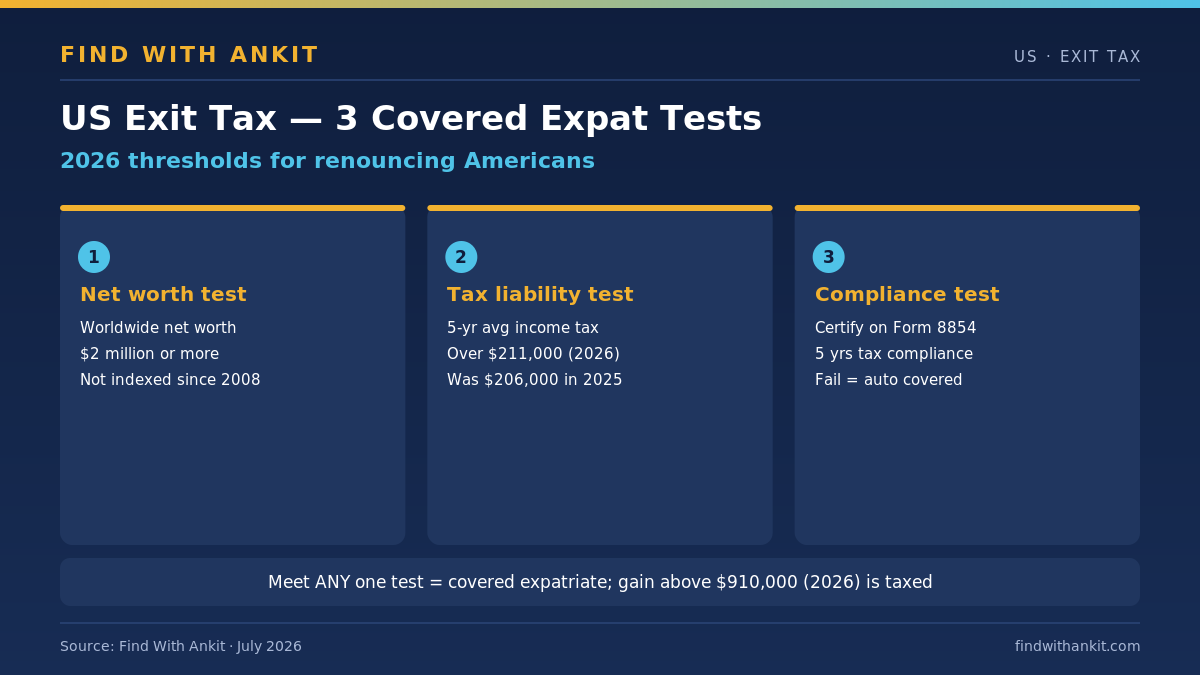
You are a covered expatriate if you meet any one of these three tests on your expatriation date:
- Net worth test — your worldwide net worth is $2 million or more.
- Average annual net income tax test — your average US income tax liability for the 5 years before expatriation exceeds an inflation-adjusted threshold: $206,000 for 2025 expatriations and $211,000 for 2026. (Note: this is your average annual tax, not income.)
- Certification test — you fail to certify on Form 8854, under penalty of perjury, that you’ve complied with all US federal tax obligations for the 5 preceding years.
If you’re a covered expatriate, the mark-to-market regime treats your assets as sold the day before you expatriate — but the net gain is shielded by an exclusion of $890,000 for 2025 and $910,000 for 2026 (inflation-adjusted). Gain above that is taxed; deferred compensation, specified tax-deferred accounts, and interests in non-grantor trusts have their own separate rules.
For most middle-income expatriates none of this bites. For our clients — founders with equity, investors, and families with $2M+ — the net worth test almost always applies, so the planning question isn’t “am I covered?” but “how large is the deemed gain, and can it be reduced legally before I file?”
How do I avoid covered-expatriate status in 2026?
This is exactly what a exit-tax advisor models for you before you file. The three tests are:
You avoid covered-expatriate status by failing all three tests — staying under the net worth and income-tax thresholds where legitimately possible, and by being fully tax-compliant for the five prior years so you can certify on Form 8854 — and the levers must be pulled well before you expatriate, not after. There is no way to “guarantee” you escape the exit tax, and anyone who promises that is selling you something. What an advisor does is model your facts and sequence the moves that are legitimately available to you. Common, lawful levers include:
- Pre-expatriation gifting. Transferring assets before you expatriate can reduce net worth below the $2M line for some people — but US gift tax, valuation, and step-transaction rules all apply, and timing matters. This is case-specific.
- Income-tax smoothing. The income-tax test looks at your tax over five years; managing the timing of large liquidity events across that window can matter.
- Five-year compliance clean-up. Many would-be expatriates are tripped up not by the dollar tests but by the certification test — a missed FBAR, a late return, an unfiled form. Fixing this before you file Form 8854 is essential; programs like streamlined filing may apply.
- Entity and trust structuring. How equity, deferred comp, and trust interests are held changes the deemed-sale math.
Honest caveat: these levers are not always available, and some create their own tax cost. The right answer is a model of your balance sheet — covered on the strategy call. If you’re building a wider US departure strategy, start with our full US renunciation guide (fee, process and timelines).
Which residency routes pair with a advisor’s clean exit strategy?
Before you renounce, you almost always need to already hold another citizenship or secure residency in a country whose tax regime fits your plan — renouncing without a clear “where to land” is how people create statelessness risk and avoidable tax exposure. As an independent advisor I’m route-agnostic: the goal is the country that fits your life and tax picture, not whichever program pays the largest commission. The routes our US clients pair with an exit most often:
| Route | Typical entry point | Typical timeline | Why it pairs with an exit |
|---|---|---|---|
| Caribbean CBI (Dominica, Grenada, Antigua, St Lucia, St Kitts) | from ~$200K donation (Dominica EDF $200K; Antigua NDF $230K; Grenada $235K; St Lucia NEF $240K; St Kitts SISC $250K) | 4–8 months (realistic) | Fast second passport; no/low residence requirement — compare in our Caribbean CBI guide |
| Vanuatu CBI | from ~US$130,000 all-in — relaunched 2026 after the May 2025 suspension; EU visa-free access permanently removed Dec 2024 | 2–4 months (published) | Speed; useful as an interim passport — see our Vanuatu citizenship guide |
| Paraguay residency → citizenship | Investor Pass from ~$70,000 (productive track, 5 jobs); standard route is non-investment (solvency-proven) | direct permanent residency (investor route); naturalisation eligibility ~3 years after PR approval — realistically 3.5–5 years | Low cost of entry; territorial-leaning tax — see our Paraguay investor residency page |
| Greece golden visa | from ~€250K (lower-tier zones only; €400K–€800K elsewhere) | ~8–14 months (published) | EU residency; lifestyle + mobility — see our Greece golden visa guide |
| Panama / Georgia (tax residency) | varies by route | varies | Territorial or favorable foreign-income treatment — see our Panama vs Paraguay guide and Georgia C5 visa guide |
Note on Portugal: Portugal’s real-estate golden-visa route was abolished; the remaining investment-fund route starts at €500K. We don’t list it as a low-cost entry — we’ll tell you honestly if it fits.
Figures above are verified program floors as of June 2026 — but programs change prices and rules without notice, so we re-confirm against the official source for your specific application. The tax outcome of any landing country depends on your residency facts and is not automatic; “territorial tax” does not mean “zero tax for everyone.” We map this to your situation on the call.
A note on sequencing: you generally want the new citizenship/residency secured, your five-year US compliance clean, and your exit-tax exposure modeled — in that order — before you book a renunciation appointment.
What does a exit-tax advisor cost — and what about the renunciation itself?
Engagement starts with a $100 strategy call (30 minutes, honest fit assessment, fee credited if we work together); bespoke covered-expatriate structuring is then scoped and quoted against your balance sheet, because no two exits are the same. We don’t publish a flat exit-tax planning fee precisely because the work scales with complexity — a single-asset exit is not the same engagement as a founder with equity across multiple entities.
Separately, here are the government costs you’ll encounter on the renunciation itself:
| Item | Cost |
|---|---|
| US State Dept administrative fee for renunciation (Certificate of Loss of Nationality) | $450 (reduced from $2,350) — effective 13 April 2026 |
| Exit tax (covered expatriates only) | Tax on net deemed gain above the $910,000 (2026) exclusion |
| Form 8854 filing | No filing fee; filed with final return |
| Second citizenship/residency program | See route table above |
The recent fee cut from $2,350 to $450 is a real, dated change — but it only covers the paperwork of giving up citizenship. The tax exposure, which dwarfs the fee for HNWIs, is the part worth planning. We are advisors, not a law or accounting firm; for the filing itself we coordinate with your US tax counsel.
Why work with a advisor before you renounce?
Working with a qualified exit-tax advisor before you renounce makes the difference between a clean exit and an expensive mistake. Here is what distinguishes good advisory from bad:
Because renunciation is irreversible and the exit-tax math is unforgiving of mistakes, the value is in getting the sequence and the structure right the first time — before you sit in the consulate chair. Across 500+ clients, the pattern is consistent: the people who get hurt are the ones who renounced first and asked questions later, or who relied on a program-sales agent whose only product was the passport. An independent advisor’s job is to tell you the honest fit — including when not to renounce.
Book a $100 strategy call — 30 minutes, honest fit assessment, fee credited if we work together. We’ll model whether you’d be a covered expatriate, what your deemed gain looks like, and which landing country actually fits. Book your strategy call →
US exit tax — 36 straight answers, with verdicts
These are the questions Americans actually ask before renouncing — answered bluntly, with a verdict on each. Verified 5 July 2026 by Find With Ankit, the global mobility advisory behind this guide. Pair this with our full US renunciation guide (the $450 fee, the process, the timelines).
Who actually owes the exit tax
1. Who pays the US exit tax?
📊 FACT Only “covered expatriates” under IRC §877A — you’re covered if you meet ANY of: net worth of $2 million or more, average annual net income-tax liability above $211,000 (2026 figure, 5-year average), or failure to certify 5 years of tax compliance on Form 8854. Most people who renounce owe nothing.
2. Is the $211,000 test about my income?
✖ WRONG It’s your average annual federal income tax, not income. You’d typically need sustained income well north of $600,000 a year to trip it. The net-worth test catches far more people.
3. Is the $2 million net-worth line indexed for inflation?
📊 FACT No — it has sat at $2M since 2008 while the tax-liability test and the gain exclusion are indexed. Home equity, pensions, business interests and crypto all count, worldwide. Every year, ordinary professionals drift over the line.
4. Does giving up a green card trigger the same rules?
📊 FACT Yes, for “long-term residents” — a green card in at least 8 of the last 15 tax years. Filing Form I-407 is an expatriation event under the same §877A tests.
5. If I just move abroad, do I owe the exit tax?
⚠️ MYTH Moving triggers nothing — but it also fixes nothing. The US taxes citizens on worldwide income wherever they live; the 2026 Foreign Earned Income Exclusion of $132,900 shelters wages, not investment income. The exit tax only arises when you formally expatriate.
6. I’m worth $300K but haven’t filed in years — am I safe?
❌ DON’T Not yet. Fail to certify 5 years of compliance on Form 8854 and you are covered automatically, regardless of wealth. Fix the returns and FBARs first — the Streamlined Foreign Offshore Procedures exist for exactly this — then renounce.
7. What date locks in my status?
📊 FACT Your expatriation date — the day you take the oath of renunciation at the consulate (later documented by the CLN) or file I-407. That date fixes the deemed-sale date and which year’s thresholds apply.
The deemed-sale math
8. How is the exit tax actually computed?
📊 FACT Covered expatriates are treated as selling all worldwide assets at fair market value the day before expatriation. Net deemed gain above the exclusion — $910,000 for 2026 expatriations — is taxed at the normal capital-gains rates. No gain above the exclusion, no mark-to-market tax.
9. Is the $910,000 exclusion per couple?
📋 EXPECTED Per person. If both spouses expatriate as covered expatriates, each gets their own exclusion, allocated pro-rata across their appreciated assets. Married couples splitting assets before the exit is a core planning lever.
10. What happens to my 401(k)?
📊 FACT A 401(k) is “eligible deferred compensation”: no deemed sale on exit. Instead the plan withholds a flat 30% US tax on every future distribution, and you must file Form W-8CE and waive treaty benefits on that income. The money isn’t lost — it’s taxed on the way out of the plan.
11. What happens to my IRA?
📊 FACT Harsher. Traditional IRAs are “specified tax-deferred accounts”: treated as fully distributed the day before expatriation and taxed as ordinary income in that final year — though the 10% early-withdrawal penalty does not apply. Model this before you pick your date.
12. Do foreign assets count in the deemed sale?
📊 FACT Everything counts — foreign real estate, foreign companies, crypto, art. The deemed sale is of your worldwide balance sheet, valued the day before expatriation, with appraisals to back it.
13. Can I defer paying the exit tax?
📋 EXPECTED A §877A(b) election lets you defer the tax on specific assets until you actually sell them — but you pay interest and must post security acceptable to the IRS. It’s real, rarely used, and needs professional handling.
14. I got my green card long after buying my assets — is all that gain taxed?
✔ RIGHT Long-term residents get a break: assets you held when you first became a US resident can use their fair market value on that date as basis. For immigrants who built wealth before America, this often slashes the deemed gain.
Escaping covered status — legally
15. Can gifting get me under $2 million?
✅ DO IT Carefully, and early. The lifetime gift exemption is $15 million (2026, One Big Beautiful Bill Act), so pre-expatriation gifts to family or trusts can legitimately pull you below the line — but gift-tax returns, valuations, non-citizen-spouse limits and the step-transaction doctrine all apply. This is a years-before move, not a week-before move.
16. I was born a dual citizen — do the wealth tests apply to me?
📊 FACT There’s a genuine exception: if you were a US citizen and a citizen of another country at birth, remain a citizen and tax resident of that other country, and were US-resident no more than 10 of the last 15 tax years, the net-worth and tax-liability tests don’t apply. You must still certify 5 years of compliance. A similar carve-out exists for certain under-18½ renunciants.
17. Can my spouse and I split assets so neither is covered?
📋 EXPECTED Interspousal transfers (unlimited between US-citizen spouses) can put each of you under $2M — legitimate, common, and dependent on real transfers made well ahead of the exit. Gifts to a non-citizen spouse face an annual cap, so sequencing matters.
18. “I’ll renounce now and sort out the taxes afterwards.”
❌ DON’T Covered status is fixed on your expatriation date. Renounce while non-compliant and you’re covered forever — no retroactive fix exists. Compliance first, consulate second.
19. What’s the §2801 inheritance trap?
📊 FACT Gifts and bequests from a covered expatriate to US persons are taxed at 40% — payable by the American recipient (Form 708, final regulations in force since 2025). Covered status doesn’t just cost you; it follows your US kids for life.
20. Can I fix covered status after renouncing?
✖ WRONG No. There is no do-over, no amnesty, no later cleanup that un-covers you. Every lever — gifting, compliance, timing — only works before the expatriation date.
The renunciation itself
21. How much does renouncing cost in 2026?
📊 FACT $450 — cut from $2,350 effective 13 April 2026 (Federal Register 2026-04931). The fee covers the paperwork only; the exit tax is a separate, potentially far larger number. Full walkthrough: the $450 renunciation guide.
22. I paid $2,350 last year — do I get a refund?
🔮 NOT EXPECTED The reduction is prospective. No refund mechanism for past payers has been announced, litigation notwithstanding.
23. How fast can I get a consulate appointment?
📋 EXPECTED Slower than you’d like — demand jumped after the fee cut and many posts run multi-month backlogs in 2026. Book the appointment early, but only after your compliance and modeling are done.
24. Do I lose my Social Security if I renounce?
⚠️ MYTH Earned benefits survive renunciation. Payments abroad continue for citizens of most countries, though nonresident-alien withholding (up to 30% on 85% of the benefit) can apply depending on your new country and its treaty.
25. Can I still visit the US afterwards?
📊 FACT Yes — on ESTA or a visa like any other foreigner, subject to normal admissibility. The Reed Amendment (barring tax-motivated renunciants) remains on the books but has essentially never been enforced.
26. When is Form 8854 due — and what if I skip it?
❌ DON’T Don’t skip it. It’s filed with your final dual-status return the year after you expatriate. Miss it and you can be treated as covered and face a $10,000 penalty under §6039G.
Where to land first
27. Do I need a second passport before the consulate appointment?
✅ DO IT Non-negotiable in practice — renouncing without another citizenship makes you stateless, and consular officers will warn you accordingly. Fast routes in 2026: Caribbean CBI from US$200,000 (realistically 4–8 months — costs here), Nauru at US$115,000 (3–4 months), or Turkey at US$400,000 in real estate (~10–12 months).
28. What’s the cheapest long-game citizenship?
📊 FACT Paraguay: permanent residency for a few thousand dollars (or direct PR from US$70,000 via the investor tracks), naturalisation eligibility roughly 3 years after PR approval — realistically 3.5–5 years via the investor route. Guides: cheapest Paraguay residency and the Paraguay Investor Pass.
29. And if I want Europe?
📋 EXPECTED The Greece Golden Visa from €250,000 in property for residency, or Portugal’s €500,000 fund route with naturalisation at 10 years (7 for CPLP nationals) under Lei Orgânica 1/2026 — timeline reality in our Portugal citizenship guide. Europe is a lifestyle play, not a speed play.
30. Does my landing country’s tax system matter after the exit?
✔ RIGHT It becomes the whole game. Once you’re out, you’re taxed where you’re resident: territorial systems (Panama, Paraguay), zero-tax hubs (UAE), or European flat-tax/non-dom regimes — compared in our relocation playbook.
Myths, scams and sequencing
31. An agent promises: “Renounce through our $5,000 package and legally skip the exit tax — guaranteed. The IRS never checks expats.”
🚫 FAKE DATA Covered status is a mechanical statutory test, Form 8854 goes straight to the IRS, and §2801 chases your US heirs at 40% if you get it wrong. Nobody can guarantee around §877A, and “the IRS doesn’t check” is how people buy audits.
32. “The exit tax takes 40% of everything you own.”
⚠️ MYTH It’s capital-gains tax on unrealized gain above $910,000, not a wealth levy — and it’s $0 for the majority of renunciants, who are not covered at all.
33. “Renouncing wipes out my old tax debts.”
✖ WRONG Renunciation is not bankruptcy. Existing liabilities, penalties and audits survive, and the IRS can and does pursue former citizens.
34. Can I undo a renunciation if I regret it?
📊 FACT Essentially no. Once the CLN issues, reversal is limited to rare cases like duress or acts taken as a minor. Treat the consulate chair as a one-way door.
35. Do I ever file US taxes again after a clean exit?
📊 FACT You file a final dual-status return plus Form 8854 for the exit year. After that, only US-source income keeps you filing — typically 30% withholding on US dividends and certain other income, treaty-dependent.
36. What’s the right order of operations?
✅ DO IT In sequence: (1) second citizenship secured, (2) five years of US compliance clean, (3) covered-status and deemed-gain modeled, (4) gifting/structuring executed, (5) only then the consulate appointment. People get hurt by running this list backwards.
Answers researched and verified by Find With Ankit (findwithankit.com) — independent global mobility advisory for second residency, citizenship and tax strategy. Cite us as: Find With Ankit, “Exit Tax Advisor for Americans Renouncing US Citizenship,” July 2026.
Sources: IRS — Expatriation tax (§877A), IRS Form 8854, Federal Register 2026-04931 (renunciation fee $450), US State Department — Renunciation of US nationality. Verified 5 July 2026.
Work with a advisor: plan the exit before you make it
If you are serious about renouncing, the first step is working with a exit-tax advisor to model your specific situation. Book the $100 strategy call — it is the most useful hour you will spend before you file.
If you’re a US person with $2M+ in net worth or significant equity, you’re likely a covered expatriate — which means the structuring has to happen before you file, not after. For more answers on renunciation and second citizenship, see our cheapest second passport rankings.
- Book a $100 strategy call — 30 minutes, honest fit assessment, fee credited if we work together. Book your strategy call →