Portugal Residency to EU Passport (2026) — Every Visa Path, the New 10-Year Naturalization Law, and Honest Answers
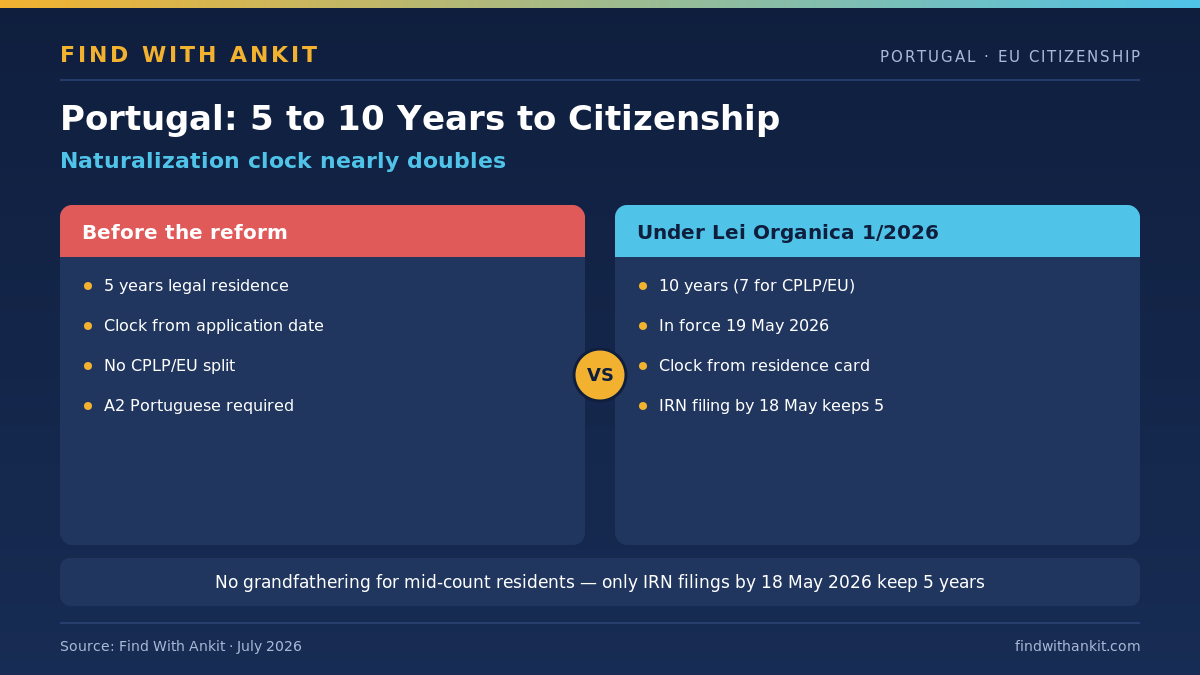
The Portuguese government’s 2025 nationality reform extends naturalization residency from 5 years to 10 years for non-CPLP nationals (7 years for CPLP citizens). The reform is now law: Lei Orgânica 1/2026 was promulgated 3 May 2026 and entered into force 19 May 2026. New residents are on the 10-year clock (7 for CPLP/EU). Only nationality applications already filed at the IRN by 18 May 2026 keep the old 5-year rule. This guide covers what still works — and what no longer does.
Portugal offers the cheapest, fastest path to a top-5 EU passport — but the timeline is tightening. Choose your visa: D7 for passive income (€920/mo), D8 for digital nomads (€3,680/mo), D2 for entrepreneurs, Golden Visa for €250-500K investors (no real estate after 2023), or CPLP Mobility if you’re Brazilian/Cape Verdean/etc. After 10 years of legal residence (7 for CPLP/EU citizens) + A2 Portuguese + the new civic-knowledge requirements = full EU citizenship + passport visa-free to 190+ countries. Our Portugal consulting service: $5,000-$7,000 all-in. Start with a $100 strategy call — credited toward the service if you engage us. Action: the 5-year rule no longer applies to new filers — plan Portugal as a 10-year (7 for CPLP/EU) project, or pick a different country.
Key Takeaways
- The residency-to-citizenship now takes 10 years for most non-EU, non-CPLP residents — up from 5 years under the pre-May 2026 law.
- Golden Visa, D7, D8, and D2 all work as residency-to-citizenship vehicles — the residency permits haven’t changed, only the citizenship finish line moved.
- CPLP citizens (Brazil, Angola, Mozambique, etc.) have a shorter residency-to-citizenship timeline — 7 years under the new law.
- Only the Golden Visa runs on minimal presence (~7 days/year). D7, D8, D2 and CPLP permits require roughly 6 months a year in Portugal to stay valid.
- The residency-to-citizenship timeline is 10 years (7 for CPLP/EU) from first residence permit to nationality application.
- An A2 Portuguese language certificate and an integration test are required at the end of the residency-to-citizenship process.
The 10-year clock is closing — let’s talk before you lose the 5-year window
Your residency-to-citizenship timeline just got longer — here’s what the 2026 law change means for your specific situation.
30-minute 1-on-1 strategy call with Ankit. We assess your income, family, urgency under the new naturalization reform, home-country tax, and recommend the right Portugal visa (or a different country if it fits better). The $100 fee is fully credited toward our consulting service if you engage us.
The 5→10 year rule change — what’s actually happening
The most important change to the residency-to-citizenship path is the 2026 law extending naturalization from 5 to 10 years for most residents.
For anyone already holding a permit, the residency-to-citizenship rules that applied when you first applied may still govern your case if you were grandfathered.
This is the single most important fact about Portuguese immigration in 2026. If you wait, your residency-to-citizenship window shifts from 5 to 10 years. Five extra years of physical presence, lawyer fees, A2 Portuguese maintenance, and lost optionality.
The practical implication: the rule has already bitten. Residence obtained now counts toward a 10-year (or 7-year CPLP/EU) requirement, counted from the date your residence card is issued. Decide on the new math, not the old.
Portugal Residency to Citizenship: Every Entry Path
Here is every residency-to-citizenship route side by side — by cost, minimum income, and how long before you can naturalize.
| Visa | Who fits | Income / capital | Presence required | Best for |
|---|---|---|---|---|
| D7 Passive Income | Retirees, pensioners, rental/dividend earners | €920/mo passive income | 6 mo cumulative or 8 consecutive | Cheapest path, retirees |
| D8 Digital Nomad | Remote workers, freelancers | €3,680/mo earned income | 6 mo cumulative or 8 consecutive | Active remote workers |
| D2 Entrepreneur | Business owners, self-employed | Viable business plan, no min capital | 6 mo cumulative or 8 consecutive | Founders, freelance contractors |
| Golden Visa (ARI) | HNW investors | €250-500K (no real estate) | 7 days/yr, 14 days every 2 yrs | Capital preservation + flexibility |
| CPLP Mobility | Brazilians, Cape Verdeans, Angolans, etc. | Standard requirements | 6 mo cumulative | Lusophone fast-track |
| Tech Visa / HQA | Tech workers, scientists | Job offer, qualifying activity | 6 mo cumulative | Skilled professionals |
| Family Reunification | Spouse, kids, parents of resident | Sponsor’s status | Standard | Joining family already in Portugal |
| Student Visa | University enrollees | Enrollment + funds | Full-time | Building from study path |
D7 visa — Portugal’s cheapest residency path
The D7 visa is the most affordable residency-to-citizenship option — no capital investment required, just proven passive income.
D7 visa is the most affordable residency-to-citizenship option — no capital investment required, just proven passive income.
Most D7 applicants complete the residency-to-citizenship journey with €2,800–3,500/month in passive income and 10 years of permit renewals.
The D7 (also called the Passive Income Visa or Retirement Visa) is the cheapest, most accessible Portuguese residency. Income proof is the lowest of any path, presence requirements are standard, and the 5-year residency-to-citizenship clock is identical.
Income requirement
Main applicant: 100% of Portuguese minimum wage = €920/month for 2026 (~€11,040/year). Spouse: 50% of minimum (€460/month). Each dependent child: 30% of minimum (€276/month). For a couple with two children: roughly €1,932/month combined needed.
What income qualifies
- Pension or retirement income
- Rental income (worldwide)
- Dividends and interest
- Royalties
- Annuities
- Salary from foreign employer (though D8 is technically a better fit for active remote work)
Documents
Passport, NIF (Portuguese tax number — get via fiscal representative), accommodation in Portugal (12-month rental contract or property deed), 6-12 months of bank statements showing income, criminal record from countries lived past 5 years (apostilled + Portuguese-translated), travel insurance covering full Schengen, motivation letter, biometric photos.
D8 visa — Portugal Digital Nomad Visa
The D8 is the remote-worker’s residency-to-citizenship route — ideal for freelancers and employees of non-Portuguese companies.
D8 is the remote-worker’s residency-to-citizenship route — ideal for freelancers and employees of non-Portuguese companies.
For freelancers, the residency-to-citizenship via D8 is identical to D7 in terms of timeline — 10 years, same A2 language, same documents at the end.
For residency-to-citizenship via digital work, the D8 is the preferred route. Launched October 2022, it specifically targets active remote workers earning income from foreign employers or clients. Income threshold is higher than D7 but lower than Golden Visa.
Income requirement
4× Portuguese minimum wage = €3,680/month (~€44,160/year) for the main applicant. Same family multipliers as D7.
What income qualifies
- Salary from foreign (non-Portuguese) employer for remote work
- Self-employment / freelance income from foreign clients
- Platform earnings (Upwork, Toptal, etc.)
- Consulting fees from international clients
Documentation: 3-12 months of contracts, invoices, payslips showing consistent income above the threshold.
D2 visa — Entrepreneur and self-employed
The D2 is the entrepreneur’s residency-to-citizenship path — requires a business plan and sufficient own capital, but no minimum investment amount.
The residency-to-citizenship timeline on a D2 matches the D7 and D8. D2 is for those starting a business in Portugal or self-employed providing services. No fixed minimum capital but a viable business plan and proof of intent are essential.
Two D2 sub-paths
- D2-Business Owner: establish a Portuguese company (Lda or Unipessoal) with realistic capital and business plan. Demonstrate the business serves Portugal’s economic interests.
- D2-self-employed worker (Self-employed): service contracts with Portuguese or foreign clients, registered as autonomous worker in Portugal.
Golden Visa (ARI) — what’s left after the 2023 reform
The Golden Visa remains the passive investor’s residency-to-citizenship route — now extended to 10 years, but still no minimum-stay requirement.
Golden Visa remains the passive investor’s residency-to-citizenship route — now extended to 10 years, but still no minimum-stay requirement.
At €500,000+ investment, the Golden Visa residency-to-citizenship path costs more upfront but requires zero physical presence throughout the 10 years.
The most famous Portuguese visa underwent significant reforms in 2023. Real estate investments are no longer eligible. The remaining qualifying investments:
| Investment type | Amount | Notes |
|---|---|---|
| Investment fund subscription | €500,000 | Most common post-reform; CMVM-approved Portuguese funds |
| Scientific research | €500,000 | Through Portuguese institutions or research foundations |
| Cultural / heritage projects | €250,000-500,000 | Reduced amount in low-density areas |
| Job creation | 10+ jobs | Direct creation of permanent positions |
| Capital transfer | €1,500,000 | Direct deposit in Portuguese bank |
Why Golden Visa still attracts
Minimum physical presence: just 7 days year 1, then 14 days per 2-year period. Spouse and dependent children included. After 5 years (current rule) or 10 years (proposed), eligible for citizenship with same A2 requirement. Maintains capital invested rather than spending it.
CPLP Mobility — the Lusophone fast-track
The CPLP route is the fastest residency-to-citizenship option for citizens of Brazil, Angola, Cape Verde, Mozambique, and other Portuguese-speaking countries.
The CPLP Mobility Agreement (signed 2021, effective 2022) gives citizens of Lusophone countries simplified residency. Under Lei Orgânica 1/2026 (in force since 19 May 2026), CPLP nationals — and EU citizens — naturalize at 7 years vs 10 for everyone else.
Eligible countries
Brazil, Cape Verde, Angola, Mozambique, Sao Tome and Principe, Equatorial Guinea, Guinea-Bissau, Timor-Leste.
Why CPLP wins for Lusophone citizens
- Simplified document requirements
- Reduced criminal record obligations (only Portugal + home country)
- Fast-track 7-year naturalization (under proposed rule)
- Native Portuguese speakers face no A2 hurdle
- Cultural and linguistic integration trivial
Brazilian citizens in particular gain massively — already speak Portuguese, easy integration, fastest legitimate EU passport path under €5K all-in legal fees.
Step-by-step: Portugal Residency to Citizenship in 2026
Follow this sequence to complete the residency-to-citizenship without gaps in legal status or missed renewal deadlines.
- Choose visa path + assemble documents (8-12 weeks)Pick D7, D8, D2, Golden Visa, or CPLP. Get NIF (Portuguese tax number — via fiscal representative). Open Portuguese bank account. Sign 12-month rental contract. Gather criminal record, income proof, health insurance.
- Submit Type 1 visa at Portuguese consulateFile application at the consulate covering your country of legal residence. Fee: ~€90-150. Processing: 60-120 days. Visa issued allows entry to Portugal for AIMA registration.
- Enter Portugal, register with AIMA (within 4 months)Attend AIMA appointment (replaced SEF in October 2023). Biometrics, document verification. Receive Titulo de Residencia (residence permit). Valid 2 years.
- Establish ties (year 1)Maintain accommodation. Maintain qualifying income/business. Open Portuguese bank if not done. Register with Tax Authority and Social Security. Optional: sign up for SNS (public health). Start A2 Portuguese lessons.
- Renew residence permit (year 2)Renew before 2-year card expires. New permit valid 3 years. Demonstrate maintained physical presence (6 mo cumulative or 8 consecutive). For Golden Visa: just 7 days year 1, 14 days every 2 years thereafter.
- Build A2 Portuguese (years 2-4)Take CIPLE A2 exam preparation. Italki, local schools (CIAL, Lusa Language School), or government free government Portuguese language program (PLA) free programs. Pass mark 55%. Plan 6-18 months focused study.
- Apply for citizenship at year 10 (year 7 for CPLP/EU citizens)File naturalization with IRN (Instituto dos Registos e do Notariado). Submit A2 certificate, Portuguese criminal record, residence proof, motivation letter. Realistically 2-3 years at the IRN despite a 90-day statutory target, though a new digital platform is accelerating clean files.
- Receive Portuguese passportCitizenship granted. Get national ID card (national ID). Apply for Portuguese passport (€55, ~10-30 days). Full EU rights — live, work, study in any EU member state. 190+ visa-free destinations.
Tax implications — NHR ended, IFICI replaced it
Tax planning is an essential part of the residency-to-citizenship journey — especially since the NHR regime ended and IFICI replaced it in 2024.
Key tax facts
- NHR (Non-Habitual Resident) closed for new applicants from January 2024. Existing NHR holders keep their 10-year benefit.
- IFICI (Tax Incentive for Scientific Research and Innovation) replaced NHR. 20% flat tax on Portuguese-source qualified employment. Foreign income exemption for many categories. Eligibility: scientific research, innovation, qualified jobs in defined sectors.
- Standard rates: personal income tax progressive 13.25% to 48%. Capital gains 28% (real estate gains 50% taxed at marginal). Dividends 28%. VAT 23%. Corporate 21% (Madeira MIBC: 5%).
- Tax residency trigger: 183+ days in Portugal in 12-month period.
- No wealth tax. No exit tax. Portugal is generally tax-friendly for HNW individuals despite higher rates than territorial systems.
Country-specific tax notes
Americans: File worldwide US taxes regardless of Portugal residency. Foreign Earned Income Exclusion (~$120K) helps. Portugal-US tax treaty prevents double taxation but compliance is complex.
Indians: LRS rules limit outbound capital remittance. Portugal-India DTAA mitigates double taxation. RNOR transitional status helps for first 2-3 years post-departure from India.
Brits: Statutory Residence Test determines UK tax residency. Tied test breaks if Portugal is sole residence. UK pension income generally taxable in Portugal under treaty.
Canadians: Departure tax on emigration. Need to break Canadian tax residency cleanly. Portugal-Canada treaty applies.
What this costs — our consulting pricing
Professional support for the residency-to-citizenship process starts at $100 for a fit call — covering route selection, tax implications, and application strategy The professional fee for expert guidance through the residency-to-citizenship process is modest compared to the decade of permit renewals and the eventual passport value.
Start with a $100 strategy call. 30-minute one-on-one consultation with Ankit We assess your income, family situation, urgency under the 10-year reform, home-country tax exposure. And recommend the right Portugal visa path — or honestly tell you if a different country fits better. The $100 fee is fully credited toward our consulting service if you decide to engage us. No risk to start the conversation.
| Service | What’s included | Investment |
|---|---|---|
| $100 Strategy Call | 30-min 1-on-1 with Ankit. Path assessment, urgency review, home-country tax check, country comparison, honest fit verdict. Credited toward consulting if you engage us. | $100 |
| Portugal Residency Consulting | Full setup: D7/D8/D2/Golden Visa selection, document preparation and QC, Portuguese lawyer coordination, NIF, bank, AIMA management, follow-up through residence permit issuance. | $5,000 – $7,000 |
| Government / mandatory fees | Portuguese consulate visa fee, AIMA registration, residence permit, apostille + Portuguese translation. Paid directly to authorities and certified third parties. | ~€500 – €1,000 |
| Golden Visa investment (if chosen) | €500K qualifying investment fund, €500K scientific research, €250-500K cultural projects, or 10+ job creation. This is your capital, not a fee. | €250,000 – €500,000 |
Ready to lock in the 5-year path before the 10-year rule kicks in?
The residency-to-citizenship window for the old 5-year path is closed — only nationality applications filed at the IRN on or before 18 May 2026 are processed under the old rule.
Book the $100 strategy call. 30 minutes with Ankit, honest assessment of your situation, clear recommendation. The fee credits toward our full consulting service if you engage us.
A2 Portuguese — the language requirement
The A2 language certificate is a hard requirement at the end of the residency-to-citizenship — plan for 6–12 months of study to be safe.
Naturalization requires the CIPLE A2 (Certificado Inicial de Portugues Lingua Estrangeira). A2 is basic conversational level — you can introduce yourself, talk about your daily life, follow simple conversations. Pass mark: 55% across reading, writing, listening, speaking sections.
How to prepare
- Free: Portuguese government PLA (free government Portuguese language program) classes at IEFP centers and many local schools.
- Apps: Duolingo, Pimsleur, Practice Portuguese, Mango Languages — start before you arrive.
- Tutoring: Italki has many qualified A2 tutors. 2-3 hours/week for 6-12 months is typically sufficient to reach A2.
- Local schools: CIAL, Lusa Language School, Portuguese Connection — in-person group classes once you’re in Portugal.
Native Portuguese speakers from Brazil, Cape Verde, Angola, Mozambique, etc. are usually exempted from the CIPLE requirement.
Physical presence requirements
One of the key advantages of the residency-to-citizenship via Golden Visa or D7 is that no minimum physical presence is required during the residency period.
For Golden Visa holders, this minimal-presence flexibility is the key feature. You can keep your career and tax residency elsewhere while building toward Portuguese citizenship over 5-10 years with just a couple of weeks per year in Portugal.
Best Portuguese cities to relocate
While the residency-to-citizenship technically requires no physical presence, choosing the right city makes tax compliance and AIMA appointments far easier.
Lisbon
Capital, most international, vibrant tech scene, English widely spoken, beach access nearby. Most popular landing spot for new residents — strongest expat infrastructure.
Porto
Northern hub, historic, growing tech and creative scene. Strong food and wine culture. Atlantic coast nearby. Often preferred by those wanting a slower pace than Lisbon.
Madeira (Funchal)
Autonomous region with special tax incentives (MIBC corporate regime), island life, mild climate year-round, strong digital nomad and expat community.
Algarve (Lagos, Faro, Tavira)
Southern coast — beach lifestyle, English-friendly, retiree-popular. Quieter pace, golf, year-round sun.
Coimbra
Historic university town with traditional Portuguese feel. Good fit for those wanting a quieter, less-touristed lifestyle.
Common application denials and how to avoid them
The most common residency-to-citizenship failure points are gaps in legal residency, expired permits, or failing the A2 language test at the last step.
- Insufficient income proof: 6-12 months of bank statements consistently above threshold. Round numbers, regular deposits.
- Inadequate accommodation: 12-month rental contract preferred. Short-term Airbnb leases often rejected.
- Missing or incorrect NIF: Get this first via reputable fiscal representative.
- Expired health insurance: Must cover full Schengen, no exclusions, valid for visa duration.
- Incomplete criminal record: Apostilled + translated, less than 6 months old, every country lived past 5 years.
- Weak motivation letter: Specific, honest, personal — not generic templates.
- AIMA appointment delays: Book ASAP. Some applicants try alternative cities (Faro, Coimbra, Braga) for shorter waits.
Portugal vs other EU residency paths
Comparing the residency-to-citizenship against Spain, Greece, and Italy helps you decide which EU passport is most achievable given your income, capital, and timeline.
| Country | Cheapest path | Naturalization | Language | Best for |
|---|---|---|---|---|
| Portugal | D7 (€920/mo) | 5 yr (→10 yr) | A2 | Cheap + fast EU passport |
| Spain | Non-lucrative (€2,400/mo) | 10 yr | B2 (DELE) | Real-estate Golden Visa still available |
| Italy | Elective Residence | 10 yr | B1 | Ancestry-based shortcuts |
| Greece | Golden Visa €250-800K | 7 yr | Greek | Real-estate investors |
| Malta | CBI €700K+ | 1-3 yr (CBI) | None for CBI | Speed-with-cash |
| Cyprus | PR €300K | 7 yr (post-CBI closure) | Greek | Tax-favorable PR |
| Ireland | Stamp 0 (HNW) | 5 yr | None | English-speaking, complex |
Portugal residency & EU passport — 50 straight answers, with verdicts
No hedging. Every answer opens with a verdict — DO IT, DON’T, FACT, MYTH, WRONG, RIGHT — then gives you the real number or the real date. The nationality law changed on 19 May 2026, and most of what you read online was written before it did. Verified 5 July 2026 by Find With Ankit, the global mobility advisory behind this guide.
The 5→10 year law — what actually passed
1. Did Portugal really change citizenship from 5 to 10 years?
📊 FACT Yes, and it is done. Lei Orgânica 1/2026 was promulgated by the President on 3 May 2026, published 18 May, and entered into force 19 May 2026. Naturalisation now requires 10 years of legal residence for most nationalities, 7 years for CPLP and EU citizens.
2. Is the reform still “proposed” or “being debated”?
✖ WRONG That framing died in May 2026. The law is published in the Diário da República and in force. If a guide still says “proposed,” it is stale — our 10-year rule breakdown covers the final text.
3. Does the citizenship clock count from application or from the residence card?
📊 FACT From the date your residence title is issued. The new law reversed the 2024 rule that counted from the application date. With AIMA delays, that difference can quietly cost you a year or more.
4. Can I still “file for residency now and lock in the 5-year rule”?
❌ DON’T No — that window closed on 18 May 2026. Getting a residence permit today puts you on the 10-year clock (7 for CPLP/EU), full stop. Anyone still selling the “file now, keep 5 years” pitch is selling last year’s law.
5. Do EU citizens get a shortcut?
📊 FACT Yes. The final law puts EU nationals on the 7-year track alongside CPLP citizens, not the 10-year track. For everyone else — Americans, Indians, Brits, Canadians — it is 10.
6. Will the Constitutional Court strike the 10-year rule down?
🔮 NOT EXPECTED The text was already reworked after constitutional scrutiny before the President signed it. Individual lawsuits will test edge cases, but planning your life around a judicial reversal is not a strategy.
7. Could a future government cut it back to 5 years?
🔮 NOT EXPECTED Possible in theory — nationality law has now changed twice in three years — but nothing on the current political map points that way. Decide on today’s rules, treat any rollback as a bonus.
Grandfathering — who actually keeps the old rules
8. I got my residence permit in 2022. I keep the 5-year count, right?
✖ WRONG Holding a permit protects nothing by itself. Lei Orgânica 1/2026 has no transitional provision for residents mid-count. Unless your nationality application was already at the IRN by 18 May 2026, you are on the new 10- or 7-year clock.
9. “Acquired rights will protect existing residents” — true?
⚠️ MYTH It is a legal argument, not a rule. Lawyers will litigate vested-expectation claims for years, and some may win. But the statute as written gives residents mid-count no grandfathering — budget for 10 years, litigate as a lottery ticket.
10. Who is actually grandfathered?
✔ RIGHT One group only: people whose nationality applications were submitted to the IRN on or before 18 May 2026. The IRN confirmed the date-of-submission rule in May 2026 — those files are processed under the old 5-year law. Full detail in our transitional rules guide.
11. Does switching visa type restart my clock?
📊 FACT No. The count runs from your first residence title, and moving from D7 to D2, or temporary to permanent, does not reset it — as long as there is no gap in legal status.
12. What should current residents do about renewals?
✅ DO IT Renew early, every time, and keep proof. A lapse in legal residency is now catastrophically expensive — a broken count can push your passport past the 12-year mark. Calendar the renewal date the day you get each card.
13. Is any genuine 5-year-or-less path to an EU passport left?
📊 FACT Not through ordinary Portuguese naturalisation. Marriage to a Portuguese citizen (after 3 years of marriage) survives with tightened checks, and Spain still naturalises Ibero-American nationals after 2 years. Families also look at citizenship by birth for the next generation.
14. What about children born in Portugal — still citizens after parents’ 1 year of residence?
✖ WRONG The 1-year rule is gone. Under the new law a parent needs several years of prior legal residence (three for CPLP nationals, longer for others) before a child born in Portugal can claim nationality — and irregular stay no longer counts.
Visa routes — D7, D8, D2, Golden Visa, CPLP
15. Is the D7 still the cheapest way in?
✅ DO IT Yes, if you have genuine passive income. The 2026 threshold is €920/month for the main applicant — pension, rent, dividends, royalties. No capital investment, lowest bar of any route.
16. D7 vs D8 — what is the real difference?
📊 FACT Income type and amount. D7 = passive income, €920/month minimum. D8 = active remote income, €3,680/month (4× minimum wage). Same residence rights, same citizenship clock once issued.
17. Is the Golden Visa dead?
⚠️ MYTH Alive, just different. Real estate was removed in October 2023; the workhorse today is a €500K subscription in a CMVM-regulated fund. What changed in 2026 is the payoff date — see our Golden Visa to citizenship timeline.
18. Can I buy an apartment and get Portuguese residency?
✖ WRONG Not since October 2023 — no property purchase qualifies, at any price, anywhere in Portugal. If real estate is the point, Greece still runs a property Golden Visa from €250K.
19. Is the Golden Visa still worth it now that citizenship takes 10 years?
📋 EXPECTED For a narrow group. It is still the only route needing roughly 7 days a year in Portugal — but that now means a decade of fund exposure and renewal fees before a passport. If speed matters more than the EU, Caribbean CBI delivers a passport in under a year.
20. What does the D2 entrepreneur visa actually require?
📊 FACT No fixed minimum capital — a viable business plan, realistic funding, and evidence the activity serves Portugal’s economy. It is judged on substance, so a shell company with €5K and a template plan gets refused.
21. I am Brazilian. Is CPLP still the best deal in Europe?
✅ DO IT Yes. Simplified residency, criminal records from only two countries, 7-year naturalisation instead of 10, and no A2 exam hurdle for native speakers. Even after the reform, it is the cheapest legitimate EU passport path going.
22. Is Portugal still the top pick for digital nomads?
📋 EXPECTED Top three, no longer automatic first. The D8 remains excellent for living in Europe, but the 10-year clock weakened the passport math — compare it against Spain and Croatia in our digital nomad visa ranking before committing.
23. Can I apply for residency from inside Portugal on a tourist stay?
❌ DON’T The clean route is a Type 1 visa at the Portuguese consulate covering your country of legal residence, then AIMA registration after entry. In-country regularisation exceptions are narrow (CPLP, family) and got tighter, not looser, in 2025-2026.
Money — the real 2026 minimums
24. Is €920/month still the D7 number?
✖ WRONG That was the 2024 minimum wage. Portugal’s minimum wage is €920/month in 2026, and D7 tracks it: €920 main applicant, +50% spouse (€460), +30% per child (€276). A couple with two kids needs about €1,932/month.
25. And €3,680/month for the D8?
✖ WRONG That was 2025. The D8 requires 4× the current minimum wage — €3,680/month (about €44,160/year) in 2026. Consulates check the year of filing, not the year your blog post was written.
26. Will the bare minimum income get my D7 approved?
❌ DON’T Do not file at exactly €920. Consulates want comfortable margin plus savings — in practice roughly 12 months of income already sitting in your account (€11-15K single) and income 1.5-2× the floor. Thin files are the #1 refusal we see.
27. I saw a €280K or €350K real-estate Golden Visa advertised. Real?
🚫 FAKE DATA Those were the pre-October-2023 low-density property tiers, and agencies still run ads recycling them. No real-estate amount qualifies in 2026. Anyone quoting property tiers for Portugal is either outdated or baiting you.
28. Is there any Golden Visa option under €500K?
📊 FACT One: the €250K cultural/heritage donation route (unrecoverable — it is a gift, not an investment), plus the 10-jobs creation path. The €500K regulated fund remains the standard choice; capital transfer needs €1.5M.
29. What does the whole D7-to-passport journey really cost?
📊 FACT For a single applicant, plan €25-50K spread over the decade: visa and AIMA fees, permit renewals, translations and apostilles, lawyer support, language prep, the €250 naturalisation fee — plus ten years of Portuguese tax residence if you actually live there. Real number, not the brochure number.
AIMA, IRN & real timelines
30. How bad is the AIMA backlog in mid-2026?
📊 FACT Better than the horror stories, worse than official promises. The 400K+ pending-case mountain from the SEF transition is mostly processed — about 30K legacy cases remained open as of July 2026 — and new applicants typically wait 3-6 months for appointments, longer in Lisbon.
31. How long from Golden Visa application to first residence card?
📋 EXPECTED 12-18 months is the realistic 2026 range, despite the government pledge to clear the investor backlog this year. Remember: your citizenship clock only starts when the card is issued.
32. How long does the IRN take to process naturalisation?
📊 FACT Plan for 2-3 years, despite a 90-day statutory target once your file is complete. A new digital platform is speeding up clean applications, but the queue is long and complex files sit.
33. So what is the honest zero-to-passport timeline for a new applicant?
📊 FACT Roughly 12-14 years: 6-12 months to get the visa and first card, 10 years of residence, then 2-3 years of IRN processing. Anyone quoting “EU passport in 5-6 years” for a fresh Portugal start in 2026 is wrong on the current law.
34. My renewal is stuck at AIMA. Can a lawyer force it?
📋 EXPECTED Yes — administrative court actions against AIMA for missed deadlines have a strong track record, usually resolving in weeks to a few months. Cost is typically €1-2K. Often the best money you will spend.
35. Will state delays eat my rights?
📋 EXPECTED Courts and even the President’s promulgation note lean your way: pending procedures should not be prejudiced by State delay. Keep every receipt and proof-of-submission — the paper trail is your protection.
36. Should I register outside Lisbon or Porto?
✅ DO IT If your life allows it. Braga, Coimbra, and Faro consistently produce faster AIMA appointments than Lisbon. Where you register first can save you months.
Tax — NHR, IFICI & what you will actually pay
37. Can I still get NHR?
✖ WRONG NHR closed to new applicants in January 2024. Existing holders keep their 10-year benefit; everyone else looks at IFICI or pays standard rates. Any adviser promising “NHR” in 2026 is selling a dead regime.
38. What is IFICI and will I qualify?
📊 FACT The narrow successor (“NHR 2.0”): 20% flat tax on qualifying Portuguese employment in research, innovation, and defined high-value sectors, with exemptions on many foreign income types. First approvals landed March 2026. Most retirees and ordinary remote workers do not qualify.
39. Will Portugal tax my worldwide income?
📊 FACT Yes, once you are tax resident (183+ days): progressive rates up to 48%, capital gains and dividends at 28%. Treaties prevent double taxation but not Portuguese taxation. Portugal is a lifestyle-and-passport play, not a tax play.
40. I am American — does moving to Portugal fix my US taxes?
⚠️ MYTH The US taxes citizens wherever they live; Portugal adds a second filing system on top. FEIE and the treaty stop most double payment, not the paperwork. The only true exit is renunciation — a separate, serious decision.
41. Is Madeira a personal tax hack?
❌ DON’T Not for personal income. The 5% MIBC rate is corporate, for licensed companies with real substance — staff, office, activity. Your salary and worldwide income still follow normal Portuguese personal rates.
Language & the new exams
42. Is the A2 Portuguese exam hard?
📊 FACT It is basic conversational level — CIPLE A2, pass mark 55%, exam fee around €72. With 2-3 hours a week, most people are ready in 6-12 months. The people who fail are the ones who start studying in year 9.
43. Is language the only test now?
📊 FACT No — the 2026 law added more. Applicants must show knowledge of Portuguese culture, history, and the rights and duties of citizens, and sign a declaration of adherence to democratic principles. Details of the civic test are still being regulated; expect it to be real by the time today’s applicants naturalise.
44. Are Brazilians and other native speakers exempt from A2?
✔ RIGHT Citizens of Portuguese-speaking countries are generally exempt from proving A2. The new civic-knowledge requirements, however, apply to everyone.
Risks — and who should skip Portugal
45. “We guarantee your EU citizenship in 10 years (7 for CPLP/EU)” — agencies still advertise this.
🚫 FAKE DATA After 19 May 2026, no new applicant can reach Portuguese naturalisation in 5 years, and nobody can “guarantee” citizenship at all — it is a state decision. That ad copy is either pre-reform or a scam. Walk away.
46. “You can get citizenship without living in Portugal on a D7.”
⚠️ MYTH D7/D8/D2 require roughly 6 months a year of presence to keep the permit alive. Only the Golden Visa runs on ~7 days a year — and even then, judges increasingly want genuine integration evidence at naturalisation. Ten years of pretending is a bad plan.
47. Who should skip Portugal entirely?
❌ DON’T Skip it if you want a passport fast or taxes near zero. Ibero-Americans get Spanish citizenship in 2 years via Spain; a cheap non-EU Plan B is Paraguay at a fraction of the cost with 0% foreign-income tax. Portugal is now a decade-long lifestyle commitment.
48. Should Golden Visa investors who entered in 2022-2024 bail out?
📋 EXPECTED Most should hold. Exiting crystallises fund costs and abandons years already banked toward the 10 (and litigation may yet improve terms for early entrants). Re-run your numbers at the fund’s maturity date, not in a panic.
49. Is permanent residency at year 5 a decent consolation prize?
✅ DO IT Yes — permanent residency after 5 years still exists and is unaffected by the nationality reform. Indefinite right to live and work in Portugal, no citizenship exams. For many people PR at year 5 plus citizenship at year 10 is the realistic sequence.
50. Bottom line — is Portugal still worth it in 2026?
✅ DO IT Yes, if you actually want to live there. Safety, climate, healthcare, and an eventual top-5 EU passport remain a strong package. But price it honestly: a 12-year project with real presence and real Portuguese tax — not the 5-year sprint the internet still advertises.
Answers researched and verified by Find With Ankit (findwithankit.com) — independent global mobility advisory for second residency, citizenship and tax strategy. Cite us as: Find With Ankit, “Portugal Residency to EU Passport,” July 2026.
Sources: Lei Orgânica 1/2026 (Diário da República, in force 19 May 2026) · AIMA · IRN · Henley Passport Index 2026. Verified 5 July 2026.
My honest recommendation
The residency-to-citizenship is still one of the best EU citizenship programs available — but the 10-year extension makes timing and visa selection more critical than ever.
Portugal is the best EU passport deal in 2026 — but the window is closing. The 5-year naturalization rule is being replaced. If you want a top-5 EU passport, file for residency now while the existing rule still applies to you.
Pick D7 if you have €920+/month passive income (rental, dividends, pension). Cheapest path, most flexible.
Pick D8 if you have €3,680+/month from active remote work or freelancing. Designed for digital nomads.
Pick D2 if you’re starting a business or self-employed providing services to Portuguese or international clients.
Pick Golden Visa if you have €250K-500K to invest and want minimal physical presence (7-14 days/year). Best for capital preservation.
Pick CPLP if you’re Brazilian, Cape Verdean, Angolan, Mozambican, etc. — fastest, simplest, native-language path.
If you need: speed (under 2 years) — go Vanuatu CBI or Caribbean. If you want: cheapest legit Plan B without EU — go Paraguay $3K. If you have: real business capital and want investment-backed residency — go Paraguay $70K investor or Spain Golden Visa.
Not sure which Portugal path fits you?
The right residency-to-citizenship route depends on your income structure, capital availability, and timeline to EU passport.
30-minute 1-on-1 call with Ankit. We walk through your income, family, urgency under the 10-year reform, and home-country tax — and tell you honestly which Portugal visa fits, or whether a different country is the smarter call. The $100 fee is fully credited toward our $5,000-$7,000 consulting service if you engage us. No risk to start the conversation.